JEE MAIN 2026 · 02 APR S2+4 / −1HARDTRANSCRIBED
JEE Main 2026 Chemistry question — Nucleophilic addition reactions of carbonyl compounds
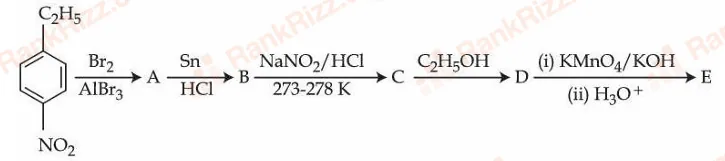
Identify compounds A and E in the following reaction sequence.
SOLUTION
Formation of Compound A
Formation of Compound B (Reduction)
- Reagent:
- Transformation: This is a selective reduction reaction that converts the nitro group () into a primary amine group ().
- Compound B: 3-bromo-4-ethylaniline.
Step 3: Formation of Compound C (Diazotization)
- Reagent: at ().
- Transformation: The primary aromatic amine group () reacts to form a stable aromatic diazonium salt ().
- Compound C: 3-bromo-4-ethylbenzenediazonium chloride.
Formation of Compound D (Deamination)
- Reagent: (Ethanol) or .
- Transformation: Ethanol acts as a mild reducing agent that replaces the diazonium group () with a hydrogen atom (), effectively removing it from the ring.
- Compound D: 1-bromo-2-ethylbenzene (o-bromoethylbenzene).
Formation of Compound E (Side-chain Oxidation)
- Reagent: (i) , (ii)
- Transformation: Potassium permanganate under basic heating conditions oxidizes any alkyl side chain containing benzylic hydrogens completely down to a carboxylic acid group (). Acid workup () protonates the resulting carboxylate salt.
- Compound E: 2-bromobenzoic acid.
Option B
Tagged Nucleophilic addition reactions of carbonyl compounds. Machine-assigned, so read it as a strong shortlist rather than a verdict.