JEE Main 2018 Chemistry question — Nucleophilic addition reactions of carbonyl compounds
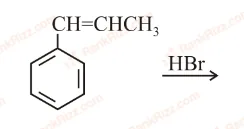
The major product of the following reaction is:
SOLUTION
In the presence of organic peroxide, the reagent adds to an alkene by a free-radical (anti-Markovnikov) mechanism, not by the normal ionic (Markovnikov) route.
Given alkene:
Step 1 - Initiation
(alkoxy radicals)
Step 2 - Generation of bromine radical
Step 3 - Propagation (anti-Markovnikov addition)
Br-radical attacks the less substituted end of the double bond to give the more stable secondary carbon radical:
The carbon radical then abstracts H• from another molecule:
The chain continues until radicals recombine and terminate. The net result is addition of to the more substituted carbon and to the terminal carbon—exactly opposite to Markovnikov’s rule.
Thus the major product is (1-bromopropane).
Option B which is: 1-bromopropane.
Tagged Nucleophilic addition reactions of carbonyl compounds. Machine-assigned, so read it as a strong shortlist rather than a verdict.