JEE Main 2019 Chemistry question — Nucleophilic addition reactions of carbonyl compounds
The major product of the following reaction is:
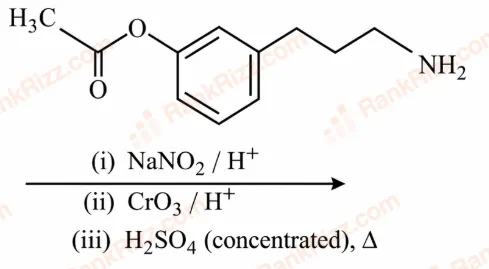
SOLUTION
We begin with an aromatic amine. The reaction sequence given is
and we must work out, one stage at a time, what each reagent does to the substrate.
Step (i) - Diazotisation followed by hydrolytic replacement. For an aromatic amine, the well-known diazotisation reaction is
The diazonium ion so formed is not isolated under these aqueous acidic conditions; it is immediately displaced by water because diazonium is an extremely good leaving group. The net result is
Thus, after the first reagent, the -NH2 group of the starting molecule has been converted cleanly to an -OH group. Consequently we are now in possession of an ortho-hydroxy aryl compound in which the side-chain attached to the same ring remains unaltered.
Step (ii) - Oxidation of the benzylic side chain. The second reagent, is Jones reagent - a strong, acidic, chromium(VI) oxidising agent. A benzylic alkyl side chain is particularly susceptible to such oxidation; every hydrogen attached to the benzylic carbon is ultimately removed, and the chain is converted into a carboxylic acid. Symbolically, for a two-carbon chain we write
Therefore, after this oxidation the molecule has become an ortho-hydroxyphenylacetic acid. Notice carefully that the aromatic ring now bears two essential functional groups in adjacent positions - a phenolic -OH and a -CH2COOH group. This juxtaposition sets the stage for an intramolecular Friedel-Crafts acylation.
Step (iii) - Intramolecular Friedel-Crafts acylation. Concentrated sulphuric acid at high temperature protonates the carboxylic acid, generating the acylium ion that actually performs the electrophilic attack. The general sequence is
The acylium ion is an excellent electrophile. In the present molecule it is tethered to the same aromatic ring through the -CH2 bridge. The ring therefore attacks its own acylium carbon at the position that is ortho to the bridge, closing a five-membered ring. Loss of a proton from the ring restores aromaticity, while the acylium oxygen remains as a carbonyl. The overall outcome is the formation of an indan-1-one skeleton carrying a hydroxyl substituent on the aromatic ring:
The newly formed five-membered fused ring (the “indan” part) contains a ketone at the bridgehead carbon (position 1), and the phenolic -OH that was introduced in the very first step is still present at the para-like (actually 7-) position of the bicyclic system. Among the options supplied, only Option 1 depicts exactly that structure - an HO-substituted indanone.
Hence, the correct answer is Option 1.
Tagged Nucleophilic addition reactions of carbonyl compounds. Machine-assigned, so read it as a strong shortlist rather than a verdict.