JEE MAIN 2019 · 12 JAN S2+4 / −1MEDIUMTRANSCRIBED
JEE Main 2019 Chemistry question — Nucleophilic addition reactions of carbonyl compounds
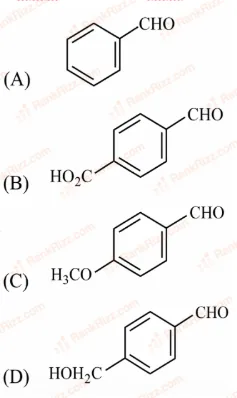
The aldehydes which will not form Grignard product with one equivalent of Grignard reagents are:
SOLUTION
- Grignard reagents are exceptionally strong bases as well as powerful nucleophiles.
- Faced with a choice, an acid-base proton transfer always occurs much faster than a nucleophilic addition to a carbonyl group.
- If a substrate contains an acidic proton (, , ), the single equivalent of the Grignard reagent is immediately quenched (destroyed) to form an alkane (), leaving no reagent left to attack the aldehyde group.
Evaluating the Compounds:
- (A) Benzaldehyde: Contains no acidic protons. It reacts smoothly to form the Grignard addition product.
- (B) 4-Formylbenzoic acid: Contains a highly acidic carboxylic acid group (). It quenches the reagent instantly. (No addition product)
- (C) 4-Methoxybenzaldehyde: The methoxy group () is an ether and carries no acidic protons. It forms the addition product smoothly.
- (D) 4-(Hydroxymethyl)benzaldehyde: Contains an acidic alcohol group (). It quenches the reagent instantly. (No addition product)
Conclusion:
Substrates (B) and (D) contain acidic functional groups that destroy the single equivalent of the Grignard reagent via an acid-base reaction, preventing nucleophilic addition to the aldehyde.
Answer: Option D — (B), (D)
Tagged Nucleophilic addition reactions of carbonyl compounds. Machine-assigned, so read it as a strong shortlist rather than a verdict.