JEE Main 2019 Chemistry question — Nucleophilic addition reactions of carbonyl compounds
The major product obtained in the following reaction is:
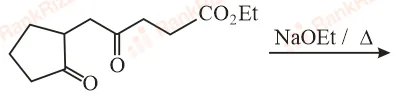
SOLUTION
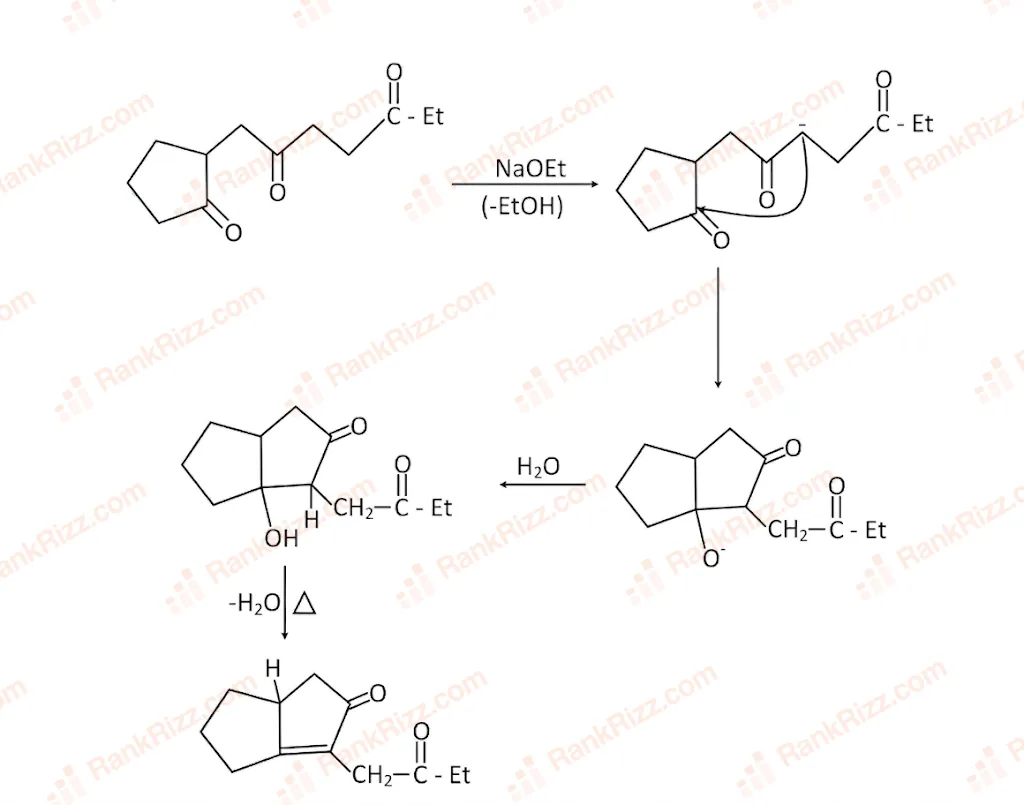
Enolate Formation:
The ethoxide ion () abstracts a highly acidic proton from the active methylene carbon located alpha () to both the ester and internal ketone carbonyl groups, generating a resonance-stabilized carbanion as shown in the initial step.
-
Intramolecular Nucleophilic Attack:
This carbanion acts as a nucleophile, performing an intramolecular attack directly on the carbonyl carbon of the cyclopentanone ring. This nucleophilic addition effectively closes the chain to create a fused bicyclic system containing a stable, newly formed six-membered ring structure.
Conclusion:
The base-driven enolate generation facilitates a clean ring-closure (intramolecular aldol/condensation pathway) to yield the corresponding bicyclic derivative.
Answer: Option A
Tagged Nucleophilic addition reactions of carbonyl compounds. Machine-assigned, so read it as a strong shortlist rather than a verdict.