JEE Main 2024 Chemistry question — Nucleophilic addition reactions of carbonyl compounds
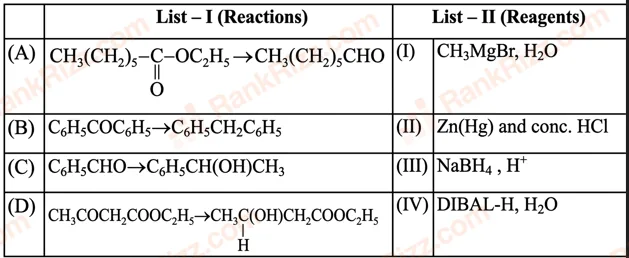
Choose the correct answer from options given below:
SOLUTION
The four reagents that are routinely used to identify and distinguish aldehydes and ketones are Fehling’s solution, the Iodoform reagent, 2,4-DNP (Brady’s reagent) and Schiff’s reagent. Each of them gives a very characteristic observation that the examiner places in List-II. We recall the basic chemistry of every reagent first, then match.
Case A : Fehling’s solution
Fehling’s solution contains complexed with tartrate ion in an alkaline medium. Only aliphatic aldehydes can reduce to , giving a brick-red precipitate. Neither ketones nor aromatic aldehydes respond.
Observation matched with Fehling’s solution is “formation of a red (brick-red) precipitate”. This statement is numbered IV.
Case B : Iodoform test ()
The haloform reaction is given by carbonyl compounds that contain the - group (i.e. methyl ketones) and by acetaldehyde (which is readily oxidised to that group). The tell-tale observation is a pale-yellow precipitate having the characteristic smell of iodoform, .
“Formation of yellow precipitate of (iodoform)” is statement II.
Case C : 2,4-DNP (Brady’s reagent)
Both aldehydes and ketones add to 2,4-dinitrophenylhydrazine giving intensely coloured yellow to orange crystalline hydrazones. This test is used merely to confirm the presence of the carbonyl (>C=O) group.
“Formation of yellow/orange crystalline precipitate” is statement I.
Case D : Schiff’s reagent
Schiff’s reagent is a decolourised solution of fuchsin dye in . With aldehydes the magenta colour reappears almost instantaneously, whereas ketones do not restore the colour under ordinary conditions.
“Solution turns colourless to magenta (positive with aldehydes)” is statement III.
Collecting all the matches:
A - IV (B - II) C - I D - III
Therefore the correct choice is
Option B which is: A - IV, B - II, C - I, D - III.
Tagged Nucleophilic addition reactions of carbonyl compounds. Machine-assigned, so read it as a strong shortlist rather than a verdict.