JEE MAIN 2023 · 01 FEB S2+4 / −1MEDIUMTRANSCRIBED
JEE Main 2023 Chemistry question — Nucleophilic addition reactions of carbonyl compounds
The structures of major products A, B and C in the following reaction sequence are:
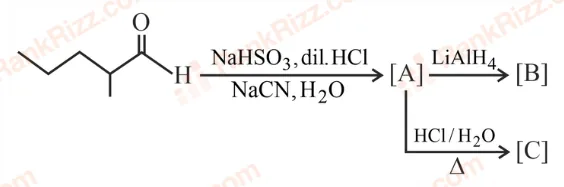
SOLUTION
1. Formation of Product [A]
The starting material is 2-methylpentanal. It is treated with , , , and , which are the standard reagents for cyanohydrin formation via the bisulfite addition pathway.
- Mechanism: The aldehyde group () undergoes nucleophilic addition by the cyanide ion (), followed by protonation to yield a cyanohydrin.
- Structure of [A]:
2. Formation of Product [B]
Product [A] (the cyanohydrin) is treated with Lithium Aluminum Hydride (), a powerful reducing agent.
- Mechanism: reduces the nitrile group () down to a primary amine group (). The alcohol group () remains unaffected after workup.
- Structure of [B]:
3. Formation of Product [C]
Product [A] is treated with and heated ().
- Mechanism: Acidic hydrolysis of a nitrile group () converts it into a carboxylic acid group (). Because it is a cyanohydrin, this yields a -hydroxy acid.
- Structure of [C]:
Tagged Nucleophilic addition reactions of carbonyl compounds. Machine-assigned, so read it as a strong shortlist rather than a verdict.