JEE Main 2023 Chemistry question — Reactions of phenols
The correct order of pK values for the following compounds is:
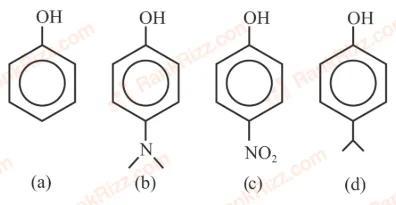
SOLUTION
The four compounds are
a : (isopropyl alcohol, 2° alcohol)
b : (tert-butyl alcohol, 3° alcohol)
c : (phenol)
d : (ethanol, 1° alcohol)
Acid strength is judged by the stability of the conjugate base. A smaller means a stronger acid; a larger means a weaker acid.
Step 1 — Alcohols (a, b, d)
Removal of from an alcohol gives an alkoxide ion . Alkyl groups are electron-releasing (+I) and therefore destabilise the negatively charged oxygen. The more alkyl groups attached to the carbon bearing the , the greater the +I effect and the weaker the acid.
Hence for simple aliphatic alcohols:
in acidity, or, in terms of (remember, weaker acid larger ):
Step 2 — Phenol (c)
For phenol, deprotonation gives the phenoxide ion which is resonance-stabilised:
The negative charge can delocalise over the aromatic ring, greatly stabilising the anion. This resonance stabilisation outweighs the +I effect of the ring, so phenol is far more acidic than normal alcohols. Consequently its is much smaller.
Step 3 — Combining the two trends
Putting phenol together with the alcohols, the overall acidity order is
phenol (c) > ethanol (d) > isopropanol (a) > tert-butanol (b)
Converting to values (largest value for the weakest acid):
This matches Option C:
Option C which is: b > a > d > c
Tagged Reactions of phenols. Machine-assigned, so read it as a strong shortlist rather than a verdict.