JEE MAIN 2022 · 27 JUL S1+4 / −1MEDIUMTRANSCRIBED
JEE Main 2022 Chemistry question — Reactions of phenols
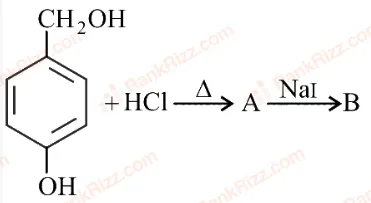
In the above reaction, product B is
SOLUTION
1. Analysis of the Starting Material
The starting reactant is 4-(hydroxymethyl)phenol. It features a benzene ring with two distinct hydroxyl (-OH) environments:
- Phenolic -OH group: Attached directly to the aromatic ring. Due to resonance, the carbon-oxygen bond has partial double-bond character, making it highly stable and resistant to substitution.
- Aliphatic -OH group: Part of the substituent at the top, written as -CH₂OH. This benzylic alcohol is highly reactive toward nucleophilic substitution.
2. Formation of Product A
When treated with HCl and heat (Δ):
- The acid protonates the aliphatic alcohol, converting the -CH₂OH group into a good leaving group (water).
- The chloride ion (Cl⁻) acts as a nucleophile and replaces the water molecule at the benzylic position.
- The phenolic -OH group remains completely unaffected.
Therefore, Product A is 4-(chloromethyl)phenol, where the top substituent is now a -CH₂Cl group.
3. Formation of Product B (Finkelstein Reaction)
When Product A reacts with NaI (Sodium Iodide):
- This reaction proceeds via an S_N2 nucleophilic substitution mechanism, commonly known as the Finkelstein reaction.
- The iodide ion (I⁻) replaces the chloride ion (Cl⁻) at the benzylic position because sodium chloride (NaCl) precipitates out in the reaction solvent (typically acetone), driving the equilibrium forward.
Consequently, the -CH₂Cl group is converted directly into a -CH₂I group.
Tagged Reactions of phenols. Machine-assigned, so read it as a strong shortlist rather than a verdict.