JEE Main 2024 Chemistry question — Ethers
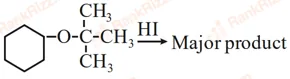
Major product formed in the following reaction is a mixture of:
SOLUTION
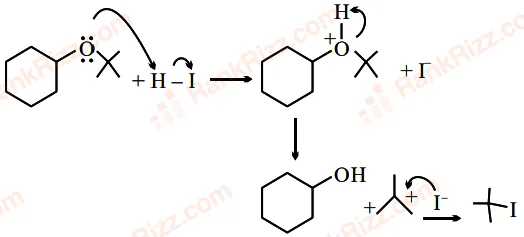
We need to determine the major product formed when the given ether reacts with hydrogen iodide ().
Key Concept: The reaction of an asymmetric ether with a strong acid like proceeds via protonation of the ether oxygen, followed by a nucleophilic substitution ( or ) reaction by the iodide ion ().
The given reactant is cyclohexylmethyl t-butyl ether, where an oxygen atom connects a cyclohexylmethyl group and a tertiary butyl () group.
Step 1: Protonation of the ether oxygen
The lone pair of electrons on the ether oxygen attacks the proton of , forming a protonated ether intermediate and releasing an iodide ion ():
Step 2: Cleavage of the C-O bond via pathway
Because one of the alkyl groups attached to the oxygen is a tertiary butyl group, the reaction proceeds via an mechanism. The leaving group is cyclohexylmethanol, and a highly stable tertiary butyl carbocation () is formed stable due to hyperconjugation and inductive effects.
Step 3: Attack of the nucleophile ()
The stable tertiary carbocation is then rapidly attacked by the remaining iodide nucleophile () to yield tert-butyl iodide:
Therefore, the major products formed in this reaction mixture are cyclohexylmethanol and tert-butyl iodide.
Answer: Option D — Cyclohexylmethanol and tert-butyl iodide
Tagged Ethers. Machine-assigned, so read it as a strong shortlist rather than a verdict.