JEE Main 2024 Chemistry question — Reactions of phenols
Match List-I with List-II.
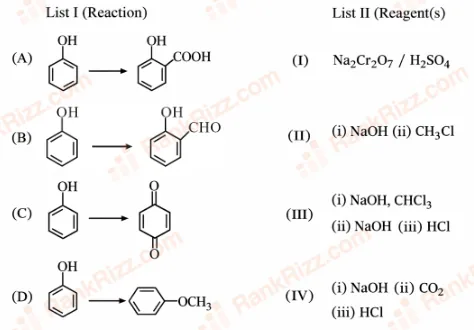
Choose the correct answer from the options given below:
SOLUTION
Reaction (A): Conversion of Phenol to Salicylic acid (2-hydroxybenzoic acid). This transformation is achieved via the Kolbe-Schmitt reaction. When phenol is treated with sodium hydroxide () to form a phenoxide ion, followed by reaction with carbon dioxide () under pressure and subsequent acidification with , salicylic acid is produced. This matches with reagent (IV). Thus, (A) matches with (IV).
Reaction (B): Conversion of Phenol to Salicylaldehyde (2-hydroxybenzaldehyde). This is the Reimer-Tiemann reaction. Phenol reacts with chloroform () in the presence of aqueous sodium hydroxide (), introducing a formyl group () at the ortho-position, followed by hydrolysis and acidification (). This matches with reagent (III). Thus, (B) matches with (III).
Reaction (C): Conversion of Phenol to p-Benzoquinone. Phenol undergoes oxidation when treated with a strong oxidizing agent like acidified sodium dichromate () to yield para-benzoquinone. This matches with reagent (I). Thus, (C) matches with (I).
Reaction (D): Conversion of Phenol to Anisole (Methoxybenzene). This is an etherification process (Williamson ether synthesis). Phenol is first converted into sodium phenoxide using , which then performs a nucleophilic substitution reaction with methyl chloride () to introduce a methoxy group (). This matches with reagent (II). Thus, (D) matches with (II).
Combining all the pairs, the correct matching sequence is: (A)-(IV), (B)-(III), (C)-(I), (D)-(II).
Answer: Option D — (A)-(IV), (B)-(III), (C)-(I), (D)-(II)
Tagged Reactions of phenols. Machine-assigned, so read it as a strong shortlist rather than a verdict.