JEE Main 2021 Chemistry question — Reactions of phenols
Identify A in the given reaction.
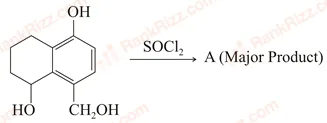
SOLUTION
The phenolic -OH group (the one attached directly to the benzene ring) does not react with thionyl chloride () due to resonance stabilization. The lone pairs of electrons on the phenolic oxygen atom delocalize into the -system of the adjacent benzene ring. This resonance interaction grants the carbon-oxygen (C-O) bond a partial double-bond character. Because of this partial double bond, the C-O bond is significantly stronger and much harder to cleave than a standard single bond. Additionally, replaces hydroxyl groups via a nucleophilic substitution mechanism that requires an hybridized carbon; it cannot successfully attack the hybridized carbon of an aromatic ring. Therefore, the phenolic -OH remains untouched, while the other two aliphatic -OH groups (which are on carbons and have standard, easily broken single bonds) will be successfully replaced by chlorine atoms.
Tagged Reactions of phenols. Machine-assigned, so read it as a strong shortlist rather than a verdict.