JEE MAIN 2021 · 24 FEB S1+4 / −1MEDIUMTRANSCRIBED
JEE Main 2021 Chemistry question — Reactions of phenols
What is the final product (major) 'A' in the given reaction?
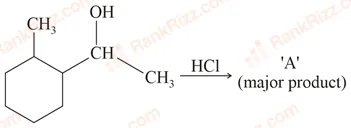
Major product among the following is?
SOLUTION
The reaction of this secondary alcohol with HCl proceeds via an SN1 mechanism involving a carbocation rearrangement.
- Formation of Carbocation: The hydroxyl (-OH) group is first protonated by the acid to form a good leaving group (-OH₂⁺), which then departs as a water molecule. This leaves behind a secondary (2°) carbocation on the side chain.
- 1,2-Hydride Shift: Carbocations always rearrange to gain stability. The positive charge is currently on a secondary carbon, but the adjacent carbon in the cyclohexane ring is tertiary (3°). A hydrogen atom moves from the ring carbon to the side chain (a 1,2-hydride shift), moving the positive charge onto the more stable tertiary position within the ring.
- Nucleophilic Attack: Finally, the chloride ion (Cl⁻) attacks this newly formed, stable tertiary carbocation.
The final major product 'A' is 1-chloro-1-(1-methylethyl)cyclohexane, where the chlorine is attached directly to the tertiary carbon of the ring.
Tagged Reactions of phenols. Machine-assigned, so read it as a strong shortlist rather than a verdict.