JEE Main 2012 Chemistry question — Reactions of phenols
Aspirin can be prepared by the reaction of
SOLUTION
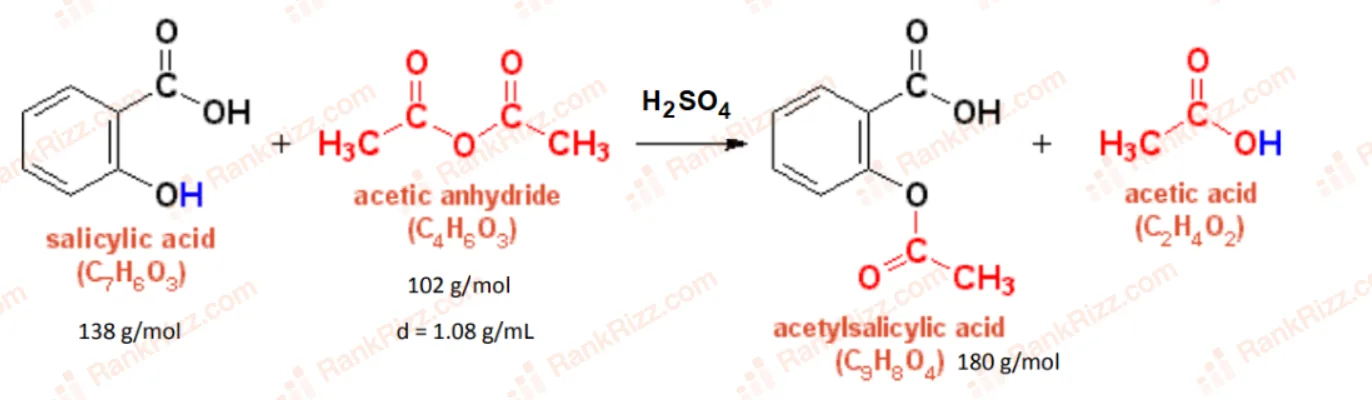
Aspirin (acetylsalicylic acid) is obtained by acetylating the phenolic -OH group of salicylic acid.
Step-1: Recall the required functional group change.
Salicylic acid, , must acquire an acetyl ( ) group on the phenolic oxygen to give .
Step-2: Choose a suitable acetylating reagent.
Common laboratory acetylating agents are acetic anhydride and acetyl chloride . Acetic anhydride is preferred because it is less corrosive and its by-product is acetic acid, which is innocuous.
Step-3: Identify the catalyst.
The acetylation is an esterification; a few drops of concentrated protonate the carbonyl oxygen of acetic anhydride, increasing its electrophilicity and thus facilitating nucleophilic attack by the phenolic -OH of salicylic acid.
Overall reaction:
Step-4: Analyse each option.
Option A: Salicylaldehyde lacks the carboxylic acid group and would yield an acetal, not aspirin → Incorrect.
Option B: Methanol is an alcohol; with salicylic acid it produces methyl salicylate (oil of wintergreen), not aspirin → Incorrect.
Option C: Salicylic acid + acetic anhydride + supplies exactly the reagent, acetylating agent, and catalyst required → Correct.
Option D: Cinnamic acid is a different substrate; acetylation would not generate the aspirin structure → Incorrect.
Hence the correct choice is:
Option C which is: Salicylic acid with acetic anhydride in presence of HSO.
Tagged Reactions of phenols. Machine-assigned, so read it as a strong shortlist rather than a verdict.