JEE MAIN 2020 · 02 SEP S1+4 / −1MEDIUMTRANSCRIBED
JEE Main 2020 Chemistry question — Ethers
The major aromatic product C in the following reaction sequence will be:

SOLUTION
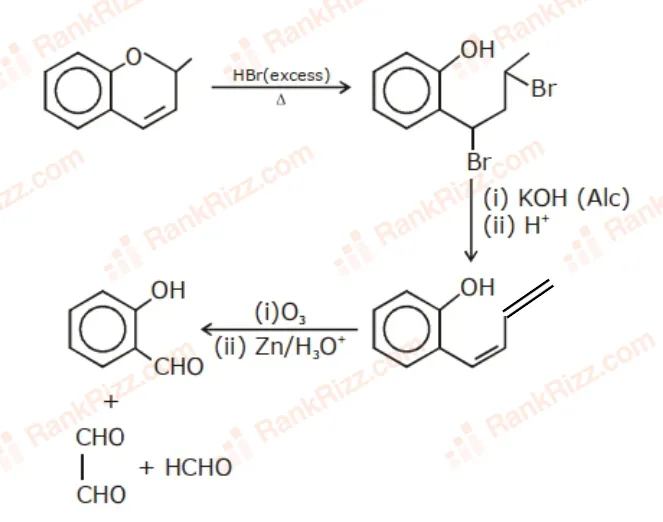
-
Step 1: Reaction with excess and heat ()
- The starting cyclic ether is protonated by , followed by a nucleophilic attack by to cleave the ether ring. This forms a phenolic group () on the benzene ring and an alkyl bromide intermediate.
- Since is in excess, it undergoes an addition reaction across the double bond of the side chain according to Markovnikov's rule.
- This gives the intermediate product A, which is a vicinal dibromide with a phenolic group:
-
Step 2: Reaction with alcoholic followed by acidic workup ()
- Alcoholic is a strong dehydrohalogenating agent. It carries out a double elimination () on the vicinal dibromide chain to form a triple bond (alkyne).
- The resulting intermediate B contains a terminal or internal alkyne attached to the benzene ring alongside the phenol group. Under these conditions, the conjugated structure stabilizes as an allylic/propargyl double bond system:
-
Step 3: Ozonolysis with (i) and (ii)
- This is a reductive ozonolysis step that selectively cleaves the carbon-carbon double bond () in the side chain.
- The double bond is broken and replaced with carbonyl () groups on both fragments:
- The side chain is chopped down to an aldehyde group () attached directly to the benzene ring at the position adjacent (ortho) to the hydroxyl group. This aromatic product is known as Salicylaldehyde (2-hydroxybenzaldehyde).
Conclusion:
The sequence converts the cyclic core through opening, double elimination, and ozonolytic cleavage to yield a substituted benzene ring featuring both an explicit phenol and a newly formed aldehyde function. This perfectly matches the molecule highlighted in the solution panel.
Answer: Option A — Salicylaldehyde (2-hydroxybenzaldehyde)
Tagged Ethers. Machine-assigned, so read it as a strong shortlist rather than a verdict.