JEE Main 2019 Chemistry question — Ethers
The major product of the following reaction is:
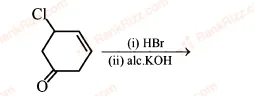
SOLUTION
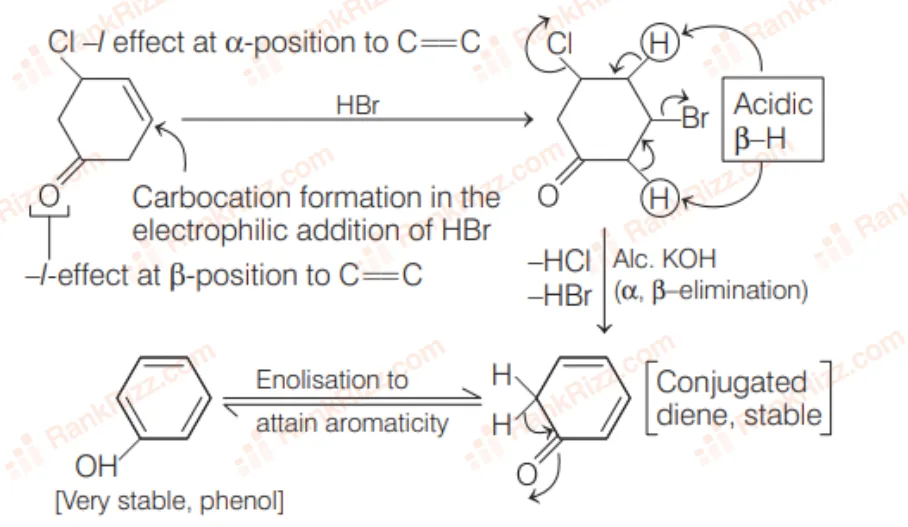
Step 1: Base-Mediated Dehydrohalogenation (-Elimination)
The reaction begins with the elimination of hydrogen bromide () from the cyclic bromo-ketone precursor. A base abstracts a proton from the -position relative to the leaving group (), triggering an -elimination that forms a stable, conjugated diene intermediate (a cyclohexadienone derivative):
-
Step 2: Tautomerization (Enolisation to Attain Aromaticity)
The non-aromatic cyclohexadienone intermediate contains a highly acidic sp3 hybridized carbon bearing two hydrogen atoms adjacent to the carbonyl group (). To relieve ring strain and gain immense thermodynamic stability, the compound undergoes rapid enolisation (keto-enol tautomerization). This restores the fully delocalized -system of the benzene ring:
Conclusion:
The driving force of the entire transformation is the immense resonance energy gained through aromatization, shifting the equilibrium completely toward the formation of the phenol derivative.
Answer: The option displaying the fully aromatic phenol derivative as the major product (Option B).
Tagged Ethers. Machine-assigned, so read it as a strong shortlist rather than a verdict.