JEE MAIN 2023 · 11 APR S2+4 / −1MEDIUMTRANSCRIBED
JEE Main 2023 Chemistry question — Reactions of phenols
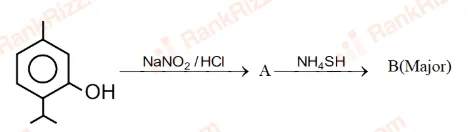
Compound 'B' is :
SOLUTION
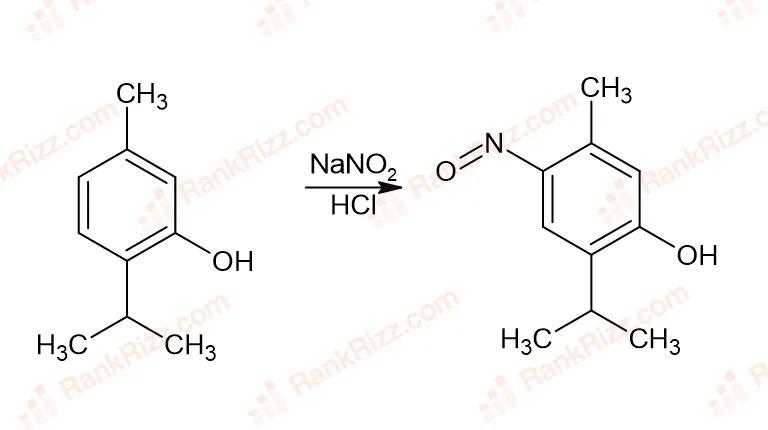
Step 1: Nitrosation ()
The starting material is a substituted phenol (thymol derivative). When treated with nitrous acid ( forming ) at a low temperature, it undergoes electrophilic aromatic substitution (nitrosation).
- The hydroxyl group () is a strongly activating, ortho/para-directing group.
- The ortho positions relative to the group are hindered or occupied.
- The carbon position directly para to the group (the top-left vertex of the ring) is completely vacant and sterically accessible.
the nitroso electrophile () attacks at this para-position to form Compound A (a para-nitrosophenol derivative).
Step 2: Selective Reduction ()
Compound A is then treated with ammonium hydrosulfide ().
- is a well-known mild and selective reducing agent.
- It reduces the nitroso group () directly to a primary amino group () without affecting the other alkyl or phenolic substituents on the ring.
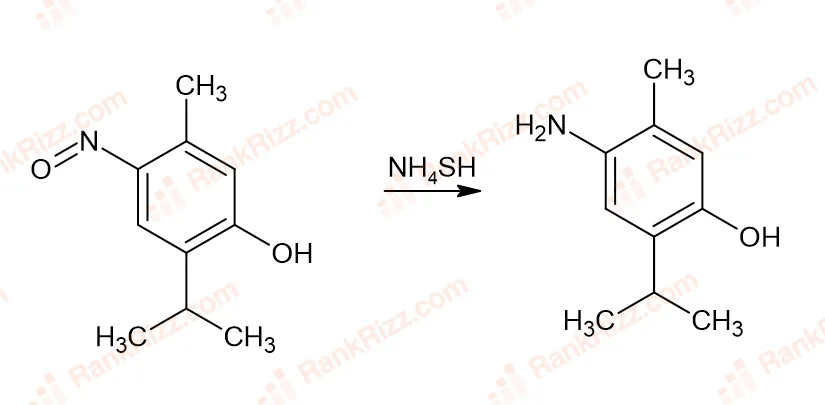
Option A
Tagged Reactions of phenols. Machine-assigned, so read it as a strong shortlist rather than a verdict.