JEE Main 2019 Chemistry question — Ethers
The major product of the following reaction is:
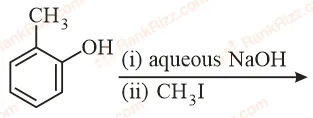
SOLUTION
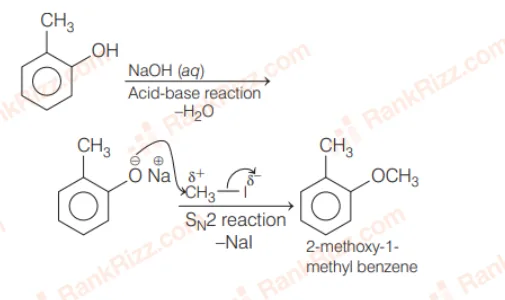
We need to determine the mechanism and major product for the reaction of sodium phenoxide with methyl iodide ().
Reaction Mechanism: Williamson Ether Synthesis
-
Nucleophilic Attack via Pathway:
The reaction between sodium phenoxide () and methyl iodide () is a classic example of a Williamson ether synthesis. The strongly nucleophilic phenoxide oxygen atom attacks the relatively unhindered primary carbon atom of the methyl iodide electrophile:
-
Transition State and Displacement:
As the nucleophilic oxygen atom forms a new covalent bond with the methyl group, the iodide ion simultaneously departs as an excellent leaving group (), yielding 2-methoxy-1-methylbenzene (or anisole depending on ring substitutions).
Conclusion:
The reaction cleanly proceeds via a bimolecular nucleophilic substitution () process to give the corresponding alkyl aryl ether.
Answer: Option B (2-methoxy-1-methylbenzene formed via S2 reaction)
Tagged Ethers. Machine-assigned, so read it as a strong shortlist rather than a verdict.