RankRizz

JEE Main 28 Jan 2026, Shift 2: Maths

The 25 Maths questions of JEE Main 28 Jan 2026, Shift 2, numbered across the whole paper. Pick an answer on any question to check it against the key. Free to read, nothing to download.

Maths

Q51Standard hyperbola and basic propertiesTRANSCRIBED

Let the ellipse E:x2144+y2169=1E:\frac{x^{2}}{144}+\frac{y^{2}}{169}=1 and the hyperbola H:x216−y2λ2=−1H:\frac{x^{2}}{16}-\frac{y^{2}}{\lambda^{2}}=-1 have the same foci. If e and L respectively denote the eccentricity and the length of the latus rectum of H , then the value of 24(e+ L) is:

  1. A

    126

  2. B

    148

  3. C

    296

  4. D

    67

Q52One-one, onto functions and counting functionsTRANSCRIBED

Given below are two statements :

Statement I : The function f:R→Rf:R\rightarrow R defined by f(x)=x1+∣x∣f(x)=\frac{x}{1+\mid x\mid} is one-one.

Statement II : The function f:R→Rf:R\rightarrow R defined by f(x)=x2+4x−30x2−8x+18f(x)=\frac{x^{2}+4x-30}{x^{2}-8x+18} is many-one.

In the light of the above statements, choose the correct answer from the options given below :

  1. A

    Both Statement I and Statement II are false

  2. B

    Statement I is true but Statement II is false

  3. C

    Statement I is false but Statement II is true

  4. D

    Both Statement I and Statement II are true

Q53Sums of binomial coefficientsTRANSCRIBED

The sum of the coefficients of x499 and x500 in (1+x)1000+x(1+x)999+x2(1+x)998+....+x1000 is: x^{499} \text{ and }x^{500} \text{ in } (1+x)^{1000}+x(1+x)^{999}+x^{2}(1+x)^{998}+....+x^{1000} \text{ is: }

  1. A

    1001C501^{1001}C_{501}

  2. B

    1002C501^{1002}C_{501}

  3. C

    1000C501^{1000}C_{501}

  4. D

    1002C500^{1002}C_{500}

Q54Vector (cross) product and areaTRANSCRIBED

Let P be a point in the plane of the vectors AB→=3i^+j^−k^ and AC→=i^−j^+3k^\overrightarrow{AB}=3\widehat{i} + \widehat{j}-\widehat{k} \text{ and }\overrightarrow{AC}=\widehat{i}-\widehat{j}+3\widehat{k} such that P is equidistant from the Lines AB and AC. If ∣AP→∣=52\mid \overrightarrow{AP} \mid=\frac{\sqrt{5}}{2} then the area of the triangle ABP is:

  1. A

    304\frac{\sqrt{30}}{4}

  2. B

    2

  3. C

    32\frac{3}{2}

  4. D

    264\frac{\sqrt{26}}{4}

Q55Greatest integer, fractional part, modulus and signum functionsTRANSCRIBED

The sum of all the elements in the range of f(x)=Sgn(sin⁡x)+Sgn(cos⁡x)+Sgn(tan⁡x)+Sgn(cot⁡x)f(x) =Sgn(\sin x) + Sgn(\cos x) +Sgn(\tan x) +Sg n(\cot x), x≠nπ2,nϵZ, where Sgn(t)={1, if t>0−1 if t<0,is:x \neq \frac{n\pi}{2}, n\epsilon Z, \text{ where } Sgn(t)=\begin{cases}1, & \text{ if } t>0\\-1 & \text{ if } t<0\end{cases} ,is:

  1. A

    4

  2. B

    -1

  3. C

    0

  4. D

    2

Q56Area between curvesTRANSCRIBED

Let P1:y=4x2 and P2:y=x2+27P_1 : y=4x^2 \text{ and } P_2 : y=x^2 + 27 be two parabolas. If the area of the bounded region enclosed betweenP1P_1 and P2P_2 is six times the area of the bounded region enclosed between the line y=αx,α>0 and P1,y = \alpha x, \alpha > 0 \text{ and } P_1, then α\alpha is equal to:

  1. A

    6

  2. B

    8

  3. C

    15

  4. D

    12

Q57Equation of a circle in various formsTRANSCRIBED

Let the circle x2+y2=4x^{2}+y^{2}=4 intersect x-axis at the points A(a,0), a > 0 and B(b, 0). let P(2cos⁡α,2sin⁡α),0<α<π2and Q(2cos⁡β,2sin⁡β)P(2 \cos \alpha, 2 \sin \alpha),0 \lt \alpha \lt \frac{\pi}{2} \text{and } Q(2\cos \beta, 2\sin \beta) be two points such that (α−β)=π2( \alpha - \beta) =\frac {\pi}{2}. Then the point of intersection of AQ and BP lies on:

  1. A

    x2+y2−4x−4y=0x^{2}+y^{2}-4x-4y=0

  2. B

    x2+y2−4x−4=0x^{2}+y^{2}-4x-4=0

  3. C

    x2+y2−4y−4=0x^{2}+y^{2}-4y-4=0

  4. D

    x2+y2−4x−4y−4=0x^{2}+y^{2}-4x-4y-4=0

Q58Integration by partial fractionsTRANSCRIBED

Let f(x)=∫dxx(23)+2x(12)f(x)=\int\frac{dx}{x^{\left(\frac{2}{3}\right)}+2x^{\left(\frac{1}{2}\right)}} be such that f(0)=−26+24log⁡e(2). If f(1)=a+blog⁡e(3), where a,b∈Zf(0)=-26+24\log_{e}{(2)}. \text { If } f(1)=a+b \log_{e}{(3)}, \text{ where } a,b \in Z, then a+b is equal to:

  1. A

    -26

  2. B

    -5

  3. C

    -18

  4. D

    -11

Q59Arithmetico-geometric progressionTRANSCRIBED

6326+10.1325+10.2324+10.22323+...+10.2243\dfrac{6}{3^{26}}+\dfrac{10.1}{3^{25}}+\dfrac{10.2}{3^{24}}+\dfrac{10.2^{2}}{3^{23}}+...+\dfrac{10.2^{24}}{3} is equal to :

  1. A

    3253^{25}

  2. B

    2252^{25}

  3. C

    3263^{26}

  4. D

    2262^{26}

Q60Definite integrals: properties and King's ruleTRANSCRIBED

Let [⋅][\cdot] denote the greatest integer function. Then ∫−π2π2(12(3+[x])3+[sin⁡x]+[cos⁡x])dx\int_{-\frac{\pi}{2}}^{\frac{\pi}{2}} \left(\frac{12(3+[x])}{3+[\sin x]+[\cos x]}\right)dx is equal to:

  1. A

    15π+415\pi+4

  2. B

    11π+211\pi+2

  3. C

    12π+512\pi+5

  4. D

    13π+113\pi+1

Q61Properties and simplification of inverse trigonometric functionsTRANSCRIBED

Considering the principal values of inverse trigonometric functions, the value of the expression tan⁡(2sin⁡−1(213)−2cos⁡−1(310))\tan \left( 2 \sin^{-1} \left( \frac{2}{\sqrt{13}} \right) - 2 \cos^{-1} \left( \frac{3}{\sqrt{10}} \right) \right) is equal to:

  1. A

    3356\frac{33}{56}

  2. B

    1663\frac{16}{63}

  3. C

    −3356-\frac{33}{56}

  4. D

    −1663-\frac{16}{63}

Q62Continuity at a pointTRANSCRIBED

Let f(x)=lim⁡θ→0(cos⁡πx−x2θsin⁡(x−1)1+x(2θ)(x−1)),x∈Rf(x) = \lim_{\theta \to 0}\left(\frac{\cos\pi x - x^{\frac{2}{\theta}} \sin(x - 1)}{1 + x^{\left(\frac{2}{\theta}\right)} (x - 1)}\right), \quad x \in \mathbb{R}. Consider the following two statements :

(I) f(x)f(x) is discontinuous at x=1x=1.
(II) f(x)f(x) is continuous at x=−1x= - 1.
Then,

  1. A

    Neither (I) nor (II) is True

  2. B

    Only (II) is True

  3. C

    Both (I) and (II) are True

  4. D

    Only (I) is True

Q63Random variables, mean and varianceTRANSCRIBED

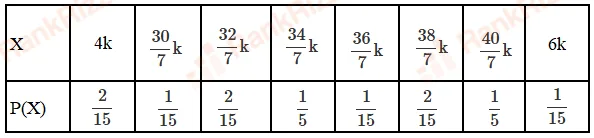
The probability distribution of a random variable X is given below:

Screenshot_53

If E(X)=26315E(X)=\frac{263}{15}. then P(X<20)P(X<20) is equal to:

  1. A

    815\frac{8}{15}

  2. B

    1115\frac{11}{15}

  3. C

    35\frac{3}{5}

  4. D

    1415\frac{14}{15}

Q64Locus and regions in the Argand planeTRANSCRIBED

Let A={z∈C:∣z−2∣≤4}A = \{ z \in \mathbb {C} : |z - 2| \le 4 \}\quad and  B={z∈C:∣z−2∣+∣z+2∣=5}.\quad B = \{ z \in \mathbb{C} : |z - 2| + |z + 2| = 5 \}.Then the maximum of {∣z1−z2∣:z1∈A and z2∈B}\left\{ |z_1 - z_2| : z_1 \in A \text{ and } z_2 \in B \right\} is

  1. A

    8

  2. B

    9

  3. C

    172\frac{17}{2}

  4. D

    152\frac{15}{2}

Q65Linear first-order differential equationsTRANSCRIBED

Let y=y(x)y = y(x) be the solution of the differential equation xdydx−y=x2cot⁡x,x∈(0,π).x\frac{dy}{dx} - y = x^2 \cot x, \quad x \in (0, \pi). If y(π2)=π2y\left(\frac{\pi}{2}\right) = \frac{\pi}{2}, then 6y(π6)−8y(π4)6y\left(\frac{\pi}{6}\right) - 8y\left(\frac{\pi}{4}\right) is equal to :

  1. A

    −3π-3\pi

  2. B

    3π3\pi

  3. C

    π\pi

  4. D

    −π-\pi

Q66Foot of perpendicular, image and distance from a lineTRANSCRIBED

Let Q(a, b, c) be the image of the point P(3, 2, 1) in the line x−11=y2=z−11\frac{x-1}{1} = \frac{y}{2} = \frac{z-1}{1} Then the distance of Q from the line x−93=y−92=z−5−2\frac{x-9}{3} = \frac{y-9}{2} = \frac{z-5}{-2} is

  1. A

    5

  2. B

    7

  3. C

    8

  4. D

    6

Q67Chords of a parabola and position of a pointTRANSCRIBED

Let A be the focus of the parabolay y2=8xy^{2}=8x. Let the line y=mx+cy= mx +c intersect the parabola at two distinct points B and C. If the centroid of the triangle ABC is (73,43)\left(\frac {7}{3},\frac{4}{3}\right), then (BC)2(BC)^{2} is equal to:

  1. A

    89

  2. B

    41

  3. C

    80

  4. D

    32

Q68AM, GM, HM and the AM-GM inequalityTRANSCRIBED

Let the arithmetic mean of 1a\dfrac{1}{a} and 1b\dfrac{1}{b} be 516\dfrac{5}{16}, a > 2\text{a > 2}. If α\alpha is such that a,4,α,ba,4, \alpha,b are in A.P., then the equation αx2−ax+2(α−2b)=0\alpha x^{2}-ax+2(\alpha-2b)=0 has:

  1. A

    one root in (1, 4) and another in (- 2, 0)

  2. B

    complex roots of magnitude less than 2

  3. C

    both roots in the interval (- 2, 0)

  4. D

    one root in (0, 2) and another in (- 4, - 2)

Q69Standard ellipse and basic propertiesTRANSCRIBED

An ellipse has its center at (1, - 2), one focus at (3, -2) and one vertex at (5, -2). Then the length of its latus rectum is:

  1. A

    163\frac{16}{\sqrt{3}}

  2. B

    636\sqrt{3}

  3. C

    434\sqrt{3}

  4. D

    6

Q70Divisibility and remainder problemsTRANSCRIBED

Given below ar e two statements :
Statement I: 2513+2013+813+31325^{13}+20^{13}+8^{13}+3^{13} is divisible by 7.

Statement II: The integral part of (7+43)25(7 + 4\sqrt{3})^{25} is an odd number.
ln the light of the above statements , choose the correct answer from the options given be low :

  1. A

    Statement I is true but Statement II is false

  2. B

    Both Statement I and Statement II are false

  3. C

    Statement I is false but Statement II is true

  4. D

    Both Statement I and Statement II are true

Q71Sums of natural numbers, squares and cubesTRANSCRIBED

If ∑r=125(rr4+r2+1)=pq,\sum_{r=1}^{25}\left( \frac{r}{r^{4}+r^{2}+1} \right)=\frac{p}{q}, where p and q are positive integers such that gcd(p,q)=1, then p+q is equal to ___________

Q72Fundamental principle of countingTRANSCRIBED

Three persons enter in a lift at the ground floor. The lift will go upto 10th10^{th} floor. The number of ways, in which the three persons can exit the lift at three different floors, if the lift does not stop at first, second and third floors, is equal to________

Q73Types of matrices and matrix algebraTRANSCRIBED

Let A=[3−41−1]A=\begin{bmatrix}3 & -4 \\1 & -1 \end{bmatrix} and B be two matrices such that A100=100B+IA^{100}=100B+I. Then the sum of all the elements of B100B^{100} is_______

Q74Leibniz rule for differentiating integralsTRANSCRIBED

Let ff be a differentiable function satisfying f(x)=1−2x+∫0xe(x−t)f(t)dt,x∈Rf(x)=1-2x+\int_{0}^{x} e^{(x-t)}f(t)dt, x \in \mathbb{R} and let g(x)=∫0x(f(t)+2)15(t−4)6(t+12)17dt,x∈R.g(x)=\int_{0}^{x} (f(t)+2)^{15}(t-4)^{6}(t+12)^{17}dt, x \in \mathbb{R}. If p and q are respectively the points of local minima and local maxima of g, then the value of ∣p+q∣\mid p+q \mid is equal to _________

Q75Foot of perpendicular, image and distance from a lineTRANSCRIBED

If the distance of the point P(43,α,β),β<0,P(43, \alpha, \beta), \beta<0, from the line r→=4i^−k^+μ(2i^+3k^),μ∈R\overrightarrow{r} = 4\widehat{i}-\widehat{k}+\mu(2\widehat{i}+3\widehat{k}), \mu \in \mathbb{R} along a line with direction ratios 3, -1, 0 is 1310,13\sqrt{10}, then α2+β2\alpha ^{2}+ \beta^{2} is equal to______