RankRizz

JEE Main 23 Jan 2025, Shift 1: Chemistry

The 25 Chemistry questions of JEE Main 23 Jan 2025, Shift 1, numbered across the whole paper. Pick an answer on any question to check it against the key. Free to read, nothing to download.

Chemistry

Q26Carbohydrates: classification and monosaccharidesTRANSCRIBED

Given below are two statements:
Statement I: Fructose does not contain an aldehydic group but still reduces Tollen's reagent
Statement II: In the presence of base, fructose undergoes rearrangement to give glucose. In the light of the above statements, choose the correct answer from the options given below

  1. A

    Both Statement I and Statement II are true

  2. B

    Both Statement I and Statement II are false

  3. C

    Statement I is true but Statement II is false

  4. D

    Statement II is true but Statement I is false
Q27Structural isomerism in complexesTRANSCRIBED

The complex that shows Facial - Meridional isomerism is:

  1. A

    [Co(en)2Cl2]+[Co(en)_{2}Cl_{2}]^{+}

  2. B

    [Co(en)3]3+[Co(en)_{3}]^{3+}

  3. C

    [Co(NH3)3Cl3][Co(NH_{3})_{3}Cl_{3}]

  4. D

    [Co(NH3)4Cl2]+[Co(NH_{3})_{4}Cl_{2}]^{+}

Q28Electrode potentials, electrochemical series and cell EMFTRANSCRIBED

FeO42−→+2.0VFe3+→0.8VFe2+→−0.5VFe0FeO_{4}^{2-}\xrightarrow{+2.0_{V}} Fe^{3+}\xrightarrow{0.8_{V}} Fe^{2+}\xrightarrow{-0.5_{V}}Fe^{0} In the above diagram, the standard electrode potentials are given in volts (over the arrow). The value of EFeO42−/Fe2+0E_{FeO_{4}^{2-}/Fe^{2+}}^{0} is

  1. A

    2.1 V

  2. B

    1.7 V

  3. C

    1.4 V

  4. D

    1.2 V

Q29Modern periodic table and classification of elementsTRANSCRIBED

The element that does not belong to the same period of the remaining elements (modern periodic table) is:

  1. A

    Iridium

  2. B

    Platinum

  3. C

    Osmium

  4. D

    Palladium

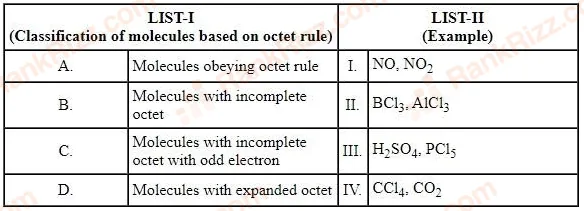
Q30Lewis structures, formal charge and coordinate bondsTRANSCRIBED

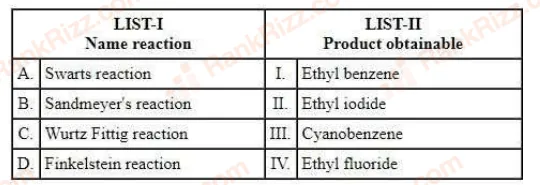
Match the LIST-I with LIST-II

page9_img1

Choose the correct answer from the options given below:

  1. A

    A-IV, B-I, C-III, D-II

  2. B

    A-IV, B-II, C-I, D-III

  3. C

    A-II, B-IV, C-III, D-I

  4. D

    A-III, B-II, C-I, D-IV

Q31Reactions of phenolsTRANSCRIBED

What amount of bromine will be required to convert 2 g of phenol into 2,4,6-tribromophenol? (Given molar mass in gmol−1gmol^{-1} of C, H, O, Br are 12, 1, 16, 80 respectively)

  1. A

    20.44 g

  2. B

    4.0 g

  3. C

    6.0 g

  4. D

    10.22 g

Q32Reactions and tests of aminesTRANSCRIBED
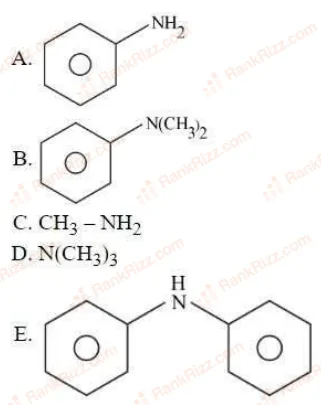
page9_img2

Which among the following react with Hinsberg's reagent?
Choose the correct answer from the options given below:

  1. A

    A, B and E Only

  2. B

    A, C and E Only

  3. C

    C and D Only

  4. D

    B and D Only

Q33General properties of transition elementsTRANSCRIBED

The correct set of ions (aqueous solution) with same colour from the following is:

  1. A

    SC3+,Ti3+,Cr2+SC^{3+},Ti^{3+}, Cr^{2+}

  2. B

    V2+,Cr3+,Mn3+V^{2+},Cr^{3+},Mn^{3+}

  3. C

    Ti4+,V4+,Mn2+Ti^{4+},V^{4+},Mn^{2+}

  4. D

    Zn2+,V3+,Fe3+Zn^{2+},V^{3+},Fe^{3+}

Q34Quantitative estimation of elementsTRANSCRIBED

Given below are two statements:
Statement I: In Lassaigne's test, the covalent organic molecules are transformed into ionic compounds.
Statement II: The sodium fusion extract of an organic compound having N and S gives prussian blue colour with FeSO4FeSO_{4} and Na4[Fe(CN)6]Na_{4}[Fe(CN)_{6}] In the light of the above statements, choose
the correct answer from the options given below.

  1. A

    Statement I is true but Statement II is false

  2. B

    Both Statement I and Statement II are false

  3. C

    Both Statement I and Statement II are true

  4. D

    Statement I is false but Statement II is true

Q35Reactions of alkanesTRANSCRIBED

Propane molecule on chlorination under photochemical condition gives two di-chloro products, " x " and " y ". Amongst " x " and " y ", " x " is an optically active molecule. How many tri-chloro products (consider only structural isomers) will be obtained from " x " when it is further treated with chlorine under the photochemical condition?

  1. A

    2

  2. B

    5

  3. C

    4

  4. D

    3

Q36Abnormal molar mass and van't Hoff factorTRANSCRIBED

CrCl3⋅xNH3CrCl_{3}\cdot xNH_{3} can exist as a complex. 0.1 molal aqueous solution of this complex shows a depression in freezing point of 0.558∘C0.558^{\circ}C. Assuming 100% ionisation of this complex and coordination number of Cr is 6 , the complex will be (Given KfK_{f} = 1.86 K kg mol−1mol^{-1})

  1. A

    [Cr(NH3)5Cl]Cl2\left[Cr(NH_{3})_{5}Cl\right]Cl_{2}

  2. B

    [Cr(NH3)6Cl]Cl3\left[Cr(NH_{3})_{6}Cl\right]Cl_{3}

  3. C

    [Cr(NH3)3Cl3]\left[Cr(NH_{3})_{3}Cl_{3}\right]

  4. D

    [Cr(NH3)4Cl2]Cl\left[Cr(NH_{3})_{4}Cl_{2}\right]Cl

Q37Solubility product and common ion effectTRANSCRIBED

Which of the following happens when NH4OHNH_{4}OH is added gradually to the solution containing 1 M A2+A^{2+} and 1MB3+1MB^{3+} ions? Given : Ksp[A(OH)2]=9×10⁻¹⁰K_{sp}[A(OH)_{2}]= 9 \times 10^{-10} and Ksp[B(OH)3]=27×10−18K_{sp}[B(OH)_{3}]= 27 \times 10^{-18} at 298 K .

  1. A

    Both A(OH)2A(OH)_{2} and B(OH)3B(OH)_{3} do not show precipitation with NH4OHNH_{4}OH

  2. B

    A(OH)2A(OH)_{2} will precipitate before B(OH)3B(OH)_{3}

  3. C

    B(OH)3B(OH)_{3} will precipitate before A(OH)2A(OH)_{2}

  4. D

    A(OH)2A(OH)_{2} and B(OH)3B(OH)_{3} will precipitate together

Q38Nucleophilic addition reactions of carbonyl compoundsTRANSCRIBED

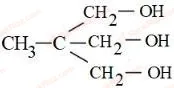
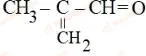
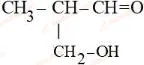
The major product of the following reaction is:

Figure for JEE Main 2025 Chemistry question on Nucleophilic addition reactions of carbonyl compounds
  1. A
    page10_img1
  2. B
    page10_img2
  3. C
    page10_img3
  4. D
    page10_img4
Q39Gibbs energy and spontaneityTRANSCRIBED

Ice at −5∘C-5^{\circ}C is heated to become vapor with temperature of 110∘C110^{\circ}C at atmospheric pressure. The entropy change associated with this process can be obtained from

  1. A

    ∫268K273KCp ,mdT+ΔHm,fusionTf+ΔHm,vaporisationTb+∫273K373KCp m dT+∫373K383KCp m dT\int_{268K}^{273K} C_p\,, _{m}{dT} + \frac{\Delta H_{m,\text{fusion}}}{T_f} + \frac{\Delta H_{m,\text{vaporisation}}}{T_b} + \int_{273K}^{373K} C_p\, m\, dT + \int_{373K}^{383K} C_p\, m\, dT

  2. B

    ∫268K273KCp ,mT dT+ΔHm,fusionTf+ΔHm,vaporisationTb+∫273K373KCp. mT dT+∫373K383KCp. mdTT\int_{268K}^{273K} \frac{C_p\,, m}{T}\, dT + \frac{\Delta H_{m,\text{fusion}}}{T_f} + \frac{\Delta H_{m,\text{vaporisation}}}{T_b} + \int_{273K}^{373K} \frac{C_p.\, m}{T}\, dT + \int_{373K}^{383K} \frac{C_p.\, m dT}{T}

  3. C

    ∫268K383KCp dT+qrevT\int_{268K}^{383K} C_p\, dT + \frac{q_{\text{rev}}}{T}

  4. D

    ∫268K383KCp dT+ΔHmelting273+ΔHboiling373\int_{268K}^{383K} C_p\, dT + \frac{\Delta H_{\text{melting}}}{273} + \frac{\Delta H_{\text{boiling}}}{373}

Q40Group 15: trends and hydridesTRANSCRIBED

The incorrect statement among the following is options .

  1. A

    PH3PH_{3} shows lower proton affinity than NH3NH_{3}.

  2. B

    SO2SO_{2} can act as an oxidizing agent, but not as a reducing agent.

  3. C

    PF3PF_{3} exists but NF5NF_{5} does not.

  4. D

    NO2NO_{2} can dimerise easily.

Q41Mole concept, atomic and molar massTRANSCRIBED

2.8×10−32.8 \times 10^{-3} mol of CO2CO_{2} is left after removing 102110^{21} molecules from its 'x' mg sample. The mass of CO2CO_{2} taken initially is Given: NA=6.02×10²³mol−1N_{A} = 6.02 \times 10^{23} mol^{-1}

  1. A

    98 .3 mg

  2. B

    48.2 mg

  3. C

    196 .2 mg

  4. D

    150 .4 mg

Q42Nucleophilic substitution (SN1 and SN2)TRANSCRIBED

Match the LIST-I with LIST-II

page11_img5

Choose the correct answer from the options given below:

  1. A

    A-II, B-I, C-III, D-IV

  2. B

    A-II, B-III, C-I, D-IV

  3. C

    A-IV, B-I, C-III, D-II

  4. D

    A-IV, B-III, C-I, D-II

Q43Hydrogen spectrum and spectral seriesTRANSCRIBED

Heat treatment of muscular pain involves radiation of wavelength of about 900 nm . Which spectral line of H atom is suitable for this? Given : Rydberg constant RH=105cm−1R_{H}=10^{5} cm^{-1}, h=6.6×10⁻³⁴h=6.6 \times 10^{-34} Js,c=3×10⁸c= 3\times 10^{8} m/s

  1. A

    Balmer series, ∞→2\infty \rightarrow 2

  2. B

    Lyman series,∞→1\infty \rightarrow 1

  3. C

    Paschen series,∞→3\infty \rightarrow 3

  4. D

    Paschen series,5→35\rightarrow 3

Q44Colour and magnetic behaviour of complexes from CFTTRANSCRIBED

The d- electronic configuration of an octahedral Co(II) complex having magnetic moment of 3.95 BM is:

  1. A

    t2g3eg0t_{2} {}_{g} {}^{3}e_{g}{}^{0}

  2. B

    t2g6eg1t_{2} {}_{g} {}^{6}e_{g}{}^{1}

  3. C

    t2g5eg2t_{2} {}_{g} {}^{5}e_{g}{}^{2}

  4. D

    e4t23e^{4}t_{2}{}^{3}

Q45AromaticityTRANSCRIBED

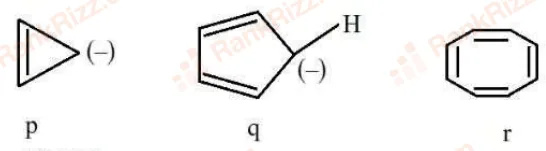
The correct stability order of the following species/molecules is:

page12_img1
  1. A

    q > r > p

  2. B

    r > q > p

  3. C

    q > p > r

  4. D

    p > q > r

Q46Gibbs energy and spontaneityTRANSCRIBED

The standard enthalpy and standard entropy of decomposition of N2O4N_{2}O_{4} to NO2NO_{2} are 55.0 kJ mol−1mol^{-1} and 175.0 J/K/mol respectively. The standard free energy change for this reaction at 25∘C25^{\circ}C in J mol−1mol^{-1} is ______ (Nearest integer)

Q47Integrated rate laws and half-life (zero and first order)TRANSCRIBED

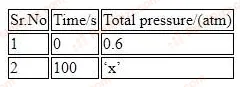
For the thermal decomposition of N2O5(g)N_{2}O_{5}(g) at constant volume, the following table can be formed, for the reaction mentioned below. 2N2O5(g)→2N2O4(g)+O2(g)2 N_{2}O_{5}(g)\rightarrow 2 N_{2}O_{4}(g)+O_{2}(g)
x=....×10−3x= .... \times 10^{-3} atm [nearest integer] Given : Rate constant for the reaction is 4.606×10⁻²s−1.4.606 \times 10^{-2} s^{-1}.

page12_img2
Q48Quantitative estimation of elementsTRANSCRIBED

During " S " estimation, 160 mg of an organic compound gives 466 mg of barium sulphate. The percentage of Sulphur in the given compound is _______ %. (Given molar mass in gmol−1gmol^{-1} of Ba : 137, S : 32, O : 16)

Q49Ionisation of weak electrolytes and Ostwald's dilution lawTRANSCRIBED

If 1 mM solution of ethylamine produces pH=9, then the ionization constant (Kb)(K_{b}) of ethylamine is 10−x10^{-x}. The value of is ______ (nearest integer). [The degree of ionization of ethylamine can be neglected with respect to unity.]

Q50Diazonium saltsTRANSCRIBED

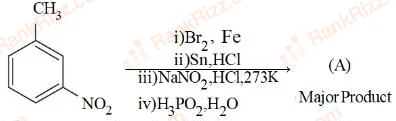
Consider the following sequence of reactions to produce major product (A)

page12_img3

Molar mass of product (A) is gmol−1gmol^{-1}. (Given molar mass in gmol−1gmol^{-1} of C : 12, H : 1, O : 16, Br : 80, N : 14, P : 31)

NEXT IN THIS PAPER →Maths, Q51 onwards