Q31Electronegativity, effective nuclear charge and shieldingTRANSCRIBED
The correct order of electronegativity for given elements is
- A
P > Br > C > At
- B
Br > P > At > C
- C
Br > C > At > P
- D
C > P > At > Br
The 30 Chemistry questions of JEE Main 08 Apr 2023, Shift 1, numbered across the whole paper. Pick an answer on any question to check it against the key. Free to read, nothing to download.
The correct order of electronegativity for given elements is
P > Br > C > At
Br > P > At > C
Br > C > At > P
C > P > At > Br
Given below are two statements: One is labelled as Assertion A and the other is labelled as Reason R.
Assertion A: Butan-1-ol has higher boiling point than ethoxyethane.
Reason R: Extensive hydrogen bonding leads to stronger association of molecules.
In the light of the above statements, choose the correct answer from the options given below :
A is true but R is false
Both A and R are true and R is the correct explanation of A
Both A and R are true but R is not the correct explanation of A
A is false but R is true
What is the value of x?
2
12
10
6
Given below are two statements:
Statement I: Lithium and Magnesium do not form superoxide
Statement II: The ionic radius of Li is larger than ionic radius of Mg
In the light of the above statements, choose the most appropriate answer from the questions given below:
Statement I is incorrect but Statement II is correct
Statement I is correct but Statement II is incorrect
Both statement I and Statement II are incorrect
Both Statement I and Statement II are correct
What is the purpose of adding gypsum to cement?
To facilitate the hydration of cement
To slow down the process of setting
To give a hard mass
To speed up the process of setting
Match List I with List II
List-I (Species) List-2 (Maximum allowed concentration in ppm in drinking water)
A. F I. < 50 ppm
B. SO II. < 5 ppm
C. NO III. < 2 ppm
D. Zn IV. < 500 ppm
Choose the correct answer from the options given below.
A-I, B-II, C-III, D-IV
A-II, B-I, C-III, D-IV
A-IV, B-III, C-II, D-I
A-III, B-II, C-I, D-IV
The reaction occurs in which of the given galvanic cell?
Pt |H(g)| HCl(sol) |AgCl(s)| Ag
Ag |AgCl(s)| KCl(sol) |AgNO |Ag
Pt |H(g)| HCl(sol) |AgNO(sol) |Ag
Pt |H(g)| KCl(sol) |AgCl(s) |Ag
The water gas on reacting with cobalt as a catalyst forms
Methanal
Methanoic acid
Ethanol
Methanol
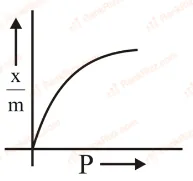
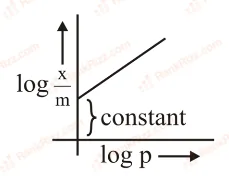
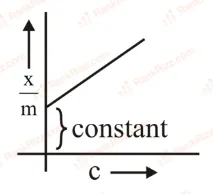
Which of the following represents the Freundlich adsorption isotherms?
(A)
(B)
(C)
(D)
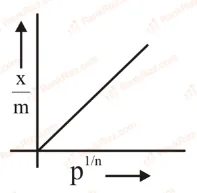
Choose the correct answer from the options given below:
A, C, D only
A, B only
B, C, D only
A, B, D only
Which of the following metals can be extracted through alkali leaching technique?
Sn
Pb
Au
Cu
In chromyl chloride, the number of d-electrons present on chromium is same as in (Given at no. of Ti: 22, V: 23, Cr: 24, Mn: 25, Fe: 26)
V (IV)
Mn (VII)
Fe (III)
Ti (III)
Which halogen is known to cause the reaction given below?
All halogens
Only Bromine
Only Iodine
Only Chlorine
Which of the following complex is octahedral, diamagnetic and the most stable?
Na[CoCl]
[Ni(NH)] Cl
K[Co(CN)]
[Co(HO)] Cl
The correct order of spin only magnetic moments for the following complex ions is
[Fe(CN)] < [CoF] < [MnBr] < [Mn(CN)]
[CoF] < [MnBr] < [Fe(CN)] < [Mn(CN)]
[Fe(CN)] < [Mn(CN)] < [CoF] < [MnBr]
[MnBr] < [CoF] < [Fe(CN)] < [Mn(CN)]
Choose the halogen which is most reactive towards SN1 reaction in the given compounds (A, B, C & D)
A.
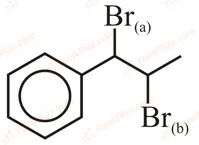
B.
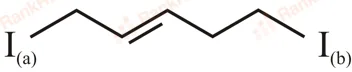
C.
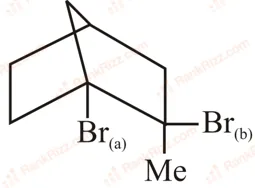
D.
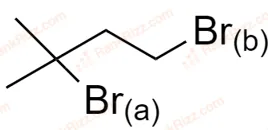
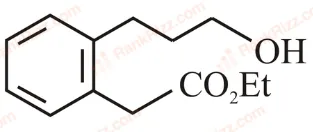
The major product formed in the following reaction is
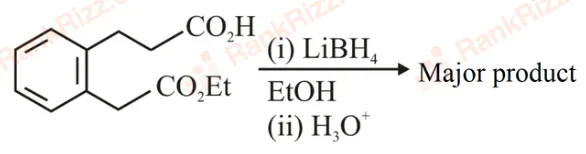
COH + COEt compound treated with (i) LiBH/EtOH (ii) HO
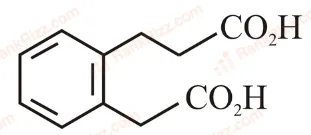
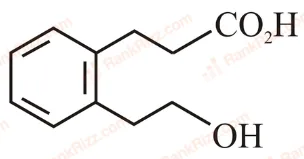
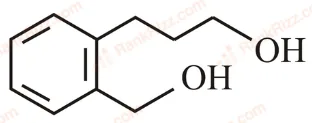
Match List I with List II:
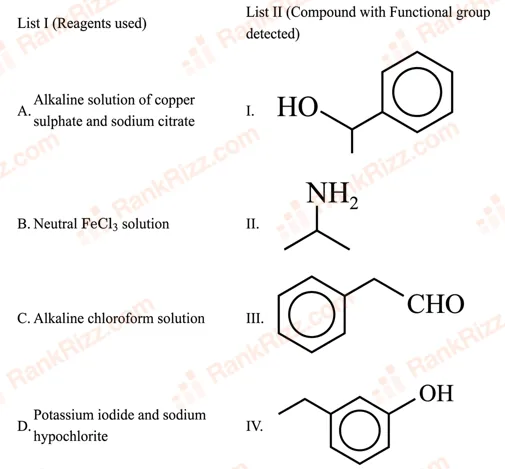
A-III, B-IV, C-I, D-II
A-III, B-IV, C-II, D-I
A-IV, B-I, C-II, D-III
A-II, B-IV, C-I, D-III
Match List I with List II:
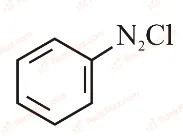
is reacted with reagents in List I to form products in List II
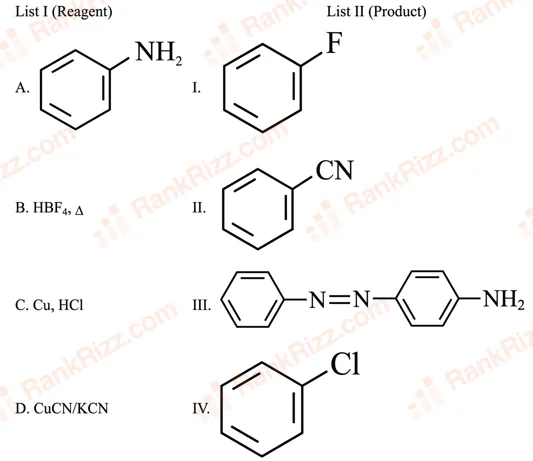
Choose the correct answer from the options given below:
A-IV, B-III, C-II, D-I
A-III, B-I, C-II, D-IV
A-I, B-III, C-IV, D-II
A-III, B-I, C-IV, D-II
Match List I with List II
List I List II
A. Saccharin I. High potency sweetener
B. Aspartame II. First artificial sweetening agent
C. Alitame III. Stable at cooking temperature
D. Sucralose IV. Unstable at cooking temperature
Choose the correct answer from the options given below :
A-IV, B-III, C-I, D-II
A-II, B-III, C-IV, D-I
A-II, B-IV, C-III, D-I
A-II, B-IV, C-I, D-III
Sulphur (S) containing amino acids from the following are:
(a) isoleucine
(b) cysteine
(c) lysine
(d) methionine
(e) glutamic acid
b, c, e
a, b, c
b, d
a, d
0.5 g of an organic compound (X) with 60% carbon will produce ______ g of CO on complete combustion.
The number of following statement/s which is/are incorrect is ______
A) Line emission spectra are used to study the electronic structure
B) The emission spectra of atoms in the gas phase show a continuous spread of wavelength from red to violet.
C) An absorption spectrum is like the photographic negative of an emission spectrum
D) The element helium was discovered in the sun by spectroscopic method
The number of following factors which affect the percent covalent character of the ionic bond is______
A) Polarising power of cation
B) Extent of distortion of anion
C) Polarisability of the anion
D) Polarising power of anion
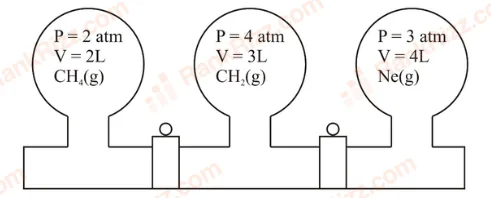
Three bulbs are filled with CH, CO and Ne as shown in the picture. The bulbs are connected through pipes of zero volume. When the stopcocks are opened and the temperature is kept constant throughout, the pressure of the system is found to be ______ atm. (Nearest integer).
When a 60 W electric heater is immersed in a gas for 100 s in a constant volume container with adiabatic walls, the temperature of the gas rises by 5°C. The heat capacity of the given gas is JK (Nearest integer)
The titration curve of weak acid vs. strong base with phenolphthalein as indicator is shown below. The
Given:
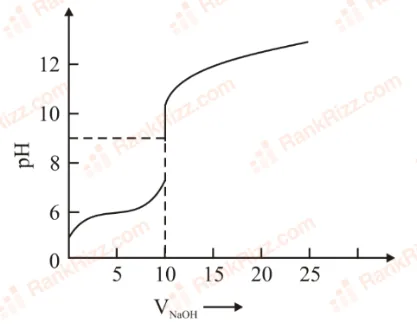
The number of following statement/s which is/are correct about phenolphthalein is ______
A. It can be used as an indicator for the titration of weak acid with weak base.
B. It begins to change colour at pH = 8.4
C. It is a weak organic base
D. It is colourless in acidic medium
Molar mass of the hydrocarbon (X) which on ozonolysis consumes one mole of O per mole of (X) and gives one mole each of ethanal and propanone is ______ g mol (Molar mass of C: 12 g mol, H: 1 g mol)
The vapour pressure vs. temperature curve for a solution solvent system is shown below.
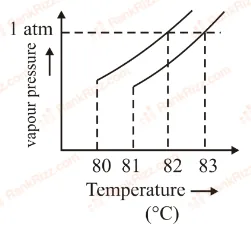
The boiling point of the solvent is ______°C.
The number of given statement/s which is/are correct is______
(A) The stronger the temperature dependence of the rate constant, the higher is the activation energy.
(B) If a reaction has zero activation energy, its rate is independent of temperature.
(C) The stronger the temperature dependence of the rate constant, the smaller is the activation energy.
(D) If there is no correlation between the temperature and the rate constant then it means that the reaction has negative activation energy.
XeF reacts with SbF to form [XeF][SbF]. = ?