Q31Atomic and ionic radiiTRANSCRIBED
Given two statements below:
Statement I: In Cl2 molecule the covalent radius is double of the atomic radius of chlorine.
Statement II: Radius of anionic species is always greater than their parent atomic radius.
Choose the most appropriate answer from options given below
- A
Both Statement I and Statement II are correct
- B
Both Statement I and Statement II are incorrect
- C
Statement I is correct but Statement II is incorrect
- D
Statement I is incorrect but Statement II is correct
Q32VSEPR theory and shapes of molecules and ionsTRANSCRIBED
Match List - I with List - II.
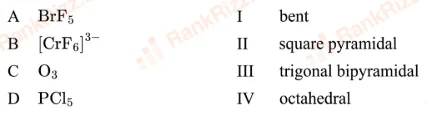
Choose the correct answer from the options given below
- A
- B
- C
- D
Q33Oxidising/reducing agents and types of redox reactionsTRANSCRIBED
Which of the given reactions is not an example of disproportionation reaction?
- A
2H2O2→2H2O+O2
- B
2NO2+H2O→HNO3+HNO2
- C
MnO4−+4H++3e−→MnO2+2H2O
- D
3MnO42−+4H+→2MnO4−+MnO2+2H2O
Q34Hydrogen peroxideTRANSCRIBED
Which of the following can be used to prevent the decomposition of H2O2?
- A
- B
- C
- D
Q35Compounds of alkaline earth metalsTRANSCRIBED
Reaction of BeCl2 with LiAlH4 gives:
(A) AlCl3
(B) BeH2
(C) LiH
(D) LiCl
(E) BeAlH4
Choose the correct answer from options given below
- A
- B
- C
- D
Q36Group 13: general trends and inert pair effectTRANSCRIBED
Borazine, also known as inorganic benzene, can be prepared by the reaction of 3-equivalents of "X" with 6-equivalents of "Y". "X" and "Y", respectively are
- A
B(OH)3 and NH3
- B
B2H6 and NH3
- C
B2H6 and HN3
- D
NH3 and B2O3
Q37Methods of purification of organic compoundsTRANSCRIBED
Which technique among the following, is most appropriate in separation of a mixture of 100 mg of p-nitrophenol and picric acid?
- A
- B
2−5 ft long column of silica gel
- C
- D
Preparative TLC (Thin Layer Chromatography)
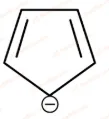
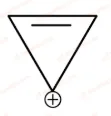
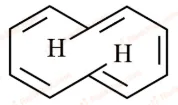
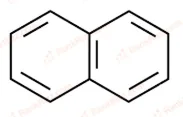
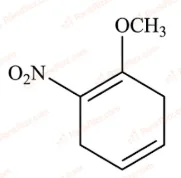
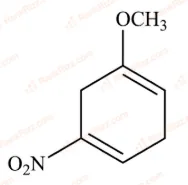
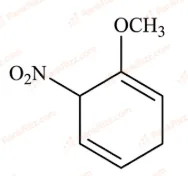
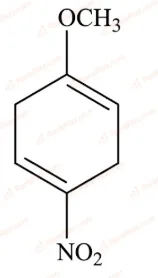
Q38AromaticityTRANSCRIBED
Which of the following compounds is not aromatic?
- A
- B
- C
- D
Q39Diazonium saltsTRANSCRIBED
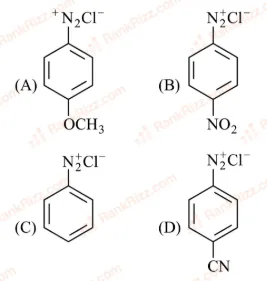
The correct stability order of the following diazonium salts is
- A
(A)>(B)>(C)>(D)
- B
(A)>(C)>(D)>(B)
- C
(C)>(A)>(D)>(B)
- D
(C)>(D)>(B)>(A)
Q40Reactions of alkanesTRANSCRIBED
C˙l+CH4→A+B. A and B in the above atmospheric reaction step are
- A
C2H6 and Cl2
- B
C˙HCl2 and H2
- C
C˙H3 and HCl
- D
C2H6 and HCl
Q41Reactions of phenolsTRANSCRIBED
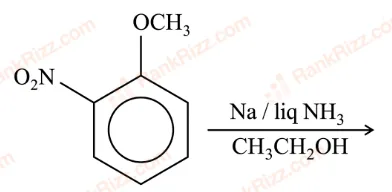
The major product formed in the given reaction is:
- A
- B
- C
- D
Q42Dinitrogen, ammonia, nitric acid and oxides of nitrogenTRANSCRIBED
Match List - I with List - II.
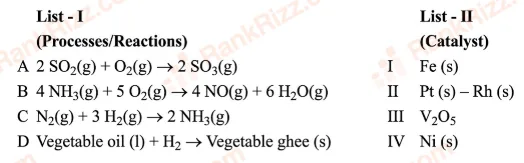
Choose the correct answer from the options given below
- A
- B
- C
- D
Q43Refining of metalsTRANSCRIBED
Refining using liquation method is the most suitable for metals with
- A
- B
- C
High electrical conductivity
- D
Less tendency to be soluble in melts than impurities
Q44Other important compounds of transition metalsTRANSCRIBED
The dark purple colour of KMnO4 disappears in the titration with oxalic acid in acidic medium. The overall change in the oxidation number of manganese in the reaction is
- A
- B
- C
- D
Q45Electrophilic substitution of anilineTRANSCRIBED
Given below are two statements: one is labelled as Assertion (A) and the other is labelled as Reason (R).
Assertion (A): Experimental reaction of CH3Cl with aniline and anhydrous AlCl3 does not give o and p-methylaniline.
Reason (R): The −NH2 group of aniline becomes deactivating because of salt formation with anhydrous AlCl3 and hence yields m-methyl aniline as the product.
In the light of the above statements, choose the most appropriate answer from the options given below
- A
Both A and R are true and R is the correct explanation of A
- B
Both A and R are true but R is not the correct explanation of A
- C
A is true, but R is false
- D
A is false, but R is true
Q46Reactions of phenolsTRANSCRIBED
The difference in the reaction of phenol with bromine in chloroform and bromine in water medium is due to
- A
Hyperconjugation in substrate
- B
- C
- D
Electromeric effect of the substrate
Q47Distinguishing tests for aldehydes and ketonesTRANSCRIBED
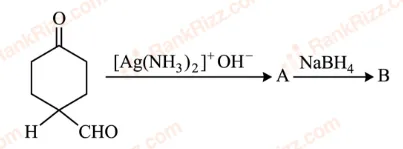
The products formed in the following reaction, A and B are
- A
- B
- C
- D
Q48Preparation of alcoholsTRANSCRIBED
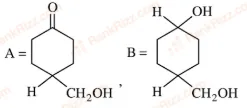
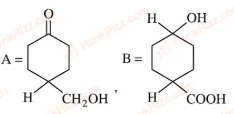
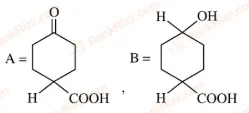
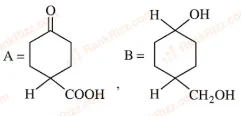
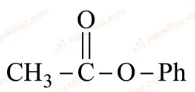
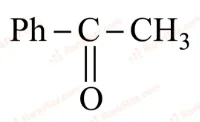
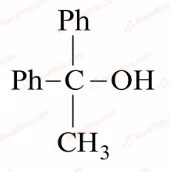
Which reactant will give the following alcohol on reaction with one mole of phenyl magnesium bromide (PhMgBr) followed by acidic hydrolysis?
- A
CH3−C≡N
- B
Ph−C≡N
- C
- D
Q49Soaps and detergentsTRANSCRIBED
Stearic acid and polyethylene glycol react to form which one of the following soap/detergents?
- A
- B
- C
- D
Q50Carbohydrates: classification and monosaccharidesTRANSCRIBED
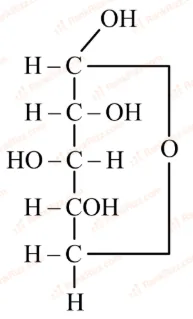
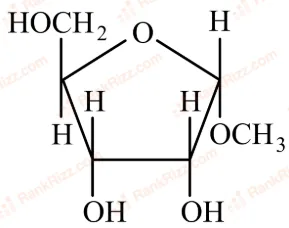
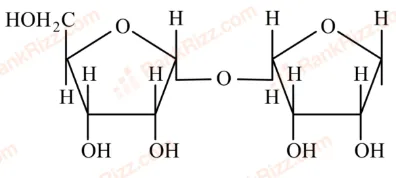
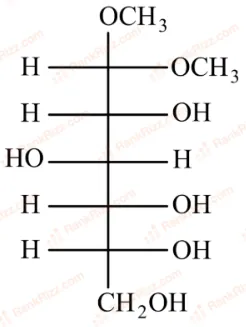
Which of the following is a reducing sugar?
- A
- B
- C
- D
Q51Concentration terms and their interconversionTRANSCRIBED
Chlorophyll extracted from the crushed green leaves was dissolved in water to make 2 L solution of Mg of concentration 48 ppm. The number of atoms of Mg in this solution is x×1020 atoms. The value of x is ______ (Nearest Integer) (Given: Atomic mass of Mg is 24 g mol−1, NA=6.02×10²³ mol−1)
Q52Concentration terms and their interconversionTRANSCRIBED
When 800 mL of 0.5M nitric acid is heated in a beaker, its volume is reduced to half and 11.5 g of nitric acid is evaporated. The molarity of the remaining nitric acid solution is x×10−2 M. (Molar mass of nitric acid is 63 g mol−1)
Q53Quantum mechanical model, wave function and probabilityTRANSCRIBED
The wavelength of an electron and a neutron will become equal when the velocity of the electron is x times the velocity of neutron. The value of x is ______ (the nearest integer) (Mass of electron is 9.1×10⁻³¹ kg and mass of neutron is 1.6×10⁻²⁷ kg)
Q54Dalton's law of partial pressuresTRANSCRIBED
A mixture of hydrogen and oxygen contains 40% hydrogen by mass when the pressure is 2.2 bar. The partial pressure of hydrogen is ______ bar.
Q55Enthalpies of reaction and Hess's lawTRANSCRIBED
2.4 g coal is burnt in a bomb calorimeter in excess of oxygen at 298 K and 1 atm pressure. The temperature of the calorimeter rises from 298 K to 300 K. The enthalpy change during the combustion of coal is −x kJ mol−1. The value of x is ______ (Given: Heat capacity of bomb calorimeter 20.0 kJ K−1. Assume coal to be pure carbon)
Q56Law of mass action and equilibrium constants Kc and KpTRANSCRIBED
At 298 K, the equilibrium constant is 2×10¹⁵ for the reaction:
Cu(s)+2Ag+(aq)⇌Cu2+(aq)+2Ag(s)
The equilibrium constant for the reaction
21Cu2+(aq)+Ag(s)⇌21Cu(s)+Ag+(aq)
is x×10−8. The value of x is ______.
Q57Electrophilic aromatic substitutionTRANSCRIBED
In the presence of sunlight, benzene reacts with Cl2 to give product X. The number of hydrogens in X is ______.
Q58Electrolysis and Faraday's lawsTRANSCRIBED
The amount of charge in F (Faraday) required to obtain one mole of iron from Fe3O4 is ______. (Round off to the nearest integer)
Q59Integrated rate laws and half-life (zero and first order)TRANSCRIBED
For a reaction A→2B+C, the half lives are 100 s and 50 s when the concentration of reactant A is 0.5 and 1.0 mol L = respectively. The order of the reaction is ______.
Q60Valence bond theory of complexesTRANSCRIBED
The difference between spin only magnetic moment values of [Co(H2O)6]Cl2 and [Cr(H2O)6]Cl3 is ______.