RankRizz

JEE Main 17 Mar 2021, Shift 1: Maths

The 30 Maths questions of JEE Main 17 Mar 2021, Shift 1, numbered across the whole paper. Pick an answer on any question to check it against the key. Free to read, nothing to download.

Maths

Q61Forming equations and power sums of rootsTRANSCRIBED

The value of 4+15+14+15+14+…∞4 + \cfrac{1}{5 + \cfrac{1}{4 + \cfrac{1}{5 + \cfrac{1}{4 + \ldots \infty}}}} is:

  1. A

    2+25302 + \frac{2}{5}\sqrt{30}

  2. B

    2+45302 + \frac{4}{\sqrt{5}}\sqrt{30}

  3. C

    4+45304 + \frac{4}{\sqrt{5}}\sqrt{30}

  4. D

    5+25305 + \frac{2}{5}\sqrt{30}

Q62Locus and regions in the Argand planeTRANSCRIBED

The area of the triangle with vertices P(z)P(z), Q(iz)Q(iz) and R(z+iz)R(z + iz) is:

  1. A

    1

  2. B

    12∣z∣2\frac{1}{2}|z|^2

  3. C

    12\frac{1}{2}

  4. D

    12∣z+iz∣2\frac{1}{2}|z + iz|^2

Q63Fundamental principle of countingTRANSCRIBED

Team 'A' consists of 7 boys and nn girls and Team 'B' has 4 boys and 6 girls. If a total of 52 single matches can be arranged between these two teams when a boy plays against a boy and a girl plays against a girl, then nn is equal to:

  1. A

    5

  2. B

    2

  3. C

    4

  4. D

    6

Q64General term and specific coefficientsTRANSCRIBED

If the fourth term in the expansion of (x+xlog⁡2x)7\left(x + x^{\log_2 x}\right)^7 is 4480, then the value of xx where x∈Nx \in N is equal to:

  1. A

    2

  2. B

    4

  3. C

    3

  4. D

    1

Q65Centroid, incentre, circumcentre and orthocentreTRANSCRIBED

In a triangle PQRPQR, the co-ordinates of the points PP and QQ are (−2,4)(-2, 4) and (4,−2)(4, -2) respectively. If the equation of the perpendicular bisector of PRPR is 2x−y+2=02x - y + 2 = 0, then the centre of the circumcircle of the △PQR\triangle PQR is:

  1. A

    (−1,0)(-1, 0)

  2. B

    (−2,−2)(-2, -2)

  3. C

    (0,2)(0, 2)

  4. D

    (1,4)(1, 4)

Q66Tangents and normals to a circleTRANSCRIBED

The line 2x−y+1=02x - y + 1 = 0 is a tangent to the circle at the point (2,5)(2, 5) and the centre of the circle lies on x−2y=4x - 2y = 4. Then, the radius of the circle is:

  1. A

    353\sqrt{5}

  2. B

    535\sqrt{3}

  3. C

    545\sqrt{4}

  4. D

    454\sqrt{5}

Q67Position of two circles and common tangentsTRANSCRIBED

Choose the incorrect statement about the two circles whose equations are given below:
x2+y2−10x−10y+41=0x^2 + y^2 - 10x - 10y + 41 = 0 and x2+y2−16x−10y+80=0x^2 + y^2 - 16x - 10y + 80 = 0

  1. A

    Distance between two centres is the average of radii of both the circles.

  2. B

    Both circles' centres lie inside region of one another.

  3. C

    Both circles pass through the centre of each other.

  4. D

    Circles have two intersection points.

Q68Limits of trigonometric functionsTRANSCRIBED

The value of lim⁡x→0+cos⁡−1(x−[x]2)⋅sin⁡−1(x−[x]2)x−x3\lim_{x \to 0^+} \frac{\cos^{-1}(x - [x]^2) \cdot \sin^{-1}(x - [x]^2)}{x - x^3}, where [x][x] denotes the greatest integer ≤x\leq x is:

  1. A

    π\pi

  2. B

    0

  3. C

    π4\frac{\pi}{4}

  4. D

    π2\frac{\pi}{2}

Q69Logical connectives, truth tables and tautologiesTRANSCRIBED

If the Boolean expression (p⇒q)⇔(q∗(∼p))(p \Rightarrow q) \Leftrightarrow (q * (\sim p)) is a tautology, then the Boolean expression p∗(∼q)p * (\sim q) is equivalent to:

  1. A

    q⇒pq \Rightarrow p

  2. B

    ∼q⇒p\sim q \Rightarrow p

  3. C

    p⇒∼qp \Rightarrow \sim q

  4. D

    p⇒qp \Rightarrow q

Q70Venn diagrams and cardinality of setsTRANSCRIBED

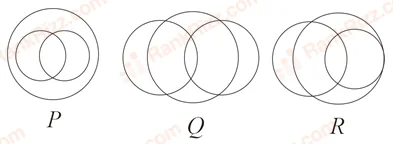
In a school, there are three types of games to be played. Some of the students play two types of games, but none play all the three games. Which Venn diagrams can justify the above statement?

Figure for JEE Main 2021 Mathematics question on Venn diagrams and cardinality of sets
  1. A

    P and Q

  2. B

    P and R

  3. C

    Q and R

  4. D

    None of these

Q71Properties of determinantsTRANSCRIBED

If A=[0sin⁡αsin⁡α0]A = \begin{bmatrix} 0 & \sin\alpha \\ \sin\alpha & 0 \end{bmatrix} and det⁡(A2−12I)=0\det\left(A^2 - \frac{1}{2}I\right) = 0, then a possible value of α\alpha is:

  1. A

    π2\frac{\pi}{2}

  2. B

    π3\frac{\pi}{3}

  3. C

    π4\frac{\pi}{4}

  4. D

    π6\frac{\pi}{6}

Q72Systems of linear equationsTRANSCRIBED

The system of equations kx+y+z=1kx + y + z = 1, x+ky+z=kx + ky + z = k and x+y+zk=k2x + y + zk = k^2 has no solution if kk is equal to:

  1. A

    0

  2. B

    1

  3. C

    −1-1

  4. D

    −2-2

Q73Series of inverse trigonometric functionsTRANSCRIBED

If cot⁡−1(α)=cot⁡−12+cot⁡−18+cot⁡−118+cot⁡−132+…\cot^{-1}(\alpha) = \cot^{-1} 2 + \cot^{-1} 8 + \cot^{-1} 18 + \cot^{-1} 32 + \ldots upto 100 terms, then α\alpha is:

  1. A

    1.01

  2. B

    1.00

  3. C

    1.02

  4. D

    1.03

Q74Properties and simplification of inverse trigonometric functionsTRANSCRIBED

The sum of possible values of xx for tan⁡−1(x+1)+cot⁡−1(1x−1)=tan⁡−1(831)\tan^{-1}(x+1) + \cot^{-1}\left(\frac{1}{x-1}\right) = \tan^{-1}\left(\frac{8}{31}\right) is:

  1. A

    −324-\frac{32}{4}

  2. B

    −314-\frac{31}{4}

  3. C

    −304-\frac{30}{4}

  4. D

    −334-\frac{33}{4}

Q75Inverse functionsTRANSCRIBED

The inverse of y=5log⁡xy = 5^{\log x} is:

  1. A

    x=5log⁡yx = 5^{\log y}

  2. B

    x=ylog⁡5x = y^{\log 5}

  3. C

    y=x1log⁡5y = x^{\frac{1}{\log 5}}

  4. D

    x=51log⁡yx = 5^{\frac{1}{\log y}}

Q76Definite integrals: properties and King's ruleTRANSCRIBED

Which of the following statement is correct for the function g(α)g(\alpha) for α∈R\alpha \in R such that g(α)=∫π6π3sin⁡αxcos⁡αx+sin⁡αxdxg(\alpha) = \int_{\frac{\pi}{6}}^{\frac{\pi}{3}} \frac{\sin^\alpha x}{\cos^\alpha x + \sin^\alpha x} dx:

  1. A

    g(α)g(\alpha) is a strictly increasing function

  2. B

    g(α)g(\alpha) has an inflection point at α=−12\alpha = -\frac{1}{2}

  3. C

    g(α)g(\alpha) is a strictly decreasing function

  4. D

    g(α)g(\alpha) is an even function

Q77Variable separable equationsTRANSCRIBED

Which of the following is true for y(x)y(x) that satisfies the differential equation dydx=xy−1+x−y\frac{dy}{dx} = xy - 1 + x - y; y(0)=0y(0) = 0:

  1. A

    y(1)=e−12−1y(1) = e^{-\frac{1}{2}} - 1

  2. B

    y(1)=e12−e−12y(1) = e^{\frac{1}{2}} - e^{-\frac{1}{2}}

  3. C

    y(1)=1y(1) = 1

  4. D

    y(1)=e12−1y(1) = e^{\frac{1}{2}} - 1

Q78Scalar triple product and coplanarityTRANSCRIBED

Let a⃗=2i^−3j^+4k^\vec{a} = 2\hat{i} - 3\hat{j} + 4\hat{k} and b⃗=7i^+j^−6k^\vec{b} = 7\hat{i} + \hat{j} - 6\hat{k}. If r⃗×a⃗=r⃗×b⃗\vec{r} \times \vec{a} = \vec{r} \times \vec{b}, r⃗⋅(i^+2j^+k^)=−3\vec{r} \cdot (\hat{i} + 2\hat{j} + \hat{k}) = -3, then r⃗⋅(2i^−3j^+k^)\vec{r} \cdot (2\hat{i} - 3\hat{j} + \hat{k}) is equal to:

  1. A

    12

  2. B

    8

  3. C

    13

  4. D

    10

Q79Distance, foot and image with respect to a planeTRANSCRIBED

The equation of the plane which contains the yy-axis and passes through the point (1,2,3)(1, 2, 3) is:

  1. A

    x+3z=10x + 3z = 10

  2. B

    x+3z=0x + 3z = 0

  3. C

    3x+z=63x + z = 6

  4. D

    3x−z=03x - z = 0

Q80Classical probability and sample spacesTRANSCRIBED

Two dices are rolled. If both dices have six faces numbered 1, 2, 3, 5, 7 and 11, then the probability that the sum of the numbers on the top faces is less than or equal to 8 is:

  1. A

    49\frac{4}{9}

  2. B

    1736\frac{17}{36}

  3. C

    512\frac{5}{12}

  4. D

    12\frac{1}{2}

Q81Divisibility and remainder problemsTRANSCRIBED

If (2021)3762(2021)^{3762} is divided by 17, then the remainder is ________.

Q82Position of two circles and common tangentsTRANSCRIBED

The minimum distance between any two points P1P_1 and P2P_2 while considering point P1P_1 on one circle and point P2P_2 on the other circle for the given circles' equations:
x2+y2−10x−10y+41=0x^2 + y^2 - 10x - 10y + 41 = 0
x2+y2−24x−10y+160=0x^2 + y^2 - 24x - 10y + 160 = 0 is ________.

Q83Properties of determinantsTRANSCRIBED

If A=[230−1]A = \begin{bmatrix} 2 & 3 \\ 0 & -1 \end{bmatrix}, then the value of det⁡(A4)+det⁡(A10−(Adj(2A))10)\det(A^4) + \det\left(A^{10} - (\text{Adj}(2A))^{10}\right) is equal to ________.

Q84Continuity at a pointTRANSCRIBED

If the function f(x)=cos⁡(sin⁡x)−cos⁡xx4f(x) = \frac{\cos(\sin x) - \cos x}{x^4} is continuous at each point in its domain and f(0)=1kf(0) = \frac{1}{k}, then kk is ________.

Q85Inverse trigonometric differentiation and derivative w.r.t. a functionTRANSCRIBED

If f(x)=sin⁡(cos⁡−1(1−22x1+22x))f(x) = \sin\left(\cos^{-1}\left(\frac{1-2^{2x}}{1+2^{2x}}\right)\right) and its first derivative with respect to xx is −balog⁡e2-\frac{b}{a}\log_e 2 when x=1x = 1, where aa and bb are integers, then the minimum value of ∣a2−b2∣|a^2 - b^2| is ________.

Q86Absolute maxima and minimaTRANSCRIBED

The maximum value of zz in the following equation z=6xy+y2z = 6xy + y^2, where 3x+4y≤1003x + 4y \leq 100 and 4x+3y≤754x + 3y \leq 75 for x≥0x \geq 0 and y≥0y \geq 0 is ________.

Q87Definite integrals: properties and King's ruleTRANSCRIBED

If [⋅][\cdot] represents the greatest integer function, then the value of ∣∫0π2[[x2]−cos⁡x]dx∣\left|\int_0^{\sqrt{\frac{\pi}{2}}} \left[\left[x^2\right] - \cos x\right] dx\right| is ________.

Q88Scalar triple product and coplanarityTRANSCRIBED

If a⃗=αi^+βj^+3k^\vec{a} = \alpha\hat{i} + \beta\hat{j} + 3\hat{k}, b⃗=−βi^−αj^−k^\vec{b} = -\beta\hat{i} - \alpha\hat{j} - \hat{k} and c⃗=i^−2j^−k^\vec{c} = \hat{i} - 2\hat{j} - \hat{k} such that a⃗⋅b⃗=1\vec{a} \cdot \vec{b} = 1 and b⃗⋅c⃗=−3\vec{b} \cdot \vec{c} = -3, then 13((a⃗×b⃗)⋅c⃗)\frac{1}{3}\left((\vec{a} \times \vec{b}) \cdot \vec{c}\right) is equal to ________.

Q89Line and plane: intersection, coplanarity and projectionTRANSCRIBED

If the equation of the plane passing through the line of intersection of the planes 2x−7y+4z−3=02x - 7y + 4z - 3 = 0, 3x−5y+4z+11=03x - 5y + 4z + 11 = 0 and the point (−2,1,3)(-2, 1, 3) is ax+by+cz−7=0ax + by + cz - 7 = 0, then the value of 2a+b+c−72a + b + c - 7 is ________.

Q90Classical probability and sample spacesTRANSCRIBED

Let there be three independent events E1,E2E_1, E_2 and E3E_3. The probability that only E1E_1 occurs is α\alpha, only E2E_2 occurs is β\beta and only E3E_3 occurs is γ\gamma. Let 'pp' denote the probability of none of events occurs that satisfies the equations (α−2β)p=αβ(\alpha - 2\beta)p = \alpha\beta and (β−3γ)p=2βγ(\beta - 3\gamma)p = 2\beta\gamma. All the given probabilities are assumed to lie in the interval (0,1)(0, 1). Then, Probability of occurrence of E1Probability of occurrence of E3\frac{\text{Probability of occurrence of } E_1}{\text{Probability of occurrence of } E_3} is equal to ________.