Q31Concentration terms and their interconversionTRANSCRIBED
Dissolving 120 g of a compound of (mol. wt. 60) in 1000 g of water gave a solution of density 1.12 g/mL. The molarity of the solution is:
- A
2.50 M
- B
1.00 M
- C
2.00 M
- D
4.00 M
The 30 Chemistry questions of JEE Main 09 Apr 2014, Online, numbered across the whole paper. Pick an answer on any question to check it against the key. Free to read, nothing to download.
Dissolving 120 g of a compound of (mol. wt. 60) in 1000 g of water gave a solution of density 1.12 g/mL. The molarity of the solution is:
2.50 M
1.00 M
2.00 M
4.00 M
The amount of oxygen in 3.6 moles of water is:
57.6 g
115.2 g
18.4 g
28.8 g
The energy of an electron in first Bohr's orbit of H atom is eV. The energy value of electron in the first excited state of Li is:
27.2 eV
eV
30.6 eV
eV
In the following sets of reactants which two sets best exhibit the amphoteric character of AlO · xHO?
Set I: AlO · xHO + OH
Set II: AlOx · HO + HO
Set III: AlOx · HO + H
Set IV: AlO · xHO + NH
2 and 4
1 and 2
1 and 3
3 and 4
The number and type of bonds in C ion in CaC are:
Two -bonds and two -bonds
One -bond and two -bonds
One -bond and one -bond
Two -bonds and one -bond
Which of the following has unpaired electron(s)?
O
N
O
N
The temperature at which oxygen molecules have the same root mean square speed as helium atoms have at 300 K is: (Atomic masses: He = 4 u, O = 16 u)
600 K
2400 K
1200 K
300 K
Van der Waal's equation for a gas is stated as, . This equation reduces to the perfect gas equation, When,
temperature is sufficiently high and pressure is low
both temperature and pressure are very low
both temperature and pressure are very high
temperature is sufficiently low and pressure is high
The standard enthalpy of formation of NH is kJ/mol. If bond enthalpy of H is kJ/mol and that of N is kJ/mol, the average bond enthalpy of NH bond in NH is:
kJ/mol
kJ/mol
kJ/mol
kJ/mol
At a certain temperature, only 50% HI is dissociated into H and I at equilibrium. The equilibrium constant is:
0.5
4.0
1.0
0.25
In which of the following pairs is A more stable than B?
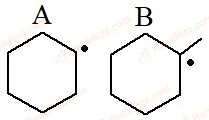
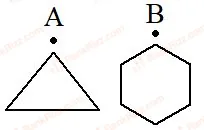
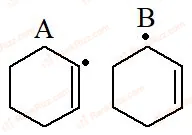
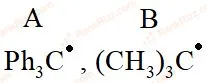
In a face centered cubic lattice atoms A are at the corner points and atoms B at the face centered points. If atom B is missing from one of the face centered points, the formula of the ionic compound is:
AB
AB
AB
AB
A current of 10.0 A flows for 2.00 h through an electrolytic cell containing a molten salt of metal X. This results in the decomposition of 0.250 mol of metal X at the cathode. The oxidation state of X in the molten salt is: (F = 96,500 C)
1+
4+
3+
2+
The standard electrode potentials () of four metals A, B, C and D are V, 0.6 V, 0.85 V and V, respectively. The sequence of deposition of metals on applying potential is:
B > D > C > A
A > C > B > D
C > B > D > A
D > A > B > C
The half-life period of a first-order reaction is 15 minutes. The amount of substance left after one hour will be:
of the original amount
of the original amount
of the original amount
of the original amount
The form of iron obtained from blast furnace is:
Cast Iron
Wrought Iron
Steel
Pig Iron
The gas evolved on heating CaF and SiO with concentrated HSO, on hydrolysis gives a white gelatinous precipitate. The precipitate is:
Silicic acid
Calcium fluorosilicate
Hydrofluorosilicic acid
Silica gel
Which of the following is not formed when HS reacts with acidic KCrO solution?
KSO
Cr(SO)
S
CrSO
The correct statement about the magnetic properties of [Fe(CN)] and [FeF] is: (Z = 26).
Both are paramagnetic.
Both are diamagnetic.
[Fe(CN)] is paramagnetic, [FeF] is diamagnetic.
[Fe(CN)] is diamagnetic, [FeF] is paramagnetic.
A compound of vanadium chloride has spin only magnetic moment of 1.73 BM. Its formula is:
VCl
VCl
VCl
VCl
An octahedral complex of Co is diamagnetic. The hybridisation involved in the formation of the complex is:
dsp
dsp
dspd
spd
Allyl phenyl ether can be prepared by heating:
CH = CH - Br + CH - CH - ONa
CH - CH = CH - Br + CH - ONa
CH = CH - CH - Br + CHONa
CHBr + CH = CH - CH - ONa
For the compounds CHCl, CHBr, CHI and CHF, the correct order of increasing C-halogen bond length is:
CHF < CHBr < CHCl < CHI
CHF < CHI < CHBr < CHCl
CHF < CHCl < CHBr < CHI
CHCl < CHBr < CHF < CHI
In a nucleophilic substitution reaction: R Br + Cl R Cl + Br, which one of the following undergoes complete inversion of configuration?
CHCHCHBr
CHCCHCHBr
CHCHBr
CHCHCHBr
In the hydroboration-oxidation reaction of propene with diborane, HO and NaOH, the organic compound formed is:
CH CH CH OH
CH CH OH
CH CHOHCH
(CH) COH
Which is the major product formed when acetone is heated with iodine and potassium hydroxide?
Acetophenone
Iodoform
Iodoacetone
Acetic acid
Which one of the following reactions will not result in the formation of carbon-carbon bond?
Friedel Craft's acylation
Reimer-Tieman reaction
Cannizaro reaction
Wurtz reaction
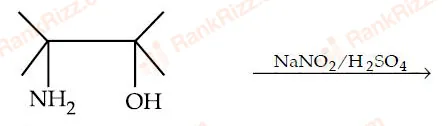
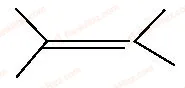
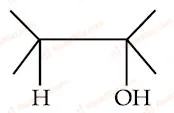
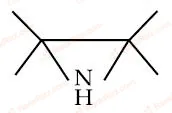
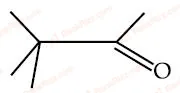
The major product of the reaction is:
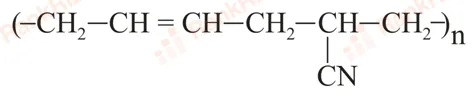
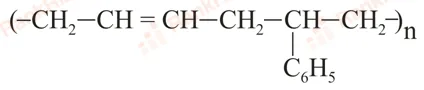
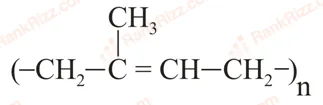
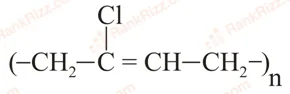
Structure of some important polymers are given. Which one represents Buna-S?
Which one of the following class of compounds is obtained by polymerization of acetylene?
Poly-ene
Poly-amide
Poly-yne
Poly-ester