JEE Advanced 2020 Physics question — Ideal gas equation and gas laws
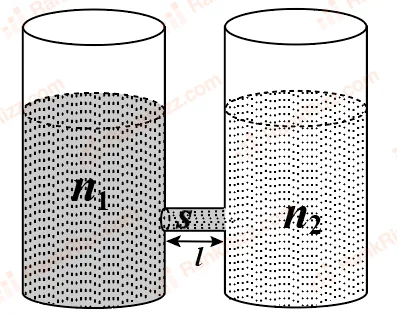
As shown schematically in the figure, two vessels contain water solutions (at temperature 𝑇) of
potassium permanganate () of different concentrations and molecules per unit volume with . When they are connected by a tube of small length l and cross-sectional area S, starts to diffuse from the left to the right vessel through the tube. Consider the collection of molecules to behave as dilute ideal gases and the difference in their partial pressure in the two vessels causing the diffusion. The speed 𝑣 of the molecules is limited by the viscous force \beta\left(\tirangle n\right)^{2}k_{B}$$ is the Boltzmann constant)
SOLUTION
For a very dilute solution each solute molecule behaves like an ideal-gas particle, so its partial pressure obeys the ideal-gas relation
where is the number of molecules per unit volume and is the (common) temperature of the two vessels.
The left vessel contains molecules per unit volume, the right one with and .
Force that drives the molecules (Option A)
The difference in partial pressure is
and it acts over the cross-sectional area of the connecting tube, so the net driving force is
Thus Option A is correct.
Force balance in the tube (Option B)
Inside the tube (length , area ) the solute molecules acquire a steady drift speed .
Each molecule experiences the viscous drag , so the total drag force on the molecules present in the tube is
The number of solute molecules in the tube is the concentration times its volume:
(we may replace the concentration everywhere by because and we are neglecting all terms).
Hence
In steady state, driving force equals drag:
or
This is exactly the relation given in Option B, so Option B is correct.
Number of molecules crossing per second (Option C)
The flux (number per unit time) through the tube equals concentration × drift speed × area:
Using the velocity from the force-balance equation:
we get
Option C quotes , which is missing the factor , so Option C is incorrect.
Time-dependence of the transfer rate (Option D)
The rate found above is proportional to . As diffusion proceeds, decreases and increases, so steadily falls and the rate correspondingly decreases. Therefore the transfer rate is not constant in time; Option D is incorrect.
Hence the correct statements are:
Option A and Option B.
Tagged Ideal gas equation and gas laws. Machine-assigned, so read it as a strong shortlist rather than a verdict.