Q1JEE ADVANCED 2009 · PAPER 1Real gases, compressibility factor and van der Waals equationTRANSCRIBED
The term that correct for the attractive forces present in a real gas in the van der Waals equation is
- A
- B
- C
- D
All 60 questions of JEE Advanced 2009 Paper 1, in the order they were asked. Pick an answer on any question to check it against the key. Free to read, nothing to download.
Questions
60
Chemistry · Mathematics · Physics
Answer key
53
questions with a checked key
Under review
7
key not yet trusted
Price
Free
no sign-up
The term that correct for the attractive forces present in a real gas in the van der Waals equation is
The IUPAC name of the following compound is -
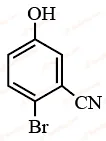
4-Bromo-3-cyanophenol
2-Bromo-5-hydroxybenzonitrile
2-Cyano-4- hydroxybromobenzene
6-Bromo-3-hydroxybenzonitrile
Given that the abundances of isotopes and are 5%,90% and 5% respectively, the atomic mass of Fe is -
55.85
55.95
55.75
56.05
Among cellulose, poly(vinyl chloride), nylon and natural rubber, the polymer in which the intermolecular force of attraction is weakest is -
Nylon
Poly(vinyl chloride)
Cellulose
Natural Rubber
The Henry's law constant for the solubility of gas in water at 298 K is atm. The mole fraction of in air is 0.8. The number of moles of from air dissolved in 10 moles of water at 298 K and 5 atm pressure is -
The correct acidity order of the following is -
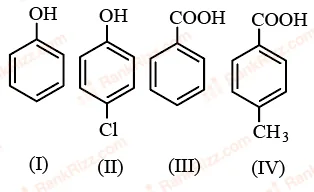
(III)>(IV)>(II)>(I)
(IV)>(III)>(I)>(II)
(III)>(II)>(I)>(IV)
(II)>(III)>(IV)>(I)
Among the electrolytes and , the most effective coagulating agent for is
The reaction of with X leads selectively to . The X is
Dry
A mixture of and
Moist
in the presence of aqueous
The compound(s) formed upon combustion of sodium metal in excess air is(are)
The correct statement(s) regarding defects in solids is(are) -
Frenkel defect is usually favoured by a very small difference in the size of cation and anion
Frenkel defect is a dislocation defect
Trapping of an electron in the lattice leads to the formation of F-center
Schottky defects have no effect on the physical properties of solids
The compound(s) that exhibit(s) geometrical isomerism is(are)
The correct statement(s) about the compound is (are)
The total number of stereoisomers possible for X is 6
The total number of diastereomers possible for X is 3
If the stereochemistry about the double bond in X is trans, the number of enantiomers possible for X is 4
If the stereochemistry about the double bond in X is cis, the number of enantiomers possible for X is 2
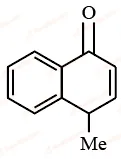
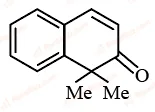
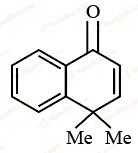
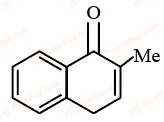
The compound X is
The compound Y is -
The compound Z is -
The structure of the carbonyl compound P is -
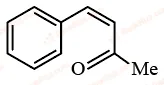
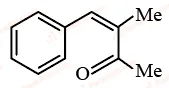
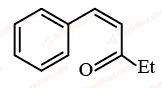
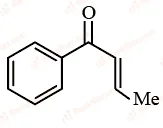
The structures of the products Q and R, respectively, are -
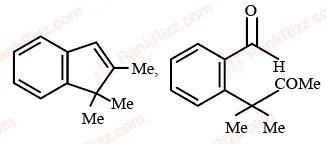
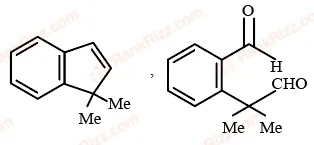
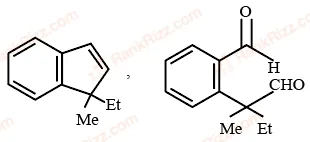
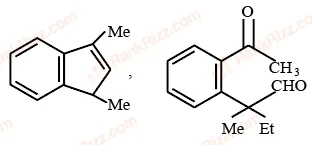
The structure of the product S is -
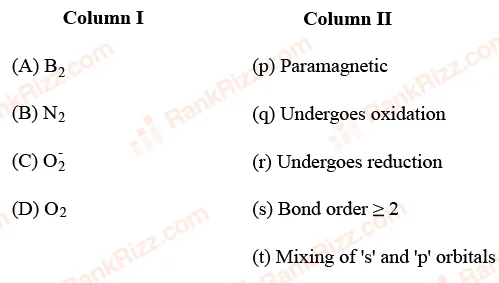
Match each of the diatomic molecules in Column I with its property/properties in Column II
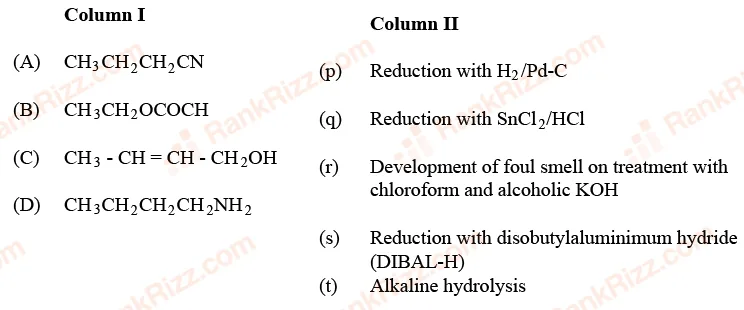
Match each of the compounds in Column I with its characteristic reaction(s) in Column II.
Tangents drawn from the point P(1, 8) to the circle touch the circle at the points A and B. The equation of the circumcircle of the triangle PAB is
The number of seven digit integers, with sum of the digits equal to 10 and formed by using the digits 1, 2 and 3 only, is
55
66
77
88
Let P(3, 2, 6) be a point in space and Q be a point on the line Then the value of for which the vector is parallel to the plane is
Let . Then the value of at is
Let be a complex number where x and y are integers. Then the area of the rectangle whose vertices are the roots of the equation is
48
32
40
80
If and are unit vectors such that and then
are non-coplanar
are non-coplanar
are non- parallel
are parallel and
Let f be a non-negative function defined on the interval . If
, and f(0) = 0, then
f\left(\frac{1}{2}\right) < \frac{1}{2} and f\left(\frac{1}{3}\right) > \frac{1}{3}
f\left(\frac{1}{2}\right) > \frac{1}{2} and f\left(\frac{1}{3}\right) > \frac{1}{3}
f\left(\frac{1}{2}\right) < \frac{1}{2} and f\left(\frac{1}{3}\right) < \frac{1}{3}
f\left(\frac{1}{2}\right) > \frac{1}{2} and f\left(\frac{1}{3}\right) < \frac{1}{3}
The line passing through the extremity A of the major axis and extremity B of the minor axis of the ellipse meets its auxiliary circle at the point M. Then the area of the triangle with vertices at A, M and the origin O is
In a triangle ABC with fixed base BC, the vertex A moves such that
If a, b and c denote the lengths of the sides of the triangle opposite to the angles A, B and C, respectively, then
locus of point A is an ellipse
locus of point A is a pair of straight lines
Area of the region bounded by the curve and line x = 0 and y = e is
Let
L = \lim_{x \rightarrow 0}\frac{a - \sqrt{a^2 - x^2} - \frac{x^4}{4}}{x^4}, a>0. If L is finite, then
a = 2
a = 1
If then
The number of matrices in A is
12
6
9
3
The number of matrices A in A for which the system of linear equations
has a unique solution, is
less than 4
at least 4 but less than 7
at least 7 but less than 10
at least 10
The number of matrices A in A for which the system of linear equations
is inconsistent, is
0
More than 2
2
1
The probability that X = 3 equals
The probability that equals
The conditional probability that given X > 3 equals
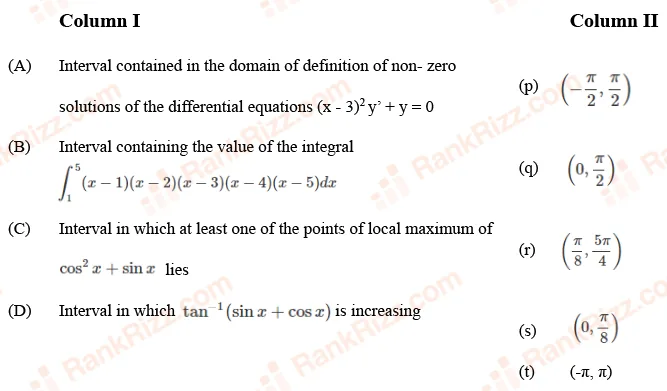
Match the statements/ expressions in Column I with the open intervals in Column- II
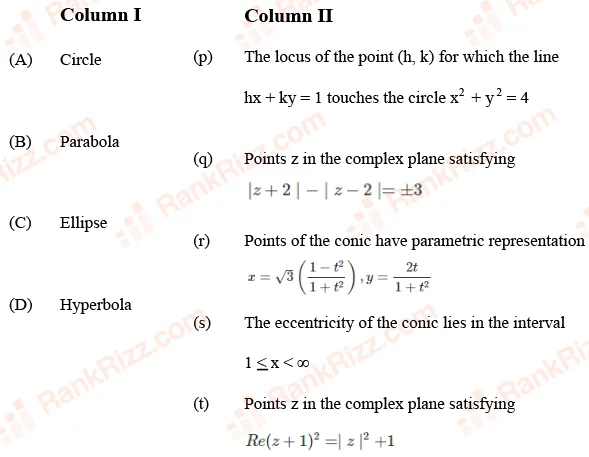
Match the conics in Column I with the statements/ expressions in Column- II
A block of base 10 cm 10 cm and height 15 cm is kept on an inclined plane. The coefficient of friction between them is . The inclination of this inclined plane from the horizontal plane is gradually increased from . Then
at , the block will start sliding down the plane
the block will remain at rest on the plane up to certain and then it will topple
at , the block will start sliding down the plane and continue to do so at higher angles
at , the block will start sliding down the plane and on further increasing , it will topple at certain
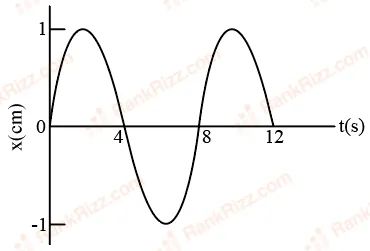
The x-t graph of a particle undergoing simple harmonic is shown below. The acceleration of the particle at is-
Three concentric metallic spherical shells of radii R, 2R, 3R are given charges respectively. It is found that the surface charge densities on the outer surfaces of the shells are equal. Then, the ratio of the charges given to the shells, is-
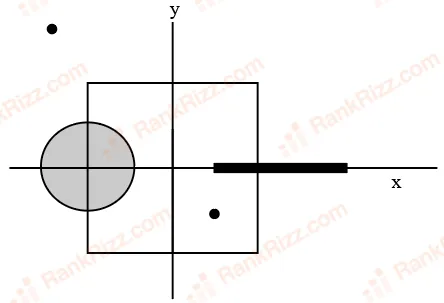
A disk of radius having a uniformly distributed charge 6C is placed in the x-y plane with its centre at . A rod of length 'a' carrying a uniformly distributed charge 8C is placed on the x-axis from to . Two point charges -7C and 3C are placed at and respectively. Consider a cubical surface formed by six surfaces . The electric flux this cubical surface is-
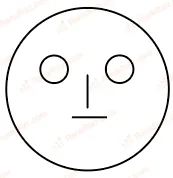
Look at the drawing given in the figure which has been drawn with ink of uniform linethickness. The mass of ink used to draw each of the two inner circles, and each of the two lines segments is m. The mass of the ink used to draw the outer circle is 6m. The coordinates of the centres of the different parts are : outer circle (0, 0), left inner circle (-a, a), right inner circle (a, a), vertical line (0, 0) and horizontal line (0, -a). The y-coordinate of the centre of mass of the ink in this drawing is-
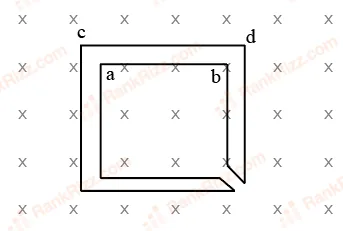
The figure shows certain wire segments joined together to form a coplanar loop. The loop is placed in a perpendicular magnetic field in the direction going into the plane of the figure. The magnitude of the field increases with time. I1 and I2 are the currents in the segments ab and cd. Then
I_1 > I_2
I_1 < I_2
is in the direction ba and is in the direction cd
is in the direction ab and is in the direction dc
A ball is dropped from a height of 20 m above the surface of water in a lake. The refractive index of water is . A fish inside the lake, in the line of fall of the ball, is looking at the ball. At an instant, when the ball is 12.8 m above the water surface, the fish sees the speed of ball as-
9 m/s
12 m/s
16 m/s
21.33 m/s
Two small particles of equal masses start moving in opposite directions from a point A in a horizontal circular orbit. Their tangential velocities are v and 2v, respectively, as shown in the figure. Between collisions, the particles move with constant speeds. After making how many collisions, other than that at A, these two particles will again reach the point A ?
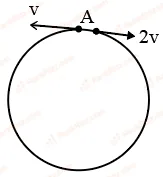
4
3
2
1
For the circuit shown in the figure
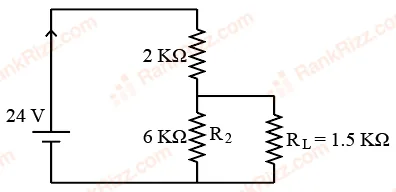
the current I through the battery is 7.5 mA
the potential difference across is 18 V
ratio of powers dissipated in and is 3
if and are interchanged, magnitude of the power dissipated in , will decrease by a factor of 9.
If the resultant of all the external forces acting on a system of particles is zero, then from an inertial frame, one can surely say that
linear momentum of the system does not change in time
kinetic energy of the system does not change in time
angular momentum of the system does not change in time
potential energy of the system does not change in time
A student performed the experiment of determination of focal length of a concave mirror by u-v method using an optical bench of length 1.5 meter. The focal length of the mirror used is 24 cm. The maximum error in the location of the image can be 0.2 cm. The 5 sets of (u, v) values recorded by the student (in cm) are : (42, 56), (48, 48), (60, 40), (66, 33), (78, 39). The data set(s) that cannot come from experiment and is(are) incorrectly recorded, is (are)
(42, 56)
(48, 48)
(66, 33)
(78, 39)
and denote the molar specific heat capacities of a gas at constant volume and constant pressure, respectively. Then
is larger for a diatomic ideal gas than for a monoatomic ideal gas
is larger for a diatomic ideal gas than for a monoatomic ideal gas
is larger for a diatomic ideal gas than for a monoatomic ideal gas
is larger for a diatomic ideal gas than for a monoatomic ideal gas
In the core of nuclear fusion reactor, the gas becomes plasma because of -
Strong nuclear force acting between the deuterons
Coulomb force acting between the deuterons
Coulomb force acting between deuteron-electron pairs
the high temperature maintained inside the reactor core
Assume that two deuteron nuclei in the core of fusion reactor at temperature T are moving towards each other, each with kinetic energy 1.5 kT, when the separation between them is large enough to neglect Coulomb potential energy. Also neglect any interaction from other particles in the core. The minimum temperature T required for them to reach a separation of m is in the range-
1.0 \times 10^9 K < T < 2.0 \times 10^9 K
2.0 \times 10^9 K < T < 3.0 \times 10^9 K
3.0 \times 10^9 K < T < 4.0 \times 10^9 K
4.0 \times 10^9 K < T < 5.0 \times 10^9 K
Results of calculations for four different designs of a fusion reactor using D-D reaction are given below. Which of these is most promising based on Lawson criterion ?
deuteron density = , confinement time = s
deuteron density = , confinement time = s
deuteron density = , confinement time = s
deuteron density = , confinement time = s
The allowed energy for the particle for a particular value of n is proportional to -
If the mass of the particle is kg and a = 6.6 nm, the energy of the particle in its ground state is closest to -
0.8 meV
8 meV
80 meV
800 meV
The speed of the particle, that can take discrete values, is proportional to -
n
Six point charges, each of the same magnitude q, are arranged in different manners as shown in Column II. In each case, a point M and a line PQ passing through M are shown. Let E be the electric field and V be the electric potential at M (potential at infinity is zero) due to the given charge distribution when it is at rest. Now, the whole system is set into rotation with a constant angular velocity about the line PQ. Let B be the magnetic field at M and be the magnetic moment of the system in this condition. Assume each rotating charge to be equivalent to a steady current.
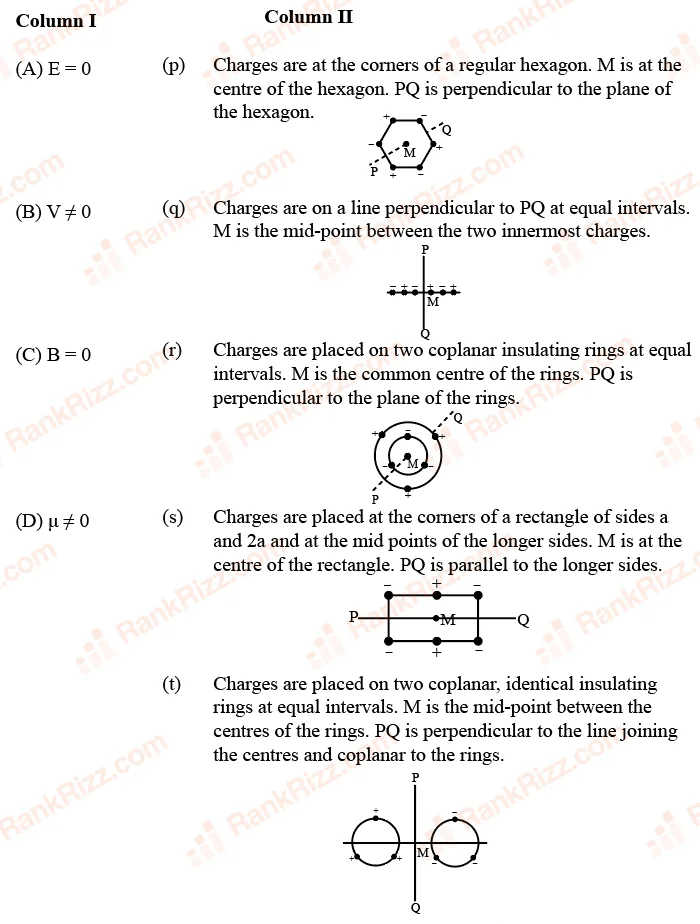
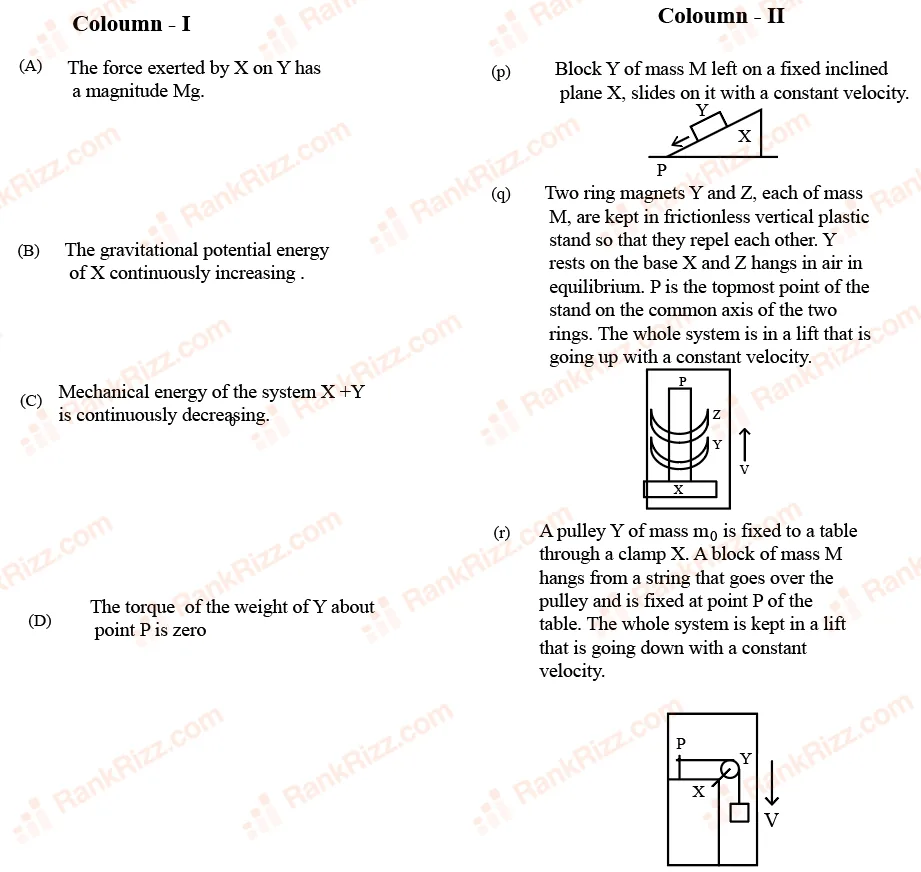
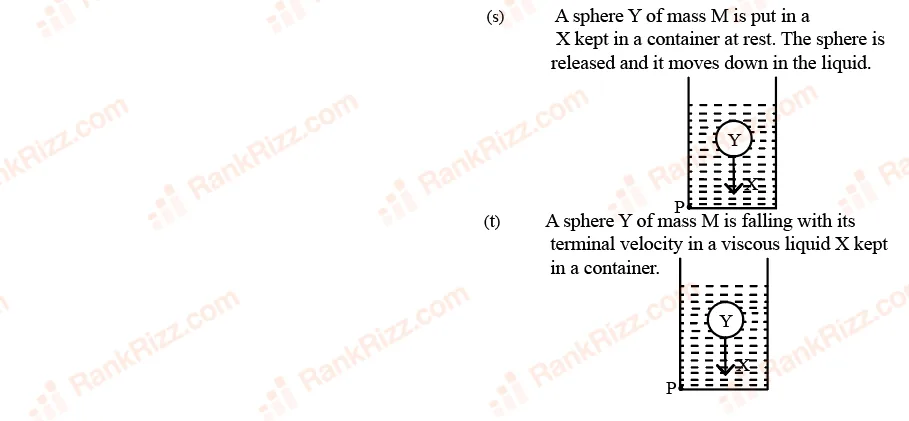
Column II shows five systems in which two object are labelled as X and Y. Also in each case a point P is shown. Column I gives some statements about X and/or Y. Match these statements to the appropriate system(s) from Column II.