JEE Advanced 2007 Physics question — RC circuits: charging and discharging
A circuit is connected as shown in the figure with the switch S open. When the switch is closed, the total amount of charge that flows from Y to X is
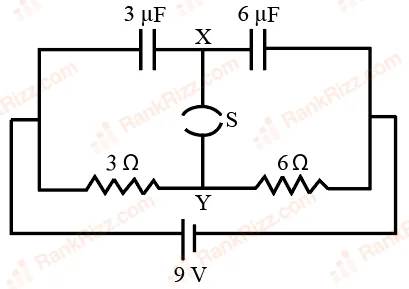
SOLUTION
Step 1: Initial State (Switch Open)
Let and be the charge and voltage on capacitor . Let and be the charge and voltage on capacitor .
When the switch is open, the two capacitors are connected in series. This means that the charge stored on each capacitor is the same. So, .
The voltages on the capacitors add up to the battery voltage:
The charges and voltages on capacitors in series also follow this equation: This means the charge on each capacitor is the same since and .
Solving these two equations gives:
- ,
- ,
Total charge on the side connected to is . No net charge has moved yet.
Step 2: After Closing the Switch
When the switch is closed, the resistors and are connected in series with the capacitors and battery.
Total resistance is .
The current from the battery is:
The voltage drop across each resistor is:
The new charges on the capacitors are:
Final Calculation
The total charge on the plates connected to is now .
This means that of charge flows from to when the switch is closed.
Tagged RC circuits: charging and discharging. Machine-assigned, so read it as a strong shortlist rather than a verdict.