JEE Advanced 2015 Chemistry question — Reactions of phenols
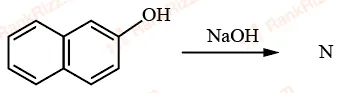
The number of resonance structures for N is
SOLUTION
NaOH removes the phenolic proton of -naphthol, so N is the -naphthoxide (2-naphthoxide) ion. The ring carbons are numbered C-1 to C-8 with fusion carbons C-4a and C-8a; the oxygen is on C-2.
With the negative charge on oxygen, the rings take each of the three Kekulé arrangements of naphthalene: double bonds C1=C2, C3=C4, C4a=C8a, C5=C6, C7=C8; or C1=C8a, C2=C3, C4=C4a, C5=C6, C7=C8; or C1=C2, C3=C4, C4a=C5, C6=C7, C8=C8a. This gives 3 structures.
With at C-2, the negative charge can sit only on a carbon an odd number of bonds away from C-2: C-1, C-3, C-4a, C-6 or C-8. The remaining eight carbons then pair into four C=C bonds.
Charge on C-1: C3=C4, C4a=C8a, C5=C6, C7=C8, or C3=C4, C4a=C5, C6=C7, C8=C8a, which gives 2 structures.
Charge on C-3: C1=C8a, C4=C4a, C5=C6, C7=C8 (1 structure). Charge on C-4a: C1=C8a, C3=C4, C5=C6, C7=C8 (1 structure). Charge on C-6: C1=C8a, C3=C4, C4a=C5, C7=C8 (1 structure). Charge on C-8: C1=C8a, C3=C4, C4a=C5, C6=C7 (1 structure).
The carbanion forms number , so the total is .
Hence, the answer is 9.
Tagged Reactions of phenols. Machine-assigned, so read it as a strong shortlist rather than a verdict.