JEE ADVANCED 2014 · PAPER 1+3MEDIUMTRANSCRIBED
JEE Advanced 2014 Chemistry question — Reactions of phenols
he reactivity of compound Z with different halogens under appropriate conditions is given below:
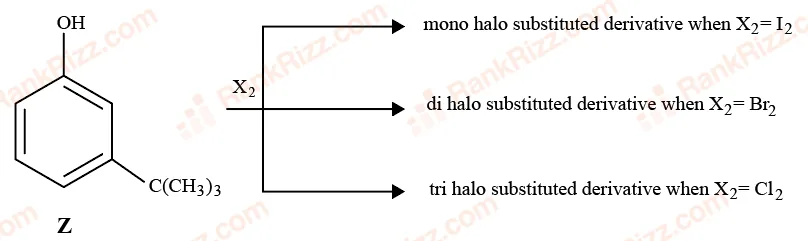
The observed pattern of electrophilic substitution can be explained by
SOLUTION
Key idea: The OH group activates the ring and directs substitution to positions 2, 4 and 6 (an electronic effect). How many of those sites actually react depends on crowding by the bulky tert-butyl group at C-3 and on the size of the halogen.
In 3-tert-butylphenol, the ortho/para sites are C-2, C-4 and C-6.
- C-6 is far from t-Bu and is substituted by every halogen.
- C-4 and especially C-2 sit next to the bulky t-Bu group (a steric effect of t-Bu).
- The small Cl atom reaches all three sites (tri), Br reaches two (di), and the large I atom reaches only one (mono). This is the steric effect of the halogen.
- The ortho/para pattern and the high reactivity come from the electronic (+M) effect of the phenolic OH. The t-Bu group's weak +I effect does not explain the pattern.
Answer: (A), (B), (C)
Tagged Reactions of phenols. Machine-assigned, so read it as a strong shortlist rather than a verdict.