RankRizz

JEE Advanced 2026 Paper 2: Chemistry

The 18 Chemistry questions of JEE Advanced 2026 Paper 2, numbered across the whole paper. Pick an answer on any question to check it against the key. Free to read, nothing to download.

Chemistry

Q19Conductance, conductivity and molar conductivityTRANSCRIBED

At 300 K, the molar conductivities of the aqueous solutions of three salts at two different concentrations are given below:
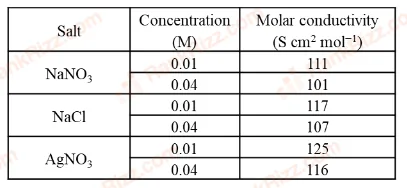
Figure for JEE Advanced 2026 Chemistry question on Conductance, conductivity and molar conductivity

The conductivity of a saturated aqueous solution of AgCl is 1.40×10−61.40\times 10^{-6} S cm−1^{-1} at 300 K. If the solubility of AgCl in water at 300 K is XX mol L−1^{-1}, then log⁡10(X−1)\log_{10}(X^{-1}) is

(Assume that AgCl dissolved in water ionizes completely and that the molar conductivity of saturated AgCl solution is equal to its limiting molar conductivity.)

  1. A

    33

  2. B

    44

  3. C

    55

  4. D

    66

Q20VSEPR theory and shapes of molecules and ionsTRANSCRIBED

The correct order of ONO bond angle in the given species is

  1. A

    NO2+<NO2<NO3−<NO2−\mathrm{NO_2^{+}} < \mathrm{NO_2} < \mathrm{NO_3^{-}} < \mathrm{NO_2^{-}}

  2. B

    NO2−<NO3−<NO2<NO2+\mathrm{NO_2^{-}} < \mathrm{NO_3^{-}} < \mathrm{NO_2} < \mathrm{NO_2^{+}}

  3. C

    NO3−<NO2−<NO2<NO2+\mathrm{NO_3^{-}} < \mathrm{NO_2^{-}} < \mathrm{NO_2} < \mathrm{NO_2^{+}}

  4. D

    NO2−<NO3−<NO2+<NO2\mathrm{NO_2^{-}} < \mathrm{NO_3^{-}} < \mathrm{NO_2^{+}} < \mathrm{NO_2}

Q21Nucleophilic addition reactions of carbonyl compoundsTRANSCRIBED

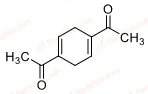
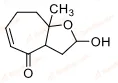
Natural rubber on complete ozonolysis (O3\mathrm{O_3}/Zn-H2O\mathrm{H_2O}) gives compound X as the major product. X gives positive iodoform and Tollen's tests. X on heating with aqueous NaOH gives Y as the major product. Y is

  1. A
    Figure for JEE Advanced 2026 Chemistry question on Nucleophilic addition reactions of carbonyl compounds
  2. B
    Figure for JEE Advanced 2026 Chemistry question on Nucleophilic addition reactions of carbonyl compounds
  3. C
    Figure for JEE Advanced 2026 Chemistry question on Nucleophilic addition reactions of carbonyl compounds
  4. D
    Figure for JEE Advanced 2026 Chemistry question on Nucleophilic addition reactions of carbonyl compounds
Q22Carbohydrates: classification and monosaccharidesTRANSCRIBED

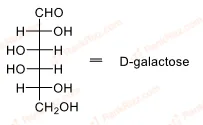
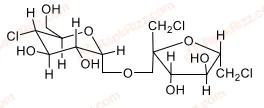
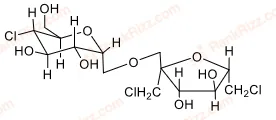
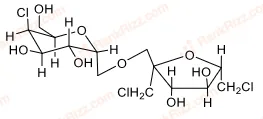
A known artificial sweetener X is composed of 4-chloro-4-deoxy-α\alpha-D-galactose and 1,6-dichloro-1,6-dideoxy-β\beta-D-fructose joined by a glycosidic linkage. Structure of D-galactose is given below (Fischer projection):

Figure for JEE Advanced 2026 Chemistry question on Carbohydrates: classification and monosaccharides

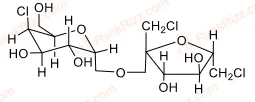
The correct structure of X is

  1. A
    Figure for JEE Advanced 2026 Chemistry question on Carbohydrates: classification and monosaccharides
  2. B
    Figure for JEE Advanced 2026 Chemistry question on Carbohydrates: classification and monosaccharides
  3. C
    Figure for JEE Advanced 2026 Chemistry question on Carbohydrates: classification and monosaccharides
  4. D
    Figure for JEE Advanced 2026 Chemistry question on Carbohydrates: classification and monosaccharides
Q23Integrated rate laws and half-life (zero and first order)TRANSCRIBED

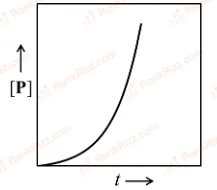
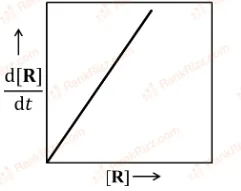
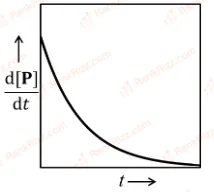
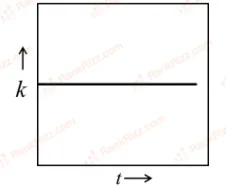
For a first-order reaction R→P\mathrm{R}\rightarrow\mathrm{P} at a given temperature, kk is the rate constant. For this reaction, at the given temperature, the concentrations of R\mathrm{R} and P\mathrm{P} at a time tt are [R][\mathrm{R}] and [P][\mathrm{P}], respectively. The correct graphical representation(s) for this reaction is(are)

  1. A
    Figure for JEE Advanced 2026 Chemistry question on Integrated rate laws and half-life (zero and first order)
  2. B
    Figure for JEE Advanced 2026 Chemistry question on Integrated rate laws and half-life (zero and first order)
  3. C
    Figure for JEE Advanced 2026 Chemistry question on Integrated rate laws and half-life (zero and first order)
  4. D
    Figure for JEE Advanced 2026 Chemistry question on Integrated rate laws and half-life (zero and first order)
Q24Group 18: noble gases and xenon compoundsTRANSCRIBED

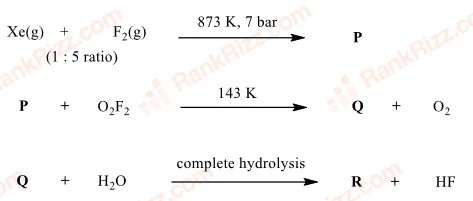
Correct statement(s) about the compounds P, Q and R is(are)

Figure for JEE Advanced 2026 Chemistry question on Group 18: noble gases and xenon compounds
  1. A

    P\mathbf{P} has two lone pairs of electrons on the central atom.

  2. B

    Q\mathbf{Q} has a perfect octahedral geometry.

  3. C

    Q\mathbf{Q} can act as a fluorinating agent.

  4. D

    The molecular structure of R\mathbf{R} is trigonal pyramidal.

Q25Modern periodic table and classification of elementsTRANSCRIBED

The correct statement(s) regarding the periodic properties of elements is(are)

  1. A

    Second ionization enthalpy of carbon atom is less than that of boron atom.

  2. B

    Increasing order of ionic radii: Al3+<Mg2+<Na+\mathrm{Al^{3+}} < \mathrm{Mg^{2+}} < \mathrm{Na^{+}}

  3. C

    Under identical conditions, in solid state, the density of potassium metal is more than density of sodium metal.

  4. D

    The H−-H bond is weaker than F−-F bond.

Q26Diazonium saltsTRANSCRIBED

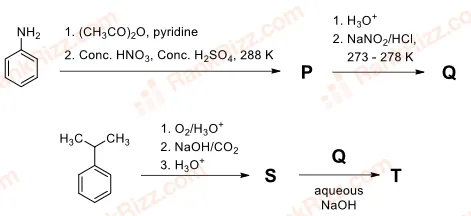
In the following reaction sequence, P, Q, S and T are the major products.

Figure for JEE Advanced 2026 Chemistry question on Diazonium salts

The correct statement(s) about P, Q, S and T is(are)

  1. A

    Q\mathbf{Q} on treatment with ethanol generates an aromatic aldehyde.

  2. B

    S\mathbf{S} gives positive phthalein dye test.

  3. C

    P\mathbf{P} is a dinitro compound.

  4. D

    T\mathbf{T} is a coloured compound.

Q27Carbohydrates: classification and monosaccharidesTRANSCRIBED

The correct statement(s) regarding sugars is(are)

Given: Specific rotations of L-(−-)-glucose and L-(+)-fructose are −52.5∘-52.5^\circ and +92.5∘+92.5^\circ, respectively.

  1. A

    On treatment with HNO3\mathrm{HNO_3}, gluconic acid is oxidized to saccharic acid, whereas glucose is not oxidized to saccharic acid.

  2. B

    Fructose gives a positive Fehling's test because it isomerises to glucose and another aldohexose in the presence of Fehling's reagent.

  3. C

    Invert sugar is an equimolar mixture of D-glucose and D-fructose formed after hydrolysis of the corresponding disaccharide.

  4. D

    Specific rotation of invert sugar is −40∘-40^\circ.

Q28Hydrogen spectrum and spectral seriesTRANSCRIBED

Xa+\mathbf{X}^{a+} and Yb+\mathbf{Y}^{b+} are hydrogen-like species. The wavelength of light absorbed during the transition between the states with principal quantum numbers n=1n=1 and n=2n=2 of Xa+\mathbf{X}^{a+} is λ\lambda. The wavelength of light absorbed during the transition between the states with principal quantum numbers n=2n=2 and n=4n=4 of Yb+\mathbf{Y}^{b+} is 9λ9\lambda. The lowest possible value of (a+b)(a+b) is ___.

Q29Adsorption and adsorption isothermsTRANSCRIBED

At a given temperature, 0.45 g of acetic acid in 50 mL of water is shaken with 1.0 g of charcoal and the pH of the resulting solution is 3.0. Assume, the adsorption of acetic acid from the aqueous solution by charcoal follows Freundlich isotherm,

xm=kC1/n\dfrac{x}{m}=kC^{1/n}

If the plot of log⁡10(x/m)\log_{10}(x/m) against log⁡10C\log_{10}C gives a straight line with slope 1, the value of kk in L mol−1^{-1} is ___.

Given: The molar mass of acetic acid is 60 g mol−1^{-1}.
The acid dissociation constant of acetic acid is 1.0×10−51.0\times 10^{-5} at the given temperature.
xx is the mass (in grams) of acetic acid adsorbed. mm is the mass (in grams) of charcoal.
CC is the equilibrium concentration of acetic acid in the solution after the adsorption is complete.
kk and nn are constants for acetic acid−-charcoal system at the given temperature.

Q30Abnormal molar mass and van't Hoff factorTRANSCRIBED

In a solvent S, a compound B is partially dissociated into C and D as given below:

B⇌2C+2D\mathbf{B}\rightleftharpoons 2\mathbf{C}+2\mathbf{D}

B, C and D are non-volatile in nature. The molar mass of B is 10 times the molar mass of S. The standard boiling point and the standard enthalpy of vaporization of S are 400 K and 10R10R J mol−1^{-1}, respectively (RR is the gas constant in J K−1^{-1} mol−1^{-1}). A solution of B in S with an initial concentration of B as 0.25% (mass/mass) has a boiling point of 408 K at 1 bar pressure. In this solution, the mole percent of B that has been dissociated is ___.

Q31Geometrical and optical isomerism in complexesTRANSCRIBED

Consider that the coordinating atoms of the ligands in cis-[Co(NH3_3)4_4Cl2_2]Cl and mer-[Co(NH3_3)3_3Cl3_3] octahedral complexes are at the vertices of an octahedron. The sum of total number of the triangular faces in both the complexes having one N atom and two Cl atoms at their corners is ___.

Q32Important polymers and their monomersTRANSCRIBED

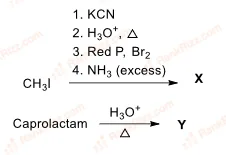
In the following reaction sequence, major products X and Y are acyclic monomers.

Figure for JEE Advanced 2026 Chemistry question on Important polymers and their monomers

500 mol of X completely reacts with 500 mol of Y to give 1 mol of a single biodegradable acyclic copolymer Z as the only product. The amount of Z formed in grams is ___.

Given: Atomic mass (in amu): H : 1, C : 12, N : 14, O : 16, Br : 80

Q33Raoult's law, ideal and non-ideal solutionsTRANSCRIBED

Question Stem (Q15 & Q16): Two volatile liquids A and B form an ideal solution. Consider a 5 molal solution of B in A inside a closed container having a total vapour pressure of 100 mm Hg at 300 K. The vapour pressure of pure A at 300 K is 105 mm Hg. Assume that A and B behave as ideal gases in the vapour phase.

Given: The gas constant R=0.08R=0.08 L atm K−1^{-1} mol−1^{-1};
Molar mass of A is 50 g mol−1^{-1};
Molar mass of B is 57 g mol−1^{-1};
Density of liquid B at 300 K is 0.5 g/mL; 1 atm =760=760 mm Hg.

At 300 K, the ratio of the molar volume of pure B in vapour phase to its molar volume in liquid phase is ___.

Q34Raoult's law, ideal and non-ideal solutionsTRANSCRIBED

Question Stem (Q15 & Q16): Two volatile liquids A and B form an ideal solution. Consider a 5 molal solution of B in A inside a closed container having a total vapour pressure of 100 mm Hg at 300 K. The vapour pressure of pure A at 300 K is 105 mm Hg. Assume that A and B behave as ideal gases in the vapour phase.

Given: The gas constant R=0.08R=0.08 L atm K−1^{-1} mol−1^{-1};
Molar mass of A is 50 g mol−1^{-1};
Molar mass of B is 57 g mol−1^{-1};
Density of liquid B at 300 K is 0.5 g/mL; 1 atm =760=760 mm Hg.

The mole fraction of B in vapour phase which is in equilibrium with this solution is ___.

Q35Titrimetric exercisesTRANSCRIBED

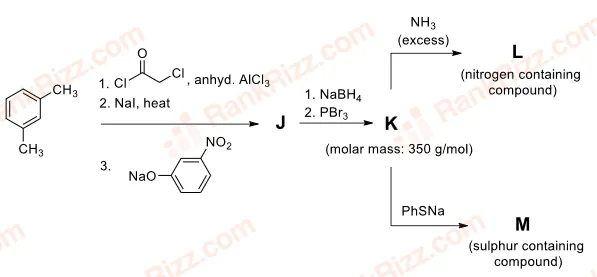
Question Stem (Q17 & Q18): Consider the following reaction sequence in which J, K, L and M are the major products.

Figure for JEE Advanced 2026 Chemistry question on Titrimetric exercises

Given: Atomic mass (in amu): H : 1, C : 12, N : 14, O : 16, S : 32, Br : 80, Ba : 137

The volume of 1 M aqueous H2SO4\mathrm{H_2SO_4} required to completely neutralize the ammonia evolved from 5.72 g of L in Kjeldahl's method of nitrogen estimation is ___ mL.

Q36Quantitative estimation of elementsTRANSCRIBED

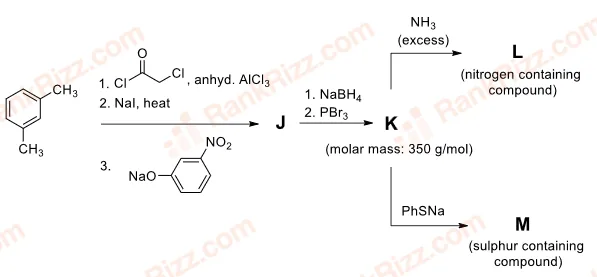
Question Stem (Q17 & Q18): Consider the following reaction sequence in which J, K, L and M are the major products.

Figure for JEE Advanced 2026 Chemistry question on Quantitative estimation of elements

Given: Atomic mass (in amu): H : 1, C : 12, N : 14, O : 16, S : 32, Br : 80, Ba : 137

In sulphur estimation by Carius method, the amount of BaSO4\mathrm{BaSO_4} formed from 3.79 g of M is ___ g.

NEXT IN THIS PAPER →Maths, Q37 onwards