RankRizz

JEE Advanced 2019 Paper 1: Chemistry

The 18 Chemistry questions of JEE Advanced 2019 Paper 1, numbered across the whole paper. Pick an answer on any question to check it against the key. Free to read, nothing to download.

Chemistry

Q19Preliminary and dry testsTRANSCRIBED

The green colour produced in the borax beadtest of a chromium(III) salt is due to

  1. A

    Cr(BO2)3Cr(BO_2)_3

  2. B

    Cr2(B4O7)3Cr_2(B_4O_7)_3

  3. C

    Cr2O3Cr_2O_3

  4. D

    CrB

Q20Occurrence of metals: minerals and oresTRANSCRIBED

Calamine, malachite, magnetite and cryolite, respectively, are

  1. A

    ZnSO4,CuCO3,Fe2O3,AlF3ZnSO_4, CuCO_3, Fe_2O_3, AlF_3

  2. B

    ZnSO4,Cu(OH)2,Fe304,,Na3AlF6ZnSO_4, Cu(OH)_2, Fe_30_4,, Na_3AlF_6

  3. C

    ZnCO3,CuCO3.Cu(OH)2,Fe3O4,Na3AlF6ZnCO_3, CuCO_3.Cu(OH)_2, Fe_3O_4, Na_3AlF_6

  4. D

    ZnCO3,CuCO3,Fe2O3,Na3AlF6ZnCO_3, CuCO_3, Fe_2O_3, Na_3AlF_6

Q21Conductance, conductivity and molar conductivityTRANSCRIBED

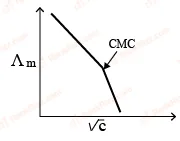
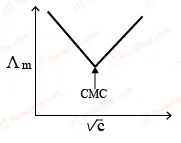
Molar conductivity (∧m)(\wedge_m) of aqueous solution of sodium stearate, which behaves as a strong electrolyte, is recorded at varying concentrations (c) of sodium stearate. Which oneofthe following plots provides the correct representation of micelle formation in the solution?
(critical micelle concentration (CMC) is marked with an arrow in the figures
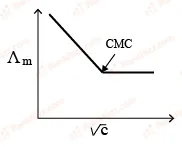
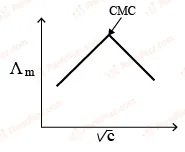
  1. A
    Figure for JEE Advanced 2019 Chemistry question on Conductance, conductivity and molar conductivity
  2. B
    Figure for JEE Advanced 2019 Chemistry question on Conductance, conductivity and molar conductivity
  3. C
    Figure for JEE Advanced 2019 Chemistry question on Conductance, conductivity and molar conductivity
  4. D
    Figure for JEE Advanced 2019 Chemistry question on Conductance, conductivity and molar conductivity
Q22Reactions of carboxylic acidsTRANSCRIBED

The correct order of acid strength of the following carboxylic acids is
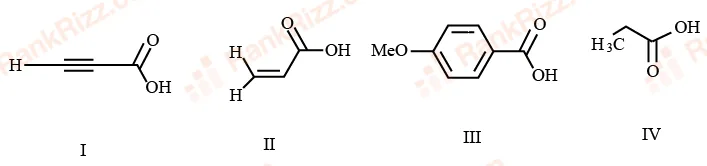
Figure for JEE Advanced 2019 Chemistry question on Reactions of carboxylic acids
  1. A

    III > II > I > IV

  2. B

    I > II > III > IV

  3. C

    I > III > II > IV

  4. D

    II > I > IV > III

Q23Oxides of carbon, silica, silicones and silicatesTRANSCRIBED

A tin chloride Q undergoes the following reactions (not balanced)
Q+Cl−→XQ + Cl^- \rightarrow X
Q+Me3N→YQ + Me_3N \rightarrow Y
Q+CuCl2→Z+CuClQ + CuCl_2 \rightarrow Z + CuCl
X is a monoanion having pyramidal geometry. Both Y and Z are neutral compounds. Choose the correct option(s)

  1. A

    The central atom in X is sp3sp^3 hybridized

  2. B

    There is a coordinate bond in Y

  3. C

    The oxidation state of the central atom in Z is +2

  4. D

    The central atom in Z has one lone pair of electrons

Q24Potassium dichromate and potassium permanganateTRANSCRIBED

Fusion of MnO2MnO_2 with KOH in presence of O2O_2 produces a salt W. Alkaline solution of W upon electrolytic oxidation yields another salt X. The manganese containing ions present in W and X, respectively, are Y and Z. Correct statement(s) is (are)

  1. A

    In aqueousacidic solution, Y undergoes disproportionation reaction to give Z and MnO2MnO_2

  2. B

    Both Y and Z are coloured and have tetrahedral shape

  3. C

    Y is diamagnetic in nature while Z is paramagnetic

  4. D

    In both Y and Z, π−\pi-bonding occurs between p-orbitals of oxygen and d-orbitals of manganese

Q25Enthalpies of reaction and Hess's lawTRANSCRIBED

Choose the reaction(s) from the following options, for which the standard enthalpy of reaction is equal to the standard enthalpy of formation.

  1. A

    2H2(g)+O2(g)→2H2O(l)2H_2(g) + O_2(g) \rightarrow 2H_2O (l)

  2. B

    2C(g)+3H2(g)→C2H6(g)2C(g) + 3H_2(g) \rightarrow C_2H_6(g)

  3. C

    32O2(g)→O3(g)\frac{3}{2} O_2(g) \rightarrow O_3(g)

  4. D

    18S8(s)+O2(g)→SO2(g)\frac{1}{8}S_8(s) + O_2 (g) \rightarrow SO_2(g)

Q26Kinetic theory of gases and molecular speedsTRANSCRIBED

Which of the following statement(s) is (are) correct regarding the root mean square speed (μrms)(\mu_{rms}) and average translational kinetic energy (ϵav)(\epsilon_{av}) of a molecule in a gas at equilibrium ?

  1. A

    (μrms)(\mu_{rms}) is doubled when its temperature is increased four times

  2. B

    (ϵav)(\epsilon_{av}) is doubled when its temperature is increased four times

  3. C

    (ϵav)(\epsilon_{av}) at a given temperature does not depend on its molecular mass

  4. D

    (μrms)(\mu_{rms}) is inversely proportional to the square rootof its molecular mass

Q27Dipole moment and molecular polarityTRANSCRIBED

Each of the following options contains a set of four molecules. Identify the option(s) where all four molecules possess permanent dipole moment at room temperature.

  1. A

    BeCl2,CO2,BCl3,CHCl3BeCl_2, CO_2, BCl_3, CHCl_3

  2. B

    NO2,NH3,POCl3,CH3ClNO_2, NH_3, POCl_3, CH_3Cl

  3. C

    BF3,O3,SF6,XeF6BF_3, O_3, SF_6, XeF_6

  4. D

    SO2,C6H5Cl,H2Se,BrF5SO_2, C_6H_5Cl, H_2Se, BrF_5

Q28Radioactivity and nuclear reactionsTRANSCRIBED

In the decay sequence

Figure for JEE Advanced 2019 Chemistry question on Radioactivity and nuclear reactions


X1,X2,X3andX4X_1, X_2, X_3 and X_4 are particles/radiation emitted by the respective isotopes. The correct option(s) is(are)

  1. A

    x1x_1 will deflect towards negatively charged plate

  2. B

    x2isβ−x_2 is \beta^-

  3. C

    x3isγx_3 is \gamma-ray

  4. D

    Z is an isotope of uranium

Q29Carbohydrates: classification and monosaccharidesTRANSCRIBED

Which of the following statement(s) is (are) true?

  1. A

    Monosaccharides cannot be hydrolysed to give polyhydroxy aldehydes and ketones

  2. B

    Oxidation of glucose with bromine water gives glutamic acid

  3. C

    Hydrolysis of sucrose gives dextrorotatory glucose and laevorotatory fructose

  4. D

    The two six-membered cyclic hemiacetal forms of D-(+)-glucose are called anomers

Q30Electrophilic addition to alkenesTRANSCRIBED

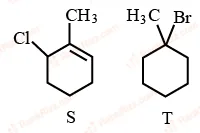
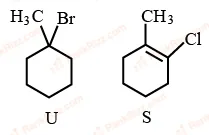
Choose the correct option(s) for the following set of reactions
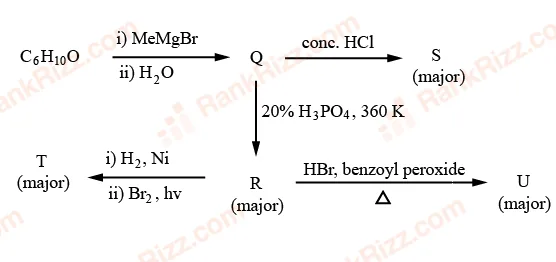
Figure for JEE Advanced 2019 Chemistry question on Electrophilic addition to alkenes
  1. A
    Figure for JEE Advanced 2019 Chemistry question on Electrophilic addition to alkenes
  2. B
    Figure for JEE Advanced 2019 Chemistry question on Electrophilic addition to alkenes
  3. C
    Figure for JEE Advanced 2019 Chemistry question on Electrophilic addition to alkenes
  4. D
    Figure for JEE Advanced 2019 Chemistry question on Electrophilic addition to alkenes
Q31Phosphorus and its compoundsTRANSCRIBED

Among B2H6,B3N3H6,N2O,N2O4,H2S2O3andH2S2O8B_2H_6, B_3N_3H_6, N_2O, N_2O_4, H_2S_2O_3 and H_2S_2O_8, the total number of molecules containing covalent bond between two atoms of the same kind is ___________

Q32Group 18: noble gases and xenon compoundsTRANSCRIBED

At 143 K,the reaction of XeF4XeF_4 with O2F2O_2F_2 produces a xenon compound Y. The total number of lone pair(s) of electrons present on the whole molecule of Y is

Q33Law of mass action and equilibrium constants Kc and KpTRANSCRIBED

For the following reaction, the equilibrium constant K_ at 298 K is 1.6×10171.6 \times 10^{17}
Fe2+(aq)+S2−(aq)⇌FeS(s)Fe^{2+} (aq) + S^{2-} (aq) \rightleftharpoons FeS (s)
When equal volumes of 0.06 M Fe2+Fe^{2+} (aq) and 0.2MS2−(aq)0.2 M S^{2-}(aq) solutions are mixed, the equilibrium concentration of Fe2+Fe^{2+} (aq) is found to be Y×10−17MY \times 10^{-17} M. The value of Y is _________ .

Q34Depression in freezing pointTRANSCRIBED

On dissolving 0.5 g of a non-volatile non-ionic solute to 39 g of benzene, its vapor pressure decreases from 650 mm Hg to 640 mm Hg. The depression of freezing point of benzene (in K) upon addition of the solute is ___________ .
(Given data: Molar mass and the molal freezing point depression constant of benzene are 78gmol−1and5.12Kkgmol−178 g mol^{-1} and 5.12 K kg mol^{-1} respectively)

Q35Rate law, order and molecularityTRANSCRIBED

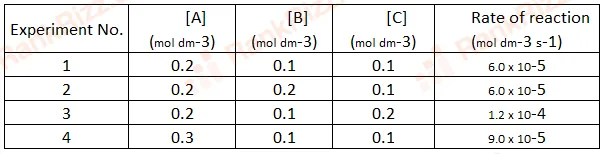
Consider the kinetic data given in the following table for the reaction A + B + C →\rightarrow Product.

Figure for JEE Advanced 2019 Chemistry question on Rate law, order and molecularity


The rate of the reaction for [A]=0.15moldm−3,[B]=0.25moldm−3and[C]=0.15moldm−3[A] = 0.15 mol dm^{-3}, [B] = 0.25 mol dm^{-3} and [C] = 0.15 mol dm^{-3} is found to be Y×10−5moldm−3s−1Y \times 10^{-5} mol dm^{-3} s^{-1}. The value of Y is _______ .

Q36Diazonium saltsTRANSCRIBED

Schemes 1 and 2 describe the conversion of P to Q and to S, respectively. Scheme 3 describes the synthesis of T from Q and S. The total number of Br atoms in a molecule of T is _________ .
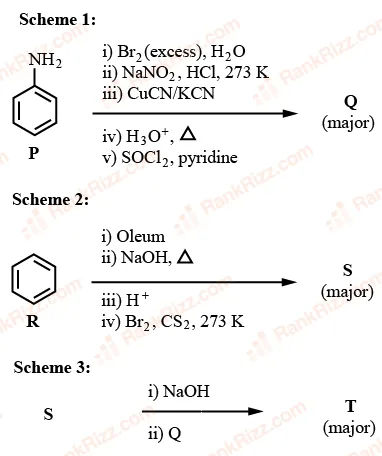
Figure for JEE Advanced 2019 Chemistry question on Diazonium salts
NEXT IN THIS PAPER →Maths, Q37 onwards