Q19Phosphorus and its compoundsTRANSCRIBED
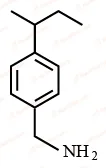
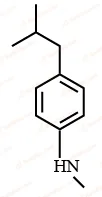
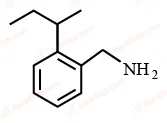
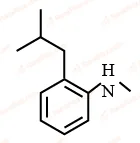
The compound(s) which generate(s) N2 gas upon thermal decomposition below is (are)
- A
- B
- C
- D
The 18 Chemistry questions of JEE Advanced 2018 Paper 1, numbered across the whole paper. Pick an answer on any question to check it against the key. Free to read, nothing to download.
The compound(s) which generate(s) N2 gas upon thermal decomposition below is (are)
The correct statement(s) regarding the binary transition metal carbonyl compounds is (are) (Atomic numbers: Fe = 26, Ni = 28)
Total number of valence shell electrons at metal centre in is 16
These are predominantly low spin in nature
Metal-carbon bond strengthens when the oxidation state of the metal is lowered
The carbonyl C−O bond weakens when the oxidation state of the metal is increased
Based on the compounds of group 15 elements, the correct statement(s) is (are)
is more basic than
is more covalent than
boils at lower temperature than
The N−N single bond is stronger than the P−P single bond
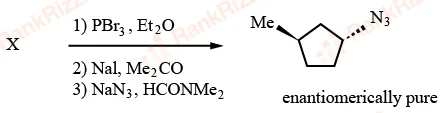
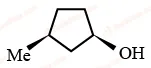
In the following reaction sequence, the correct structure(s) of X is (are)
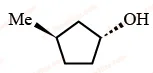
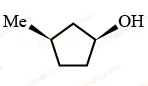
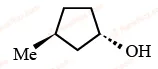
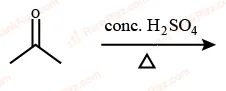
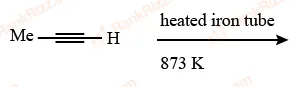
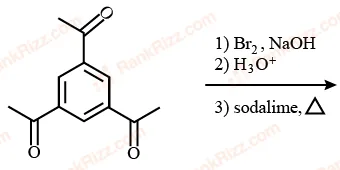
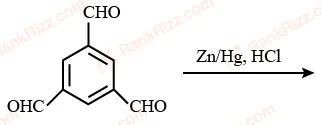
The reaction(s) leading to the formation of 1, 3, 5-trimethylbenzene is (are)
A reversible cyclic process for an ideal gas is shown below. Here, P, V, and T are pressure, volume and temperature, respectively. The thermodynamic parameters q, w, H and U are heat, work, enthalpy and internal energy, respectively.
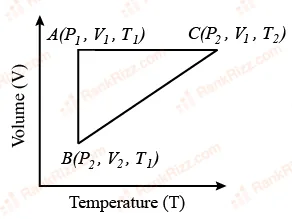
The correct options(s) is (are)
and
and
and
and
Among the species given below, the total number of diamagnetic species is ___
H atom , manometer, (superoxide),dimeric sulphur in vapour phase ,
The ammonia prepared by treating ammonium sulphate with calcium hydroxide is completely used by tp form a stable coordination compound. Assume that both the reactions are 100% complete. If 1584 g of ammonium sulphate and 952 g of are used in the preparation, the combined weight (in grams) of gypsum and the nickel-ammonia coordination compound thus produced is ____
(Atomic weights in g )
Consider an ionic solid MX with NaCl structure. Construct a new structure (Z) whose unit
cell is constructed from the unit cell of MX following the sequential instructions given
below. Neglect the charge balance.
(i) Remove all the anions (X) except the central one
(ii) Replace all the face centered cations (M) by anions (X)
(iii) Remove all the corner cations (M)
(iv) Replace the central anion (X) with cation (M)
The value of in Z is ..........
For the electrochemical cell,
(aq,1M) (aq,1M) the standard emf of the cell is 2.70 V at 300 K. When the concentration of is changed to 𝒙 M, the cell potential changes to 2.67 V at 300 K. The value of 𝒙 is ____.
(given , where F is the Faraday constant and 𝑅 is the gas constant,
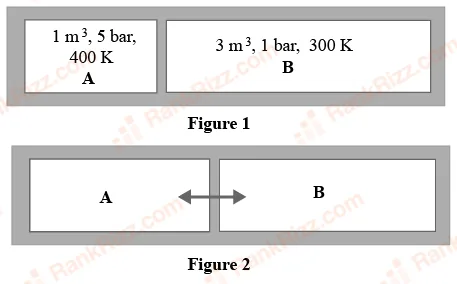
A closed tank has two compartments A and B, both filled with oxygen (assumed to be ideal gas). The partition separating the two compartments is fixed and is a perfect heat insulator (Figure 1). If the old partition is replaced by a new partition which can slide and conduct heat but does NOT allow the gas to leak across (Figure 2), the volume (in ) of the compartment A after the system attains equilibrium is ____.
Liquids A and B form ideal solution over the entire range of composition. At temperature T, equimolar binary solution of liquids A and B has vapour pressure 45 Torr. At the same temperature, a new solution of A and B having mole fractions , respectively, has vapour pressure of 22.5 Torr. The value of in the new solution is ____.
(given that the vapour pressure of pure liquid A is 20 Torr at temperature T)
The solubility of a salt of weak acid (AB) at is The value of Y is ____.(Given that the value of solubility product of and the value of ionization constant of
The plot given below shows 𝑃 − 𝑇 curves (where P is the pressure and T is the temperature) for two solvents X and Y and isomolal solutions of NaCl in these solvents. NaCl completely dissociates in both the solvents.
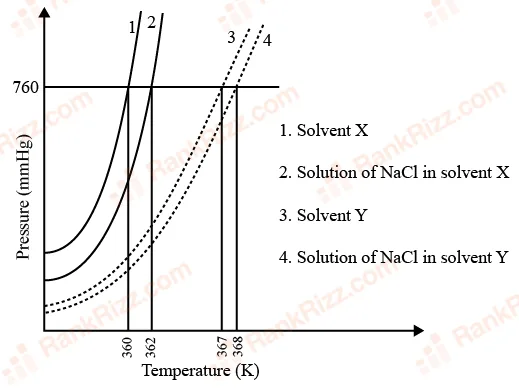
On addition of equal number of moles of a non-volatile solute S in equal amount (in kg) of
these solvents, the elevation of boiling point of solvent X is three times that of solvent Y.
Solute S is known to undergo dimerization in these solvents. If the degree of dimerization is
0.7 in solvent Y, the degree of dimerization in solvent X is ____.
The compound Y is
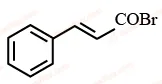
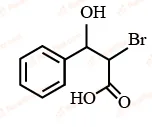
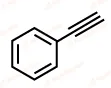
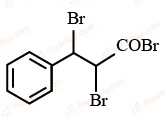
The compound Z is
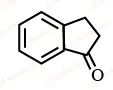
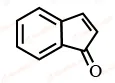
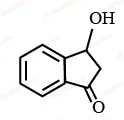
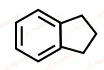
The compound R is
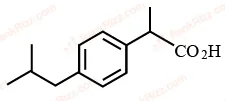
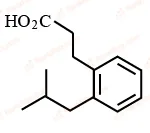
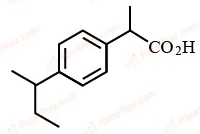
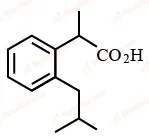
The compound S