RankRizz

JEE Advanced 2015 Paper 2: Maths

The 20 Maths questions of JEE Advanced 2015 Paper 2, numbered across the whole paper. Pick an answer on any question to check it against the key. Free to read, nothing to download.

Maths

Q41De Moivre's theorem and powers of complex numbersTRANSCRIBED

For any integer k, let αk=cos⁡(kπ7)+isin⁡(kπ7),\alpha_k = \cos \left(\frac{k\pi}{7}\right) + i \sin \left(\frac{k\pi}{7}\right), where i=−1.i = \sqrt -1. The value of the expression ∑k=112∣αk+1−αk∣∑k=13∣α4k−1−α4k−2∣\frac{\sum_{k = 1}^{12}|\alpha_{k + 1} - \alpha_k|}{\sum_{k = 1}^{3}|\alpha_{4k - 1} - \alpha_{4k - 2}|} is

Q42Arithmetic progressionTRANSCRIBED

Suppose that all the terms of an arithmetic progression (A.P.) are natural numbers. If the ratio of the sum of the first seven terms to the sum of the first eleven terms is 6: 11 and the seventh term lies in between 130 and 140, then the common difference of this A.P. is

Q43General term and specific coefficientsTRANSCRIBED

The coefficient of x9x^9 in the expansion of (1+x)(1+x2)(1+x3)...(1+x100)(1 + x)(1 + x^2)(1 + x^3)...(1 + x^{100}) is

Q44Tangents, pair of tangents and chord of contactTRANSCRIBED

Suppose that the foci of the ellipse x29+y25=1\frac{x^2}{9} + \frac{y^2}{5} = 1 are (f1,0)(f_1, 0) and (f2,0)(f_2, 0) where f1>0f_1 > 0 and f3<0.f_3 < 0. Let P1P_1 and P2P_2 be two parabolas with a common vertex at (0, 0) and with foci at (f1,0)(f_1, 0) and (2f2,0),(2f_2, 0), respectively. Let T1T_1 be a tangent to P1P_1 which passes through (2f2,0)(2f_2, 0) and T2T_2 be a tangent to P2P_2 which passes through (f1,0)(f_1, 0). If m1m_1 is the slope of T1T_1 and m2m_2 is the slope of T2,T_2, then the value of (1m12+m22)\left(\frac{1}{m_1^2} + m_2^2\right) is

Q45L'Hopital's rule and series expansionsTRANSCRIBED

Let m and n be two positive integers greater than 1. If
lim⁡α→0(ecos⁡(αn)−eαm)=−(e2)\lim_{\alpha \rightarrow 0} \left(\frac{e^{\cos(\alpha^n)} - e}{\alpha^m}\right) = -\left(\frac{e}{2}\right) then the value of mn\frac{m}{n} is

Q46Definite integrals: properties and King's ruleTRANSCRIBED

If
α=∫01(e9x+3tan⁡−1x)(12+9x21+x2)dx\alpha = \int_{0}^{1} \left(e^{9x + 3 \tan^{-1}x}\right)\left(\frac{12 + 9x^2}{1 + x^2}\right) dx
where tan⁡−1x\tan^{-1}x takes only principal values, then the value of (log⁡e∣1+α∣−3π4)\left(\log_e |1 + \alpha| - \frac{3\pi}{4}\right) is

Q47Area between curvesTRANSCRIBED

Let f:R→Rf : R \rightarrow R be a continuous odd function, which vanishes exactly at one point and f(1)=12f(1) = \frac{1}{2}. Suppose that F(x)=∫−1xf(t)dtF(x) = \int_{-1}^{x} f(t) dt for all x∈[−1,2]x \in [-1, 2] and G(x)=∫−1xt∣f(f(t))∣dtG(x) = \int_{-1}^{x} t |f(f(t))| dt for all x∈[−1,2].x \in [-1, 2]. If lim⁡x→1F(x)G(x)=114,\lim_{x \rightarrow 1} \frac {F(x)}{G(x)} = \frac{1}{14}, then the value of f(12)f \left(\frac{1}{2}\right) is

Q48Vector algebra, components and section formulaTRANSCRIBED

Suppose that p→,q→\overrightarrow{p}, \overrightarrow{q} and r→\overrightarrow{r} are three non-coplanar vectors in R3R^3. Let the components of a vector s→\overrightarrow{s} along p→,q→\overrightarrow{p}, \overrightarrow{q} and r→\overrightarrow{r} be 4, 3 and 5, respectively. If the components of this vector s→\overrightarrow{s} along (−p→+q→+r→),(p→−q→+r→)(-\overrightarrow{p} + \overrightarrow{q} + \overrightarrow{r}), (\overrightarrow{p} - \overrightarrow{q} + \overrightarrow{r}) and (−p→−q→+r→)(-\overrightarrow{p} - \overrightarrow{q} + \overrightarrow{r}) are x, y and z, respectively, then the value of 2x + y + z is

Q49Nature of roots and discriminantTRANSCRIBED

Let S be the set of all non-zero real numbers α\alpha such that the quadratic equation ax2−x+a=0ax^2 - x + a = 0 has two distinct real roots x1x_1 and x2x_2 satisfying the inequality ∣x1−x2∣<1.|x_1 - x_2| < 1. Which of the following intervals is(are) a subset(s) of S?

  1. A

    (−12,−15)\left(-\frac {1}{2}, -\frac{1}{\sqrt 5}\right)

  2. B

    (−15,0)\left(-\frac{1}{\sqrt 5}, 0\right)

  3. C

    (0,15)\left(0, \frac{1}{\sqrt 5}\right)

  4. D

    (15,12)\left(\frac{1}{\sqrt 5}, \frac {1}{2}\right)

Q50Domain, range and principal valuesTRANSCRIBED

If α=3sin⁡−1(611)\alpha = 3 \sin^{-1} \left(\frac{6}{11}\right) and $$\beta = 3 \cos^{-1} \left(\frac{4}{9}\right) where the inverse trigonometric functions take only the principal values, then the correct option(s) is(are)

  1. A

    cos⁡β>0\cos \beta > 0

  2. B

    sin⁡β<0\sin \beta < 0

  3. C

    cos⁡(α+β)>0\cos (\alpha + \beta) > 0

  4. D

    cos⁡α<0\cos \alpha < 0

Q51Tangents to an ellipseTRANSCRIBED

Let E1E_1 and E2E_2 be two ellipses whose centers are at the origin. The major axes of E1E_1 and E2E_2 lie along the x-axis and the y-axis, respectively. Let S be the circle x2+(y−1)2=2.x^2 + (y - 1)^2 = 2. The straight line x + y = 3 touches the curves S, E1E_1 and E2E_2 at P, Q and R, respectively. Suppose that PQ=PR=223.PQ = PR = \frac{2 \sqrt 2}{3}. If e1e_1 and e2e_2 are the eccentricities of E1E_1 and E2E_2, respectively, then the correct expression(s) is(are)

  1. A

    e12+e22=4340e_1^2 + e_2^2 = \frac{43}{40}

  2. B

    e1e2=7210e_1 e_2 = \frac{\sqrt 7}{2 \sqrt 10}

  3. C

    ∣e12−e22=58∣|e_1^2 - e_2^2 = \frac{5}{8}|

  4. D

    e1e2=34e_1 e_2 = \frac{\sqrt 3}{4}

Q52Tangents to a hyperbolaTRANSCRIBED

Consider the hyperbola H:x2−y2=1H : x^2 - y^2 = 1 and a circle S with center N(x2,0).N(x_2, 0). Suppose that H andS touch each other at a point P(x1,y1)P(x_1, y_1) with x1>1x_1 > 1 and y1>0.y_1 > 0. The common tangent to H and S at P intersects the x-axis at point M. If (l,m) is the centroid of the triangle △PMN\triangle PMN, then the correct expression(s) is(are)

  1. A

    dldx1=1−1312\frac{dl}{dx_1} = 1 - \frac{1}{3_1^2} for x1>1x_1 > 1

  2. B

    dmdx1=x13(x12−1)\frac{dm}{dx_1} = \frac{x_1}{3\left(\sqrt {x_1^2 - 1}\right)} for x1>1x_1 > 1

  3. C

    dldx1=1+1312\frac{dl}{dx_1} = 1 + \frac{1}{3_1^2} for x1>1x_1 > 1

  4. D

    dmdy1=13\frac{dm}{dy_1} = \frac{1}{3} for y1>0y_1 > 0

Q53Definite integrals: properties and King's ruleTRANSCRIBED

The option(s) with the values of a and L that satisfy the following equation is(are)
∫04πet(sin⁡6at+cos⁡4at)dt∫0πet(sin⁡6at+cos⁡4at)dt=L\frac{\int_{0}^{4\pi}e^t (\sin^6 at + \cos^4 at)dt}{\int_{0}^{\pi}e^t (\sin^6 at + \cos^4 at)dt} = L ?

  1. A

    a=2,L=e4π−1eπ−1a = 2, L = \frac{e^{4\pi} - 1}{e^{\pi} - 1}

  2. B

    a=2,L=e4π+1eπ+1a = 2, L = \frac{e^{4\pi} + 1}{e^{\pi} + 1}

  3. C

    a=4,L=e4π−1eπ−1a = 4, L = \frac{e^{4\pi} - 1}{e^{\pi} - 1}

  4. D

    a=4,L=e4π+1eπ+1a = 4, L = \frac{e^{4\pi} + 1}{e^{\pi} + 1}

Q54Rolle's theorem and Lagrange's mean value theoremTRANSCRIBED

Let f,g:[−1,2]→Rf,g:[-1, 2] \rightarrow R be continuous functions which are twice differentiable on the interval (-1, 2). Let the valuesof f and g at the points —1, 0 and 2 be as given in the following table:
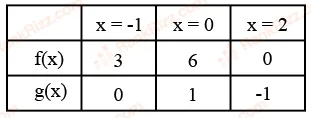
Figure for JEE Advanced 2015 Mathematics question on Rolle's theorem and Lagrange's mean value theorem


In each of the intervals (-1,0) and (0, 2) the function (f−3g)"(f - 3g)" never vanishes. Then the correct statement(s) is(are)

  1. A

    f′(x)−3g′(x)=0f'(x) - 3g'(x) = 0 has exactly three solutions in (−1,0)∪(0,2)(-1, 0) \cup (0, 2)

  2. B

    f′(x)−3g′(x)=0f'(x) - 3g'(x) = 0 has exactly one solution in (-1, 0)

  3. C

    f′(x)−3g′(x)=0f'(x) - 3g'(x) = 0 has exactly one solution in (0, 2)

  4. D

    f′(x)−3g′(x)=0f'(x) - 3g'(x) = 0 has exactly two solutions in (-1, 0) and exactly two solutions in (0, 2)

Q55Definite integrals: properties and King's ruleTRANSCRIBED

Let f(x)=7tan⁡8x+7tan⁡6x−3tan⁡4x−3tan⁡2xf(x) = 7 \tan^8 x + 7 \tan^6 x - 3 \tan^4 x - 3 \tan^2 x for all x∈(−π2,π2).x \in \left(-\frac{\pi}{2}, \frac{\pi}{2} \right). Then the correct expression(s) is(are)

  1. A

    ∫0π4xf(x)dx=112\int_{0}^{\frac{\pi}{4}}xf(x)dx = \frac{1}{12}

  2. B

    ∫0π4f(x)dx=0\int_{0}^{\frac{\pi}{4}}f(x)dx = 0

  3. C

    ∫0π4xf(x)dx=16\int_{0}^{\frac{\pi}{4}}xf(x)dx = \frac{1}{6}

  4. D

    ∫0π4f(x)dx=1\int_{0}^{\frac{\pi}{4}}f(x)dx = 1

Q56Leibniz rule for differentiating integralsTRANSCRIBED

Let f′(x)=192x32+sin⁡4πxf'(x) = \frac{192x^3}{2 + \sin^4 \pi x} for all x∈Rx \in R with f(12)=0f\left(\frac{1}{2}\right) = 0. If m≤∫121f(x)dx≤M,m \leq \int_{\frac{1}{2}}^{1} f(x) dx \leq M, then the possible values of m and M are

  1. A

    m=13,M=24m = 13, M = 24

  2. B

    m=14,M=12m = \frac{1}{4}, M = \frac{1}{2}

  3. C

    m=−11,M=0m = -11, M = 0

  4. D

    m=1,M=12m = 1, M = 12

Q57Bayes' theoremTRANSCRIBED

One of the two boxes, box I and box II, was selected at random anda ball was drawn randomly out of this box. The ball was found to be red. If the probability that this red ball was drawn from box II is 13,\frac{1}{3}, then the correct option(s) with the possible values of n1,n2,n3n_1, n_2, n_3 and n4n_4 is(are)

  1. A

    n1=3,n2=3,n3=5,n4=15n_1 = 3, n_2 = 3, n_3 = 5, n_4 = 15

  2. B

    n1=3,n2=6,n3=10,n4=50n_1 = 3, n_2 = 6, n_3 = 10, n_4 = 50

  3. C

    n1=8,n2=6,n3=5,n4=20n_1 = 8, n_2 = 6, n_3 = 5, n_4 = 20

  4. D

    n1=6,n2=12,n3=5,n4=20n_1 = 6, n_2 = 12, n_3 = 5, n_4 = 20

Q58Conditional probability and multiplication theoremTRANSCRIBED

A ball is drawn at random from box I and transferred to box II. If the probability of drawing a red ball from box I, after this transfer, is 13,\frac{1}{3}, then the correct option(s) with the possible values of n1andn2n_1 and n_2 is(are)

  1. A

    n1=4n_1 = 4 and n2=6n_2 = 6

  2. B

    n1=2n_1 = 2 and n2=3n_2 = 3

  3. C

    n1=10n_1 = 10 and n2=20n_2 = 20

  4. D

    n1=3n_1 = 3 and n2=6n_2 = 6

Q59Derivatives of standard and composite functionsTRANSCRIBED

The correct statement(s) is(are)

  1. A

    f′(1)<0f'(1) < 0

  2. B

    f(2)<0f(2) < 0

  3. C

    f′(x)≠0f'(x) \neq 0 for any x∈(1,3)x \in (1, 3)

  4. D

    f′(x)=0f'(x) = 0 for some x∈(1,3)x \in (1, 3)

Q60Area between curvesTRANSCRIBED

If ∫13x2F′(x)dx=−12\int_{1}^{3}x^2 F'(x)dx = -12 and ∫13x3F"(x)dx=40,\int_{1}^{3}x^3 F"(x)dx = 40, then the correct expression(s) is(are)

  1. A

    9f′(3)+f′(1)−32=09f'(3) + f'(1) - 32 = 0

  2. B

    ∫13f(x)dx=12\int_{1}^{3}f(x)dx = 12

  3. C

    9f′(3)−f′(1)+32=09f'(3) - f'(1) + 32 = 0

  4. D

    ∫13f(x)dx=−12\int_{1}^{3}f(x)dx = -12