RankRizz

JEE Advanced 2012 Paper 2: Chemistry

The 20 Chemistry questions of JEE Advanced 2012 Paper 2, numbered across the whole paper. Pick an answer on any question to check it against the key. Free to read, nothing to download.

Chemistry

Q21Colour and magnetic behaviour of complexes from CFTTRANSCRIBED

NiCl2{P(C2H5)2(C6H5)}2NiCl_2\left\{P (C_2H_5)_2(C_6H_5)\right\}_2 exhibits temperature dependentmagnetic behaviour (paramagnetic/ diamagnetic). the coordination geometries of Ni2+Ni^{2+} in the paramagnetic and diamagnetic states are respectively

  1. A

    tetrahedral and tetrahedral

  2. B

    square planar and square planar

  3. C

    tetrahedral and square planar

  4. D

    square planar and tetrahedral
Q22Phosphorus and its compoundsTRANSCRIBED

The reaction of white phosphorous with aqueous NaOH gives phosphine along with another phosphorus containing compound. The reaction type; the oxidation states of phosphorous in phosphine and the other product are respectively

  1. A

    redox reaction; -3 and -5

  2. B

    redox reaction; 3 and +5

  3. C

    disproportionation reaction ; -3 and +5

  4. D

    disproportionation reaction ; -3 and +3

Q23Extraction of Fe, Cu, Zn, Al, Ag and AuTRANSCRIBED

In the cyanide extraction process of silver from argentite ore, the oxidizing and reducing agents used are

  1. A

    O2O_2 and CO respectively

  2. B

    O2O_2 and Zn dust respectively

  3. C

    HNO3HNO_3 and Zn dust respectively

  4. D

    HNO3HNO_3 and CO respectively

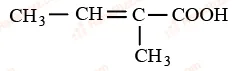
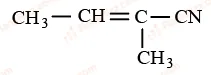
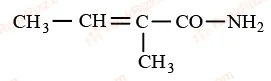
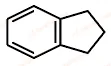
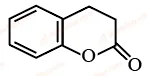
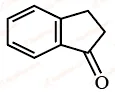
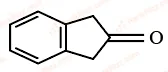
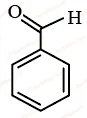
Q24Reactions of carboxylic acidsTRANSCRIBED

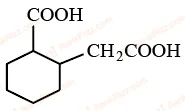
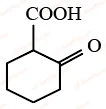
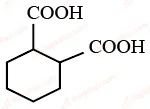
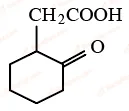
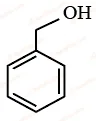
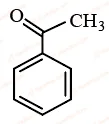
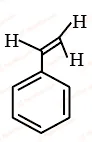
The compound that undergoes decarboxlylationmost readily under mild condition is

  1. A
    Figure for JEE Advanced 2012 Chemistry question on Reactions of carboxylic acids
  2. B
    Figure for JEE Advanced 2012 Chemistry question on Reactions of carboxylic acids
  3. C
    Figure for JEE Advanced 2012 Chemistry question on Reactions of carboxylic acids
  4. D
    Figure for JEE Advanced 2012 Chemistry question on Reactions of carboxylic acids
Q25Enthalpies of reaction and Hess's lawTRANSCRIBED

Using the data provided, calculate the multiple bond energy (kJmol−1)(kJ mol^{-1}) of a C≡CC \equiv C bond C2H2C_2H_2. That energy is (take the bond energy of a C-H bond as 350 kJ mol−1mol^{-1})

2C(s)+H2(g)→C2H2(g)2C(s) + H_2(g) \rightarrow C_2H_2(g)                          △H=225kJmol−1\triangle H = 225 kJ mol^{-1}

2C(s) →2C(g)2C(s)  \rightarrow 2C(g)                                              △H=1410kJmol−1\triangle H = 1410 kJ mol^{-1}

H2(g)→2H(g)H_2(g) \rightarrow 2H(g)                                             △H=330kJmol−1\triangle H = 330 kJ mol^{-1}

  1. A

    1165

  2. B

    837

  3. C

    865

  4. D

    815

Q26VSEPR theory and shapes of molecules and ionsTRANSCRIBED

The shape of XeO2F2XeO_2F_2 molecule is

  1. A

    trigonal bipyramidal

  2. B

    square plannar

  3. C

    tetrahedral

  4. D

    see-saw

Q27Aldol condensation, Cannizzaro and related reactionsTRANSCRIBED

The major product H in the given reaction sequence is

Figure for JEE Advanced 2012 Chemistry question on Aldol condensation, Cannizzaro and related reactions
  1. A
    Figure for JEE Advanced 2012 Chemistry question on Aldol condensation, Cannizzaro and related reactions
  2. B
    Figure for JEE Advanced 2012 Chemistry question on Aldol condensation, Cannizzaro and related reactions
  3. C
    Figure for JEE Advanced 2012 Chemistry question on Aldol condensation, Cannizzaro and related reactions
  4. D
    Figure for JEE Advanced 2012 Chemistry question on Aldol condensation, Cannizzaro and related reactions
Q28Elevation in boiling pointTRANSCRIBED

For a dilute solution containing 2.5 g of a non- volatile non- electrolyte solute in 100 g of water, the elevation in boiling point at 1 atm pressure is 2∘C2^\circ C. Assuming concentration of solute is much lower than the concentration of solvent, the vapour pressure (mm of Hg) of the solution is (take Kb=0.76K_b = 0.76 K kg mol−1mol^{-1})

  1. A

    724

  2. B

    740

  3. C

    736

  4. D

    718

Q29Electrode potentials, electrochemical series and cell EMFTRANSCRIBED

The solubility product (Ksp;mol3dm−9K_{sp};mol^3 dm^{-9}) of MX2MX_2 at 298 based on the information available the given concentration cell is (take 2.303×R×298F=0.059V2.303 \times R \times \frac{298}{F} = 0.059 V)

  1. A

    1×10−151 \times 10^{-15}

  2. B

    4×10−154 \times 10^{-15}

  3. C

    1×10−121 \times 10^{-12}

  4. D

    4×10−124 \times 10^{-12}

Q30Electrode potentials, electrochemical series and cell EMFTRANSCRIBED

The value of △G(kJmol−1)\triangle G (kJ mol^{-1}) for the given cell is (take 1F = 96500 C mol−1mol^{-1})

  1. A

    -5.7

  2. B

    5.7

  3. C

    11.4

  4. D

    -11.4

Q31Oxoacids of halogens and interhalogen compoundsTRANSCRIBED

25mL of household bleach solution was mixed with 30mL of 0.50MKI and 10mL of 4N acetic acid. In the titration of the liberated iodine, 48mL of 0.25 N Na2S2O3Na_2S_2O_3 was used to reach the end point. Themolarity of the household bleach solution is

  1. A

    0.48 M

  2. B

    0.96 M

  3. C

    0.24 M

  4. D

    0.024 M

Q32Oxoacids of halogens and interhalogen compoundsTRANSCRIBED

Bleaching powder contains a salt of an oxoacid as one of its components. The anhydride of that oxoacid is

  1. A

    Cl2OCl_2O

  2. B

    Cl2O7Cl_2O_7

  3. C

    ClO2ClO_2

  4. D

    Cl2O6Cl_2O_6

Q35Oxides of carbon, silica, silicones and silicatesTRANSCRIBED

With respect to graphite and diamond, which of the statement(s) given below is (are) correct ?

  1. A

    Graphite is harder than diamond.

  2. B

    Graphite has higher electrical conductivity than diamond

  3. C

    Graphite has higher thermal conductivity than diamond

  4. D

    Graphite has higher C-C bond order than diamond

Q36Adsorption and adsorption isothermsTRANSCRIBED

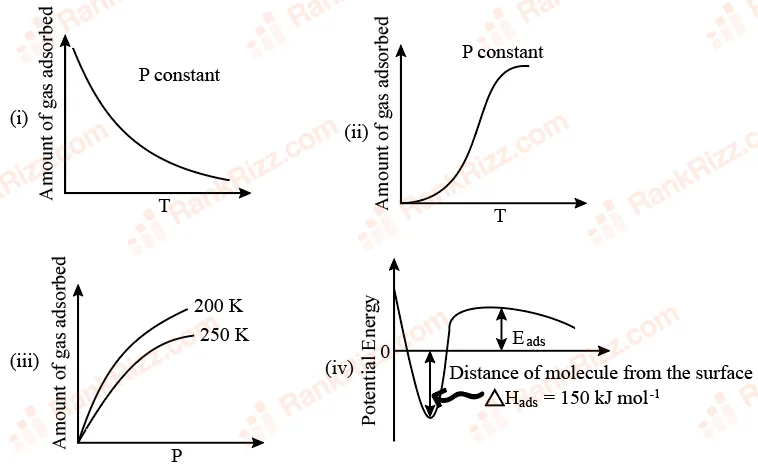
The given graph / data I, II, III and IV represent general trends observed for different physisorption and chemisorption processes under mild conditions of temperature and pressure. Which of the following choice (s) about I, II, III and IV is (are) correct

Figure for JEE Advanced 2012 Chemistry question on Adsorption and adsorption isotherms
  1. A

    I is physisorption and II is chemisorption

  2. B

    I is physisorption and III is chemisorption

  3. C

    IV is chemisorption and II is chemisorption

  4. D

    IV is chemisorption and III is chemisorption

Q37First law: work, heat and internal energyTRANSCRIBED

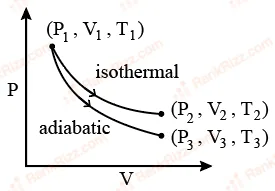
The reversible expansion of an ideal gas under adiabatic and isothermal conditions is shown in the figure. Which of the following statement(s) is (are) correct ?

Figure for JEE Advanced 2012 Chemistry question on First law: work, heat and internal energy
  1. A

    T1=T2T_1 = T_2

  2. B

    T3>T1T_3 > T_1

  3. C

    Wisothermal>WadiabaticW_{isothermal} > W_{adiabatic}

  4. D

    △Uisothermal>△Uadiabatic\triangle U_{isothermal} > \triangle U_{adiabatic}

Q38Magnetic moment, colour and catalytic properties of transition metalsTRANSCRIBED

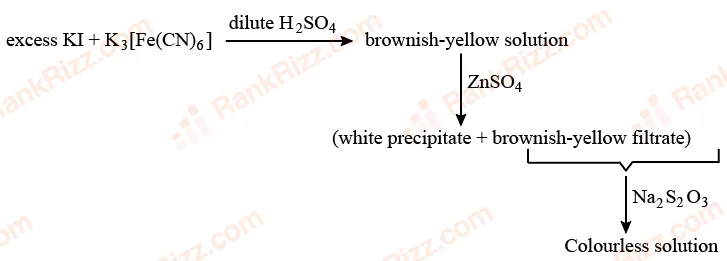
For the given aqueous reaction which of the statement(s) is (are) true ?

Figure for JEE Advanced 2012 Chemistry question on Magnetic moment, colour and catalytic properties of transition metals
  1. A

    The first reaction is a redox reaction

  2. B

    White precipitate is Zn3[Fe(CN)6]2Zn_3[Fe(CN)_6]_2

  3. C

    Addition of filtrate to starch solution gives blue colour.

  4. D

    White precipitate is soluble in NaOH solution

Q39Reactions of carboxylic acidsTRANSCRIBED

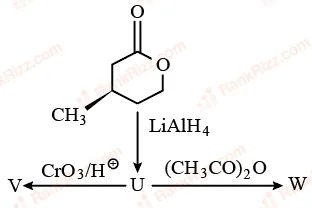
With reference to the scheme given, which of the given statements(s) about T, U, V and W is (are) correct?

Figure for JEE Advanced 2012 Chemistry question on Reactions of carboxylic acids
  1. A

    T is soluble in hot aqueous NaOH

  2. B

    U is optically active

  3. C

    Molecular formula of W is C10H18O4C_{10}H_{18}O_{4}

  4. D

    V gives effervescence on treatment with aqueous NaHCO3NaHCO_3

Q40Structural isomerismTRANSCRIBED

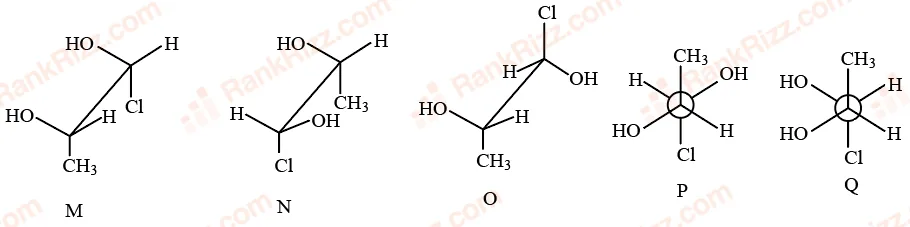
Which of the given statement(s) about N, O, P and Q with respect to M is (are) correct ?

Figure for JEE Advanced 2012 Chemistry question on Structural isomerism
  1. A

    M and N are non-mirror image stereoisomers

  2. B

    M and O are identical

  3. C

    M and P are enantiomers

  4. D

    M and Q are identical

NEXT IN THIS PAPER →Maths, Q41 onwards