RankRizz

JEE Advanced 2011 Paper 2: Maths

The 20 Maths questions of JEE Advanced 2011 Paper 2, numbered across the whole paper. Pick an answer on any question to check it against the key. Free to read, nothing to download.

Maths

Q41Normals to a hyperbolaTRANSCRIBED

Let P(6, 3) be a point on the hyperbola x2a2−y2b2=1\frac{x^2}{a^2} - \frac{y^2}{b^2} = 1. If the normal at the point P intersects the x-axis at (9, 0), then the eccentricity of the hyperbola is

  1. A

    52\sqrt{\frac{5}{2}}

  2. B

    32\sqrt{\frac{3}{2}}

  3. C

    2\sqrt{2}

  4. D

    3\sqrt{3}

Q42Common roots of equationsTRANSCRIBED

A value of b for which the equations
x2+bx−1=0x^2 + bx - 1 = 0
x2+x+b=0x^2 + x + b = 0,
have one root in common is

  1. A

    −2-\sqrt{2}

  2. B

    −i3-i\sqrt{3}

  3. C

    i5i\sqrt{5}

  4. D

    2\sqrt{2}

Q43Properties of determinantsTRANSCRIBED

Let ω≠1\omega \neq 1 be a cube root of unity and S bethe set of all non-singular matrices of the form
[1abω1cω2ω1]\begin{bmatrix}1 & a & b\\\omega & 1 & c\\\omega^2 & \omega & 1\end{bmatrix},
where each of a, b, and c is either ω\omega or ω2\omega^2. Then the number of distinct matrices in the set S is

  1. A

    2

  2. B

    6

  3. C

    4

  4. D

    8

Q44Intercepts and position of a pointTRANSCRIBED

The circle passing through the point (-1,0) and touching the y-axis at (0, 2) also passes through the point

  1. A

    (−32,0)\left(-\frac{3}{2}, 0\right)

  2. B

    (−52,2)\left(-\frac{5}{2}, 2\right)

  3. C

    (−32,52)\left(-\frac{3}{2}, \frac{5}{2}\right)

  4. D

    (−4,0)\left(-4, 0\right)

Q45L'Hopital's rule and series expansionsTRANSCRIBED

If
lim⁡x→0[1+xln⁡(1+b2)]1x=2bsin⁡θ,b>0\lim_{x \rightarrow 0} \left[1 + x \ln (1 + b^2)\right]^{\frac{1}{x}} = 2b \sin \theta, b > 0 and θ∈(−π,π]\theta \in (-\pi, \pi], then the value of θ\theta is

  1. A

    ±π4\pm \frac{\pi}{4}

  2. B

    ±π3\pm \frac{\pi}{3}

  3. C

    ±π6\pm \frac{\pi}{6}

  4. D

    ±π2\pm \frac{\pi}{2}

Q46Area between curvesTRANSCRIBED

Let f:[−1,2]→[0,∞)f:[-1, 2] \rightarrow [0, \infty) be a continuous function such that f(x)=f(1−x)f(x) = f(1 - x) for all x∈[−1,2]x \in [-1, 2]. Let R1=∫−12xf(x)dxR_1 = \int_{-1}^{2} x f(x)dx and R2R_2 be the area of the region bounded by y = f(x), x = -1, x = 2, and the x-axis. Then

  1. A

    R1=2R2R_1 = 2R_2

  2. B

    R1=3R2R_1 = 3R_2

  3. C

    2R1=R22R_1 = R_2

  4. D

    3R1=R23R_1 = R_2

Q47Composite functionsTRANSCRIBED

Let f(x)=x2f(x) = x^2 and g(x)=sin⁡xg(x) = \sin x for all x∈Rx \in R. Then the set of all x satisfying (f∘g∘g∘f)(x)=(g∘g∘f)(x)(f\circ g \circ g \circ f)(x) = (g\circ g \circ f)(x), where (f∘g)(x)=f(g(x))(f \circ g)(x) = f(g(x)), is

  1. A

    ±nπ,n∈{0,1,2,....}\pm \sqrt{n \pi}, n \in \left\{0, 1, 2, ....\right\}

  2. B

    ±nπ,n∈{1,2,....}\pm \sqrt{n \pi}, n \in \left\{1, 2, ....\right\}

  3. C

    π2+2nπ,n∈{.....,−2,−1,0,1,2,....}\frac{\pi}{2} + 2n \pi, n \in \left\{....., -2, -1, 0, 1, 2, ....\right\}

  4. D

    2nπ,n∈{.....,−2,−1,0,1,2,....}2n \pi, n \in \left\{....., -2, -1, 0, 1, 2, ....\right\}

Q48Locus problems on parabolaTRANSCRIBED

Let (x, y) be any point on the parabola y2=4xy^2 = 4x. Let P be the point that divides the line segment from (0, 0) to (x, y) in the ratio 1:3. Then the locus of P is

  1. A

    x2=yx^2 = y

  2. B

    y2=2xy^2 = 2x

  3. C

    y2=xy^2 = x

  4. D

    x2=2yx^2 = 2y

Q49Differentiability at a pointTRANSCRIBED

If
f(x)={−x−π2,x≤−π2−cos⁡x,−π2<x≤0x−1,0<x≤1ln⁡x,x>1f(x) = \begin{cases}-x-\frac{\pi}{2}, & x \leq -\frac{\pi}{2}\\-\cos x, & -\frac{\pi}{2}<x \leq 0\\x-1, & 0 < x \leq 1\\\ln x, & x > 1\end{cases}, then

  1. A

    f(x) is continuous at x=−π2x = -\frac{\pi}{2}

  2. B

    f(x) is not differentiable at x =0

  3. C

    f(x) is differentiable at x=1

  4. D

    f(x) is differentiable at x=−32x = -\frac{3}{2}

Q50Conditional probability and multiplication theoremTRANSCRIBED

Let E and F be two independent events. The probability that exactly one of them occurs is 1125\frac{11}{25} and the probability of none of them occurring is 225\frac{2}{25}. If P(T) denotes the probability of occurrence of the event T , then

  1. A

    P(E)=45,P(F)=35P(E) = \frac{4}{5}, P(F) = \frac{3}{5}

  2. B

    P(E)=15,P(F)=25P(E) = \frac{1}{5}, P(F) = \frac{2}{5}

  3. C

    P(E)=25,P(F)=15P(E) = \frac{2}{5}, P(F) = \frac{1}{5}

  4. D

    P(E)=35,P(F)=45P(E) = \frac{3}{5}, P(F) = \frac{4}{5}

Q51Normals to a parabolaTRANSCRIBED

Let L be anormal to the parabola y2=4xy^2 = 4x. If L passes through the point (9, 6), then L is given by

  1. A

    y - x + 3 = 0

  2. B

    y + 3x - 33 = 0

  3. C

    y + x - 15 = 0

  4. D

    y - 2x + 12 = 0

Q52Inverse functionsTRANSCRIBED

Let f:(0,1)→Rf : (0, 1) \rightarrow R be defined by
f(x)=b−x1−bxf(x) = \frac{b - x}{1 - bx}, where b is a constant such that 0 < b < 1. Then

  1. A

    f is not invertible on (0, 1)

  2. B

    f≠f−1f \neq f^{-1} on (0, 1) and f′(b)=1f′(0)f'(b) = \frac{1}{f'(0)}

  3. C

    f=f−1f = f^{-1} on (0, 1) and f′(b)=1f′(0)f'(b) = \frac{1}{f'(0)}

  4. D

    f−1f^{-1} is differentiable on (0, 1)

Q53Cube roots and nth roots of unityTRANSCRIBED

Let ω=eiπ3\omega = e^{\frac{i \pi}{3}} and a, b, c, x, y, z be non-zero complex numbers such that
a+b+c=xa + b + c = x
a+bω+cω2=ya + b \omega + c \omega^2 = y
a+bω2+cω=za + b \omega^2 + c \omega = z.
Ten the value of ∣x∣2+∣y∣2+∣z∣2∣a∣2+∣b∣2+∣c∣2\frac{\mid x \mid^2 + \mid y \mid^2 + \mid z \mid^2}{\mid a \mid^2 + \mid b \mid^2 + \mid c \mid^2} is

Q54Nature of roots and discriminantTRANSCRIBED

The number of distinct real roots of x4−4x3+12x2+x−1=0x^4 - 4x^3 + 12 x^2 + x - 1 = 0 is

Q55Linear first-order differential equationsTRANSCRIBED

Let y′(x)+y(x)g′(x)=g(x)g′(x),y(0)=0,x∈Ry'(x) + y(x)g'(x) = g(x)g'(x), y(0) = 0, x \in R, where f′(x)f'(x) denotes df(x)dx\frac{d f(x)}{dx} and g(x)g(x) is a given non-constant differentiable function on R with g(0) = g(2) = 0. Then the value of y(2) is

Q56Trace and special matricesTRANSCRIBED

Let M be a 3×33 \times 3 matrix satisfying
M[010]=[−123],M[1−10]=[11−1]M\begin{bmatrix}0\\1\\0 \end{bmatrix} = \begin{bmatrix}-1\\2\\3 \end{bmatrix}, M\begin{bmatrix}1\\-1\\0 \end{bmatrix} = \begin{bmatrix}1\\1\\-1 \end{bmatrix}, and M[111]=[0012]M\begin{bmatrix}1\\1\\1 \end{bmatrix} = \begin{bmatrix}0\\0\\12 \end{bmatrix}. Then the sum of the diagonal entries of M is

Q57Scalar (dot) productTRANSCRIBED

Let a→=−i^−k^,b→=−i^+k^\overrightarrow{a} = -\hat{i} - \hat{k}, \overrightarrow{b} = -\hat{i} + \hat{k} and c→=i^+2j^+3k^\overrightarrow{c} = \hat{i} + 2\hat{j} + 3\hat{k} be three given vectors. If r→\overrightarrow{r} is a vector such that r→×b→=c→×b→\overrightarrow{r} \times \overrightarrow{b} = \overrightarrow{c} \times \overrightarrow{b} and r→.a→=0\overrightarrow{r} . \overrightarrow{a} = 0, then the value of r→.b→\overrightarrow{r} . \overrightarrow{b} is

Q58Intercepts and position of a pointTRANSCRIBED

The straight line 2x - 3y = 1 divides the circular region x2+y2≤6x^2 + y^2 \leq 6 into two parts. If
S={(2,34),(52,34),(14,−14),(18,14)}S = \left\{\left(2, \frac{3}{4}\right), \left(\frac{5}{2}, \frac{3}{4}\right), \left(\frac{1}{4}, -\frac{1}{4}\right), \left(\frac{1}{8}, \frac{1}{4}\right)\right\},
then the number of point(s) in S lying inside the smaller part is

Q59Equation of a circle in various formsTRANSCRIBED

Match the statements given in Column I with the values given in Column II
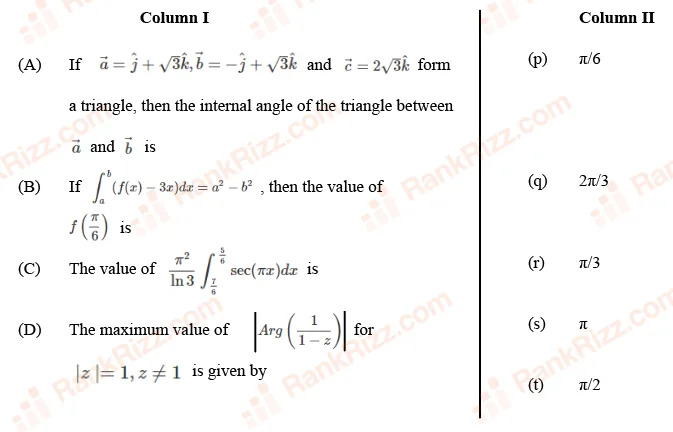
Figure for JEE Advanced 2011 Mathematics question on Equation of a circle in various forms
Q60Domain of real functionsTRANSCRIBED

Match the statements given in Column I with the intervals/union of intervals given in Column II
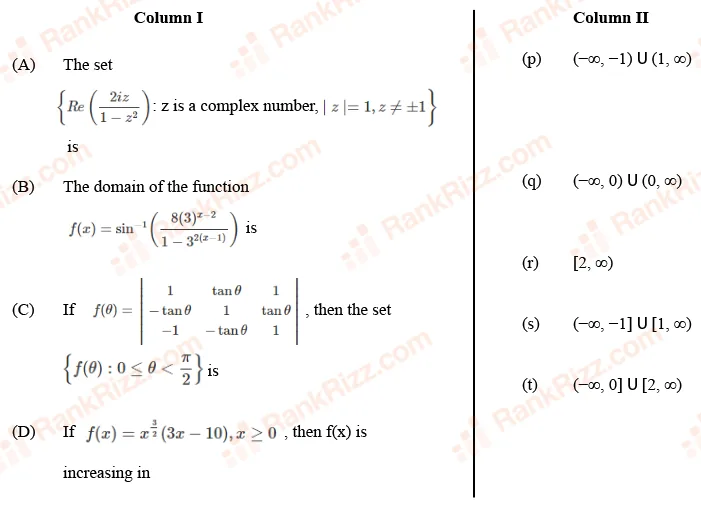
Figure for JEE Advanced 2011 Mathematics question on Domain of real functions