Q39Products of coefficients and calculus-based sumsTRANSCRIBED
For , let and denote, respectively, the coefficient of in the expansions of and . Then
is equal to
- A
- B
- C
0
- D
The 19 Maths questions of JEE Advanced 2010 Paper 2, numbered across the whole paper. Pick an answer on any question to check it against the key. Free to read, nothing to download.
For , let and denote, respectively, the coefficient of in the expansions of and . Then
is equal to
0
Let S = {1, 2, 3, 4}. The total number of unordered pairs of disjoint subsets of S is equal to
25
34
42
41
Let f be a real-valued function defined on the interval (-1, 1) such that , for all , and let be the inverse function of f. Then is equal to
1
If the distance of the point P(1, -2, 1) from the plane , where , is 5, then the foot of the perpendicular from P to the plane is
Two adjacent sides of a parallelogram ABCD are given by
and
The side AD is rotated by an acute angle in the plane of the parallelogram so that AD becomes AD'. If AD' makes a right angle with the side AB, then the cosine of the angle is given by
A signal which can be green or red with probability and respectively, is received by station A and then transmitted to station B. The probability of each station receiving the signal correctly is . If the signal received at station B is green, then the probability that the original signal was green is
Two parallel chords of a circle of radius 2 are at a distance apart. If the chords subtend at the center, angles of and , where k > 0, then the value of [k] is
[Note : [k] denotes the largest integer less then or equal to k]
Consider a triangle ABC and let a, b and c denote the lengths of the sides opposite to vertices A, B and C respectively. Suppose a = 6, b = 10 and the area of the triangle is . If is obtuse andif r denotes the radius of the incircle of the triangle, then is equal to
Let f be a function defined on R (the set of all real numbers) such that
, for all .
If g is a function defined on R with values in the interval such that , for all ,
then the number of points in R at which g has a local maximum is
Let be real numbers satisfying
and , for k = 3, 4, ...., 11.
If , then the value of is equal to
Let k be a positive real number and let
and .If , then [k] is equal to
[Note : adj M denotes the adjoint of a square matrix M and [k] denotes the largest integer less than or equal to k].
The real numbers lies in the interval
The area bounded bythe curve y= f(x) and the lines x = 0, y = O and x = t, lies in the interval
(9, 10)
The function is
increasing in and decreasing in
decreasing in and increasing in
increasing in (-t, t)
decreasing in (-t, t)
The coordinates of A and B are
(3, 0) and (0, 2)
and
and (0, 2)
(3, 0) and
The orthocenter of the triangle PAB is
The equation of the locus of the point whose distances from the point P and the line AB are equal, is
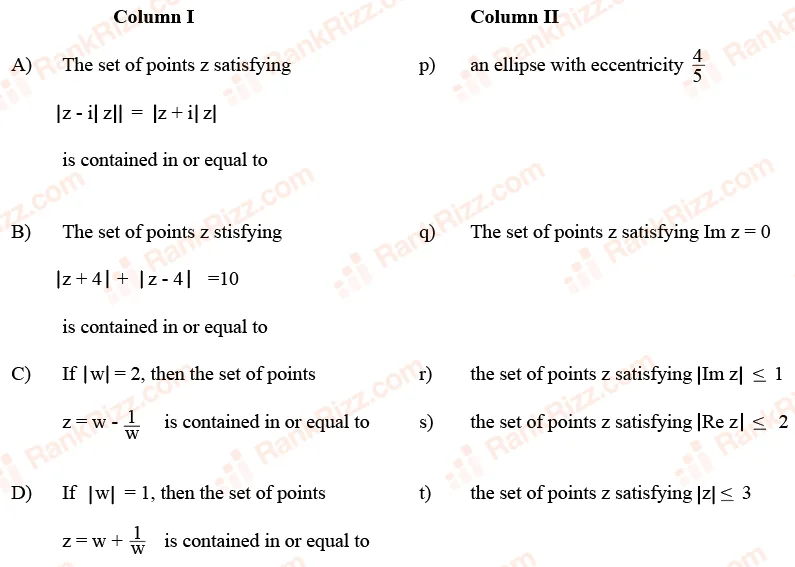
Match the statements in Column-I with those in Column-II.
(Note: Here z takes values in the complex plane and Im z and Re z denote, respectively, the imaginary part and the real part of z.]
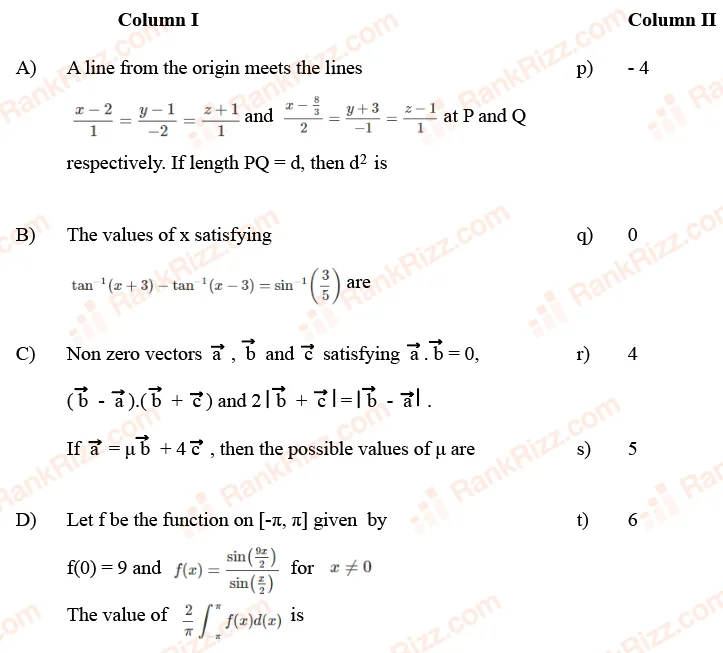
Match the statements in Column-I with the values in Column-II.