RankRizz

JEE Advanced 2010 Paper 1: Maths

The 28 Maths questions of JEE Advanced 2010 Paper 1, numbered across the whole paper. Pick an answer on any question to check it against the key. Free to read, nothing to download.

Maths

Q57Sine rule, cosine rule and projection formulaTRANSCRIBED

If the angles A, B andC of a triangle are in an arithmetic progression andif a, b and c denote the lengths of the sides opposite to A, B andC respectively, then the value of the expression acsin⁡2C+casin⁡2A\frac{a}{c}\sin 2C+\frac{c}{a}\sin 2A is

  1. A

    12\frac{1}{2}

  2. B

    32\frac{\sqrt{3}}{2}

  3. C

    11

  4. D

    3\sqrt{3}

Q58Equation of a planeTRANSCRIBED

Equation of the plane containing the straight line X2=Y3=Z4\frac{X}{2}=\frac{Y}{3}=\frac{Z}{4} and perpendicular to the plane containing the straight lines X3=Y4=Z2\frac{X}{3}=\frac{Y}{4}=\frac{Z}{2} and X4=Y2=Z3\frac{X}{4}=\frac{Y}{2}=\frac{Z}{3} is

  1. A

    x+2y−2z=0x+2y-2z=0

  2. B

    3x+2y−2z=03x+2y-2z=0

  3. C

    x−2y+z=0x-2y+z=0

  4. D

    5x+2y−4z=05x+2y-4z=0

Q59Random variables, mean and varianceTRANSCRIBED

Let ω\omega be a complex cube root of unity with ω≠1\omega\neq1. A fair die is thrownthree times. If r1,r2r_{1},r_{2} and r3r_{3} are the numbers obtained on the die, then the probability that is ωr1+ωr2+ωr3=0\omega^{r_{1}}+\omega^{r_{2}}+\omega^{r_{3}}=0

  1. A

    118\frac{1}{18}

  2. B

    19\frac{1}{9}

  3. C

    29\frac{2}{9}

  4. D

    136\frac{1}{36}

Q60Scalar (dot) productTRANSCRIBED

Let P, Q, R and S be the points on the plane with position vectors −2i^−j^,4i^,3i^+3j^-2\hat{i}-\hat{j},4\hat{i},3\hat{i}+3\hat{j} and −3i^+2j^-3\hat{i}+2\hat{j} respectively. The quadrilateral PQRS must be a

  1. A

    parallelogram, which is neither a rhombus nor a rectangle

  2. B

    square

  3. C

    rectangle, but not a square

  4. D

    rhombus, but not a square

Q61Systems of linear equationsTRANSCRIBED

The number of 3×33\times3 matrices A whose entries are either O or 1 and for which the system A[xyz]=[100]A\begin{bmatrix}x\\y\\z\end{bmatrix}=\begin{bmatrix}1\\0\\0\end{bmatrix} has exactly two distinct solutions, is

  1. A

    00

  2. B

    29−12^{9}-1

  3. C

    168168

  4. D

    22

Q62Definite integral as limit of a sumTRANSCRIBED

The value of lim⁡x→01x3∫0xtln⁡(1+t)t4+4dt\lim_{x \rightarrow 0}\frac{1}{x^{3}}\int_{0}^{x} \frac{t \ln(1+t)}{t^{4}+4}dt is

  1. A

    00

  2. B

    112\frac{1}{12}

  3. C

    124\frac{1}{24}

  4. D

    164\frac{1}{64}

Q63Relation between roots and coefficientsTRANSCRIBED

Let p and q be real numbers such that p≠0,p3≠qp\neq 0,p^{3}\neq q and p3≠−qp^{3}\neq -q. If α\alpha and β\beta are nonzero complex numbers satisfying α+β=−p\alpha+\beta=-p and α3+β3=q\alpha^{3}+\beta^{3}=q, then a quadratic equation having αβ\frac{\alpha}{\beta} and βα\frac{\beta}{\alpha} as its roots is

  1. A

    (p3+q)x2−(p3+2q)x+(p3+q)=0(p^{3}+q)x^{2}-(p^{3}+2q)x+(p^{3}+q)=0

  2. B

    (p3+q)x2−(p3−2q)x+(p3+q)=0(p^{3}+q)x^{2}-(p^{3}-2q)x+(p^{3}+q)=0

  3. C

    (p3−q)x2−(5p3−2q)x+(p3−q)=0(p^{3}-q)x^{2}-(5p^{3}-2q)x+(p^{3}-q)=0

  4. D

    (p3−q)x2−(5p3+2q)x+(p3−q)=0(p^{3}-q)x^{2}-(5p^{3}+2q)x+(p^{3}-q)=0

Q64Optimization word and geometry problemsTRANSCRIBED

Let f, g and h be real-valued functions defined on the interval [0,1] by f(x)=ex2+e−x2,g(x)=xex2+e−x2f(x) = e^{x^2} + e^{-x^2}, g(x) = xe^{x^2} + e^{-x^2} and h(x)=x2ex2+e−x2h(x) = x^2 e^{x^2} + e^{-x^2}. If a, b and c denote, respectively, the absolute maximum of f, g and h on [0, 1], Then

  1. A

    a=ba = b and c≠bc \neq b

  2. B

    a=ca = c and a≠ba \neq b

  3. C

    a≠ba \neq b and c≠bc \neq b

  4. D

    a=b=ca = b = c

Q65Chords of a parabola and position of a pointTRANSCRIBED

Let A and B be two distinct points on the parabola y2=4xy^2 = 4x. If the axis of the parabola touches a circle of radius r having AB as its diameter, then the slope of the line joining A and B can be

  1. A

    −1r-\frac{1}{r}

  2. B

    1r\frac{1}{r}

  3. C

    2r\frac{2}{r}

  4. D

    −2r-\frac{2}{r}

Q66Sine rule, cosine rule and projection formulaTRANSCRIBED

Let ABC be a triangle such that ∠ACB=π6\angle ACB = \frac{\pi}{6} and let a, b and c denote the lengths of the sides opposite to A, B and C respectively. The value(s) of x for which a=x2+x+1,b=x2−1a = x^2 + x + 1, b = x^2 - 1 and c=2x+1c = 2x + 1 is (are)

  1. A

    −(2+3)-(2 + \sqrt{3})

  2. B

    (1+3)(1 + \sqrt{3})

  3. C

    (2+3)(2 + \sqrt{3})

  4. D

    434\sqrt{3}

Q67Argument, polar and Euler formTRANSCRIBED

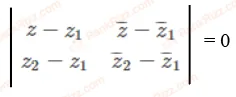
Let z1z_1 and z2z_2 be two district complex numbers and let z=(1−t)z1+tz2z = (1 - t)z_1 + tz_2 for some real number t with 0 < t 1. If Arg(w) denotes the principal argument of a nonzero complex number w, then

  1. A

    ∣z−z1∣+∣z−z2∣=∣z1−z2∣\mid z - z_1\mid + \mid z - z_2\mid = \mid z_1 - z_2\mid

  2. B

    Arg(z−z1)=Arg(z−z2)Arg(z - z_1) = Arg(z - z_2)

  3. C
    Figure for JEE Advanced 2010 Mathematics question on Argument, polar and Euler form
  4. D

    Arg(z−z1)=Arg(z2−z1)Arg(z - z_1) = Arg(z_2 - z_1)

Q68Area between curvesTRANSCRIBED

Let f be a real-valued function defined on the interval (0,∞)(0, \infty) by f(x)=ln⁡x+∫0x1+sin⁡tf(x) = \ln x + \int_{0}^{x}\sqrt{1 + \sin t} dt. Then which of the following statement(s) is (are) true ?

  1. A

    f′′(x)f''(x) exists for all x∈(0,∞)x \in (0, \infty)

  2. B

    f′(x)f'(x) exists for all x∈(0,∞)x \in (0, \infty) f′f' is continuous on (0,∞)(0, \infty), but not differentiable on (0,∞)(0, \infty)

  3. C

    there exists α>1\alpha > 1 such that ∣f′(x)∣<∣f(x)∣\mid f'(x) \mid < \mid f(x) \mid for all x∈(α,∞)x \in (\alpha, \infty)

  4. D

    there exists β>0\beta > 0 such that ∣f(x)∣+∣f′(x)∣≤β\mid f(x) \mid + \mid f'(x) \mid \leq \beta for all x∈(0,∞)x \in (0, \infty)

Q69Definite integrals: properties and King's ruleTRANSCRIBED

The value(s) of ∫01x4(1−x)41+x2dx\int_{0}^{1}\frac{x^4(1-x)^4}{1+x^2}dx is(are)

  1. A

    227−π\frac{22}{7} - \pi

  2. B

    2105\frac{2}{105}

  3. C

    0

  4. D

    7115−3π2\frac{71}{15} - \frac{3 \pi}{2}

Q70Properties of determinantsTRANSCRIBED

The number of A in TpT_p, such that A is either symmetric or skew-symmetric or both, and det (A) divisible by p is

  1. A

    (p−1)2(p-1)^2

  2. B

    2(p−1)2(p-1)

  3. C

    (p−1)2+1(p-1)^2 + 1

  4. D

    2p−12p-1

Q71Properties of determinantsTRANSCRIBED

The number of A in TpT_p, suchthat the trace of A is not divisible by p but det (A) is divisible by p is
[Note : The trace of a matrix is the sumofits diagonal entries.]

  1. A

    (p−1)(p2−p+1)(p-1)(p^2 - p + 1)

  2. B

    p3−(p−1)2p^3 - (p - 1)^2

  3. C

    (p−1)2(p-1)^2

  4. D

    (p−1)(p2−2)(p-1)(p^2 - 2)

Q72Properties of determinantsTRANSCRIBED

The number of A in TpT_p, such that det (A) is not divisible byp is

  1. A

    2p22p^2

  2. B

    p3−5pp^3 - 5p

  3. C

    p3−3pp^3 - 3p

  4. D

    p3−p2p^3 - p^2

Q73Tangents to a hyperbolaTRANSCRIBED

Equation of a common tangent with positive slope to the circle as well as to the hyperbola is

  1. A

    2x−5y−20=02x - \sqrt{5}y - 20 = 0

  2. B

    2x−5y+4=02x - \sqrt{5}y + 4 = 0

  3. C

    3x−4y+8=03x - 4y + 8 = 0

  4. D

    4x−3y+4=04x - 3y + 4 = 0

Q74Chords and locus on hyperbolaTRANSCRIBED

Equation of the circle with AB as its diameter is

  1. A

    x2+y2−12x+24=0x^2 + y^2 - 12x + 24 = 0

  2. B

    x2+y2+12x+24=0x^2 + y^2 + 12x + 24 = 0

  3. C

    x2+y2+24x−12=0x^2 + y^2 + 24x - 12 = 0

  4. D

    x2+y2−24x−12=0x^2 + y^2 - 24x - 12 = 0

Q75Equations with parameters and trigonometric inequalitiesTRANSCRIBED

The numberof values of θ\theta in the interval (−π2,π2)\left(-\frac{\pi}{2}, \frac{\pi}{2}\right) such that θ≠nπ5\theta \neq \frac{n \pi}{5} for n=0,±1,±2n = 0, \pm 1, \pm 2 and tan⁡θ=cot⁡5θ\tan \theta = \cot 5 \theta as well as sin⁡2θ=cos⁡4θ\sin 2 \theta = \cos 4 \theta is

Q76Range and extreme values of trigonometric expressionsTRANSCRIBED

The maximum value of the expression 1sin⁡2θ+3sin⁡θcos⁡θ+5cos⁡2θ\frac{1}{\sin^2 \theta + 3 \sin \theta \cos \theta + 5 \cos^2 \theta} is

Q77Scalar triple product and coplanarityTRANSCRIBED

If a→\overrightarrow{a} and b→\overrightarrow{b} are vectors in space given by a→=i^−2j^5\overrightarrow{a} = \frac{\hat{i} - 2 \hat{j}}{\sqrt{5}} and b→=2i^+j^+3k^14\overrightarrow{b} = \frac{2\hat{i} + \hat{j} + 3\hat{k}}{\sqrt{14}}, then the value of (2a→+b→).[(a→×b→)×(a→−2b→)]\left(2\overrightarrow{a} + \overrightarrow{b}\right).\left[\left(\overrightarrow{a} \times \overrightarrow{b}\right) \times \left(\overrightarrow{a} - 2\overrightarrow{b}\right)\right] is

Q78Tangents to a hyperbolaTRANSCRIBED

The line 2x + y = 1 is tangent to the hyperbola x2a2−y2b2=1\frac{x^2}{a^2} - \frac{y^2}{b^2} = 1. If this line passes through the point of intersection of the nearest directrix and the x-axis, then the eccentricity of the hyperbola is

Q79Equation of a planeTRANSCRIBED

If the distance between the plane Ax−2y+z=dAx - 2y + z = d and the plane containing the lines x−12=y−23=z−34\frac{x-1}{2} = \frac{y-2}{3} = \frac{z-3}{4} and x−23=y−34=z−45\frac{x-2}{3} = \frac{y-3}{4} = \frac{z-4}{5} is 6\sqrt{6}, then ∣d∣\mid d \mid is

Q80Definite integrals: properties and King's ruleTRANSCRIBED

For any real numberx, let [x] denote the largest integer less than or equal to x. Let f be a real valued function defined on the interval [-10, 10] by
f(x)={x−[x]if[x]isodd,1+[x]−xif[x]isevenf(x) = \begin{cases}x-[x] & if & [x] & is & odd,\\1+[x]-x & if & [x] & is & even\end{cases}
Then the value of π210∫−1010f(x)cos⁡πxdx\frac{\pi^2}{10}\int_{-10}^{10}f(x) \cos \pi x dx is

Q81Properties of determinantsTRANSCRIBED

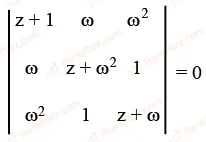
Let ω\omega be the complex number cos⁡2π3+isin⁡2π3\cos \frac{2 \pi}{3} + i \sin \frac{2 \pi}{3}. Then the number of distinct complex numbers z satisfying

Figure for JEE Advanced 2010 Mathematics question on Properties of determinants
Q82Sums of natural numbers, squares and cubesTRANSCRIBED

Let Sk=1,2,....100S_k = 1, 2, .... 100, denote the sumof the infinite geometric series whose first term is k−1k!\frac{k-1}{k!} and the common ratio is 1k\frac{1}{k}. Then the value of 1002100!+∑k=1100∣(k2−3k+1)Sk∣\frac{100^2}{100!}+\sum_{k=1}^{100}\mid (k^2 - 3k + 1)S_k \mid is

Q83Equations with parameters and trigonometric inequalitiesTRANSCRIBED

The number of all possible values of θ\theta , where 0<θ<π0 < \theta < \pi. for which the system of equations
(y+z)cos⁡3θ=(xyz)sin⁡3θ(y + z) \cos 3 \theta = (xyz) \sin 3\theta
xsin⁡3θ=2cos⁡3θy+2sin⁡3θzx \sin 3 \theta = \frac{2 \cos 3\theta}{y} + \frac{2 \sin 3\theta}{z}
(xyz)sin⁡3θ=(y+2z)cos⁡3θ+ysin⁡3θ(xyz) \sin 3\theta = (y + 2z) \cos 3 \theta + y \sin 3 \theta
have a solution (x0,y0,z0)(x_0, y_0, z_0) with y0z0≤0y_0z_0 \leq 0, is

Q84Linear first-order differential equationsTRANSCRIBED

Let f be a real-valued differentiable function on R (the set of all real numbers) such that f(1) = 1. If the y-intercept of the tangent at any point P(x, y) on the curve y= f(x) is equal to the cube of the abscissa of P, then the value off(-3) is equal to