JEE Main 2025 Physics question — Conservation of mechanical energy
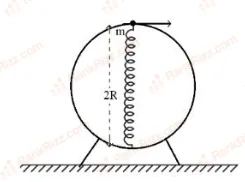
A bead of mass 'm' slides without friction on the wall of a vertical circular hoop of radius 'R' as shown in figure. The bead moves under the combined action of gravity and a massless spring ( k ) attached to the bottom of the hoop. The equilibrium length of the spring is 'R'. If the bead is released from top of the hoop with (negligible) zero initial speed, velocity of bead, when the length of spring becomes ' R ', would be (spring constant is 'k', g is accleration due to gravity
SOLUTION
When the length of the spring becomes R, the angle spring will form from the vertical will be .
Since all forces acting on the body are conservative, total energy remains conserved.
Potential energy of the bead at the top due to gravity,
Potential energy of the bead at the top due to the spring,
Initial potential energy,
When spring becomes the length R, the extension in the spring becomes 0. Therefore, Potential energy = gravitational potential energy
Final potential energy,
Loss in potential energy = Gain in kinetic energy
Tagged Conservation of mechanical energy. Machine-assigned, so read it as a strong shortlist rather than a verdict.