Given below is the plot of a potential energy function U(x) for a system, in which a particle is in one dimensional motion, while a conservative force F(x) acts on it. Suppose that Emech=8E_{mech} = 8Emech=8 J, the incorrect statement for this system is:
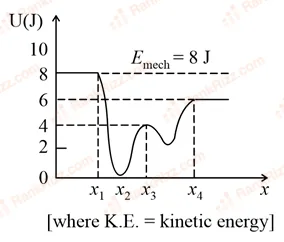
at x>x4x > x_4x>x4, K.E. is constant throughout the region.
at x<x1x < x_1x<x1, K.E. is smallest and the particle is moving at the slowest speed.
at x=x2x = x_2x=x2, K.E. is greatest and the particle is moving at the fastest speed.
at x=x3x = x_3x=x3, K.E. = 4 J
Emech=K+U=8 JE_{\text{mech}} = K + U = 8\ \text{J}Emech=K+U=8 J ⟹ K=8−U\implies K = 8 - U⟹K=8−U
Check Option A:
For x>x4:U=6 J ⟹ K=8−6=2 J (constant)\text{For } x > x_4: U = 6\ \text{J} \implies K = 8 - 6 = 2\ \text{J}\ (\text{constant})For x>x4:U=6 J⟹K=8−6=2 J (constant)
Check Option B:
For x<x1:U=8 J ⟹ K=8−8=0 J (particle is at rest)\text{For } x < x_1: U = 8\ \text{J} \implies K = 8 - 8 = 0\ \text{J}\ (\text{particle is at rest})For x<x1:U=8 J⟹K=8−8=0 J (particle is at rest)
Check Option C:
At x=x2:U=0 J ⟹ Kmax=8−0=8 J (fastest speed)\text{At } x = x_2: U = 0\ \text{J} \implies K_{\text{max}} = 8 - 0 = 8\ \text{J}\ (\text{fastest speed})At x=x2:U=0 J⟹Kmax=8−0=8 J (fastest speed)
Check Option D:
At x=x3:U=4 J ⟹ K=8−4=4 J\text{At } x = x_3: U = 4\ \text{J} \implies K = 8 - 4 = 4\ \text{J}At x=x3:U=4 J⟹K=8−4=4 J
Tagged Conservation of mechanical energy. Machine-assigned, so read it as a strong shortlist rather than a verdict.