JEE Main 2023 Physics question — Conservation of mechanical energy
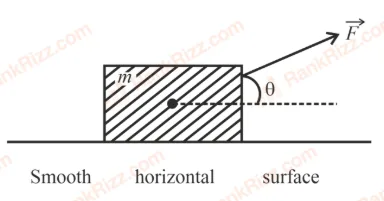
An object of mass initially at rest on a smooth horizontal plane starts moving under the action of force N. In the process of its linear motion, the angle (as shown in figure) between the direction of force and horizontal varies as , where is a constant and is the distance covered by the object from its initial position. The expression of kinetic energy of the object will be . The value of is _____.
SOLUTION
An object of mass m is placed on a smooth horizontal surface and acted upon by a force F making an angle \theta\ with the horizontal, where .
Since the surface is smooth, there is no friction. The vertical component of the force is balanced by the normal reaction, so only the horizontal component contributes to acceleration.
Now relate acceleration to velocity using:
Now separate variables and integrate both sides, taking limits from initial position (where velocity is zero) to any position xxx.
Now express kinetic energy using velocity.
Finally, use the relation to rewrite the expression in terms of \theta\ and compare with the given form.
(as F = 2)
Thus, the value of n is 2.
Tagged Conservation of mechanical energy. Machine-assigned, so read it as a strong shortlist rather than a verdict.