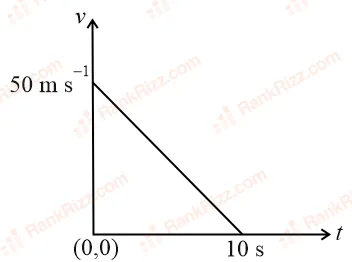
The velocity-time graph of a particle of mass 10 kg is shown in the figure. The net work done on the particle in the first two seconds of the motion is
−9300-9300−9300 J
12000 J
−4500-4500−4500 J
−12000-12000−12000 J
Wnet=ΔK.E.=12mv2−12mu2W_{net} = \Delta K.E. = \frac{1}{2} m v^2 - \frac{1}{2} m u^2Wnet=ΔK.E.=21mv2−21mu2
Wnet=12m(v2−u2)W_{net} = \frac{1}{2} m (v^2 - u^2)Wnet=21m(v2−u2)
a=vf−vitf−ti=0−5010−0=−5 m/s2a = \frac{v_f - v_i}{t_f - t_i} = \frac{0 - 50}{10 - 0} = -5\text{ m/s}^2a=tf−tivf−vi=10−00−50=−5 m/s2
u=50m/su = 50\text{m/s}u=50m/s
v=u+atv = u + atv=u+at: v=50+(−5)(2)v = 50 + (-5)(2)v=50+(−5)(2)
W=12×10×(402−502)W = \frac{1}{2} \times 10 \times (40^2 - 50^2)W=21×10×(402−502)
W=5×(1600−2500)W = 5 \times (1600 - 2500)W=5×(1600−2500)
W=−4500 JW = -4500\text{ J}W=−4500 J
Tagged Conservation of mechanical energy. Machine-assigned, so read it as a strong shortlist rather than a verdict.