JEE Main 2019 Physics question — Superposition, interference and beats
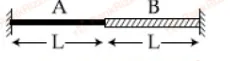
A wire of length 2L, is made by joining two wires A and B of same length but different radii r and 2r and made of the same material. It is vibrating at a frequency such that the joint of the two wires forms a node. If the number of antinodes in wire A is p and that in B is q then ratio p:q is:
SOLUTION
We have a composite stretched wire of total length . It is prepared by joining two separate wires, called A and B, each of length . Both wires are made of the same material and hence have the same mass-density (per unit volume) and are under the same tensile force when the whole wire is set up on a sonometer (or any similar frame).
Let the radius of wire A be and that of wire B be . Because cross-sectional area of a wire is , the linear mass density (mass per unit length)
where is the material density (same for both). So
The speed of a transverse wave on a stretched wire is given first:
Substituting the two values of , we obtain
Thus
The joint between the two wires acts as a node (displacement is zero there). The outer ends are fixed as well, so each individual piece behaves exactly like an independent string with both ends fixed: one end at the outer support and the other at the junction node.
If a string of length with both ends fixed vibrates in its harmonic, its length equals half-wavelengths:
The number of antinodes (loops) present is the same integer . Therefore,
For wire A:
For wire B:
Because the two portions form a single continuous system, the frequency of vibration is the same in both parts. Using , we write
Substituting the expressions for and , we get
Simplifying the denominators first:
The factors cancel out, leaving
We already have , so substituting this value:
Dividing both sides by (non-zero), we obtain
Re-writing,
Hence, the correct answer is Option D.
Tagged Superposition, interference and beats. Machine-assigned, so read it as a strong shortlist rather than a verdict.