JEE Main 2021 Physics question — Vectors: addition, subtraction, resolution and unit vectors
The angle between vector and is:
SOLUTION
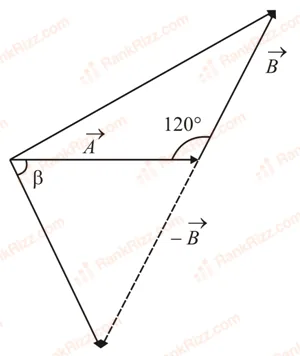
We need to find the angle between the vector and the resultant vector . From the options, we can infer that the angle between vector and vector is given as .
1. Visualize Vector Subtraction
The vector subtraction can be treated as the vector addition of and :
If the angle between and is , then the angle between and is .
2. Use the Formula for Direction of Resultant Vector
Let be the angle that the resultant vector makes with the vector . Using the standard vector direction formula:
Using the trigonometric identities and , the expression simplifies to:
3. Substitute into the Equation
Let's substitute the values for and into the expression:
To eliminate the fractions in the numerator and denominator, multiply both top and bottom by :
4. Solve for
Taking the inverse tangent of both sides isolates the angle :
Final Answer: Option B
Tagged Vectors: addition, subtraction, resolution and unit vectors. Machine-assigned, so read it as a strong shortlist rather than a verdict.