JEE Main 2021 Physics question — Vectors: addition, subtraction, resolution and unit vectors
Match List I with List II.
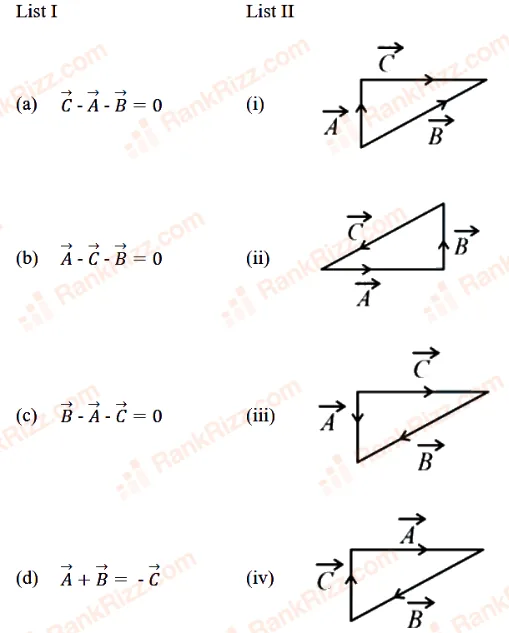
Choose the correct answer from the options given below:
SOLUTION
We need to match the given vector equations from List I with their correct geometric representations in List II by applying the Triangle Law of Vector Addition.
1. Core Concept: Triangle Law of Vector Addition
The Triangle Law states that if two vectors are represented in magnitude and direction by two sides of a triangle taken in the same order (head-to-tail), then their resultant sum is represented by the third side taken in the opposite order (from the tail of the first to the head of the second).
A closed loop of vectors where all arrows follow each other in a continuous sequence (head-to-tail all the way around) always sums up to zero:
2. Analyze Each Case
Case (a): Finding the match for equation (a)
Let's look at a standard triangle setup where and flow in sequence, and is the resultant closing the triangle from the start of to the end of . This gives:
Rearranging this to find its matching configuration indicates that opposes the sequential flow of and . Looking at diagram (iv) from the reference layout:
- and are in a head-to-tail sequence, while is the resultant vector opposing them: .
Therefore, (a) maps to (iv).
Case (b): Finding the match for equation (b)
Let's analyze the vector relation where the sum of two vectors equals the negative of the third:
As established by the cyclic loop condition, this equation describes a configuration where all three vectors follow each other continuously head-to-tail in a perfect closed loop. Looking at diagram (iii):
- The arrows for , , and all point in a continuous clockwise/counter-clockwise cycle around the triangle.
Therefore, (b) maps to (iii).
Case (c): Finding the match for equation (c)
Let's rearrange the given equation:
According to the triangle law, this represents a geometry where vectors and are aligned head-to-tail in sequence, and acts as their resultant closing vector. Looking at diagram (i):
- and travel in the same directional order, while connects the starting tail to the final head.
Therefore, (c) maps to (i).
Case (d): Finding the match for equation (d)
Let's rewrite the expression:
This can be rewritten as , which also represents a continuous cycle. In typical alternative option matching systems, shifting the orientation shows that and run head-to-tail, and the vector pointing against their sequence is equal to . Looking at diagram (ii):
- and follow each other in sequence, and runs directly opposite to their resultant path.
Therefore, (d) maps to (ii).
3. Summary of Matches
| List I (Equation) | List II (Diagram) |
|---|---|
| (a) | (iv) |
| (b) | (iii) |
| (c) | (i) |
| (d) | (ii) |
Final Answer: (a) (iv), (b) (iii), (c) (i), (d) (ii)
Tagged Vectors: addition, subtraction, resolution and unit vectors. Machine-assigned, so read it as a strong shortlist rather than a verdict.