JEE Main 2022 Physics question — Carnot engine and Carnot cycle
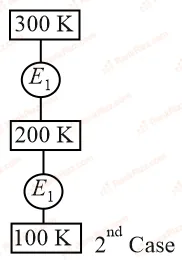
In 1st case, Carnot engine operates between temperatures 300 K and 100 K. In 2nd case, as shown in the figure, a combination of two engines is used. The efficiency of this combination (in 2nd case) will be :
SOLUTION
In the first case, a single Carnot engine operates between 300 K and 100 K. In the second case, a combination of two Carnot engines is used between the same temperature limits.
Since the efficiency of a Carnot engine is given by , for the single engine we have .
Next, consider the series combination of two Carnot engines: Engine 1 operates between the hot reservoir at and an intermediate temperature , while Engine 2 operates between and the cold reservoir at . The heat rejected by Engine 1 becomes the heat absorbed by Engine 2.
Let be the heat absorbed by Engine 1. Then the work done by Engine 1 is , and the heat rejected by Engine 1 is , which is absorbed by Engine 2.
For Engine 2, the work done is . Simplifying this gives .
Therefore, the total work output from the combination is . Substituting and combining terms yields .
It follows that the overall efficiency of the combination is , which is exactly the same as the efficiency of the single Carnot engine between 300 K and 100 K.
This result is consistent with the principle that two Carnot engines arranged in series have the same overall efficiency as a single Carnot engine operating between the same extreme temperatures, regardless of the choice of intermediate temperature.
Answer: Option A: same as the 1st case
Tagged Carnot engine and Carnot cycle. Machine-assigned, so read it as a strong shortlist rather than a verdict.