JEE Main 2020 Physics question — Angular momentum of particles and rigid bodies
A uniformly thick wheel with moment of inertia and radius is free to rotate about its centre of mass (see fig). A massless string is wrapped over its rim and two blocks of masses and are attached to the ends of the string. The system is released from rest. The angular speed of the wheel when descends by a distance is:
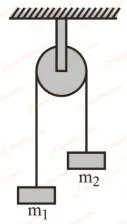
SOLUTION
We begin by noting that the wheel can rotate without any slipping of the string, so the linear speed of each block is related to the angular speed of the wheel by the no-slip condition
The system is released from rest, therefore its initial kinetic energy is zero. Block descends a vertical distance while block rises the same distance. The change in gravitational potential energy of the two blocks is
Because energy is lost by the heavier block and gained by the lighter one, the net decrease in potential energy available to produce motion is
We now invoke the principle of conservation of mechanical energy, which states:
“Loss of gravitational potential energy = Gain in kinetic energy of all moving parts.”
The kinetic energy acquired has two contributions:
- The translational kinetic energies of the two blocks, each moving with speed .
- The rotational kinetic energy of the wheel, which is rotating with angular speed .
Writing each term explicitly, we have
Combining the first two terms gives
Substituting into the rotational part, we obtain
Equating the loss in potential energy to this total kinetic energy, we write
Solving for gives
Multiplying numerator and denominator of the right-hand side by to prepare for finding , we write
Finally, using , we have
and therefore
Comparing this result with the options provided, we see that it matches Option A.
Hence, the correct answer is Option A.
Tagged Angular momentum of particles and rigid bodies. Machine-assigned, so read it as a strong shortlist rather than a verdict.