RankRizz
JEE MAIN 2019 · 09 JAN S1+4 / −1MEDIUMTRANSCRIBED

JEE Main 2019 Physics question — Torque and the rotational form of Newton's second law

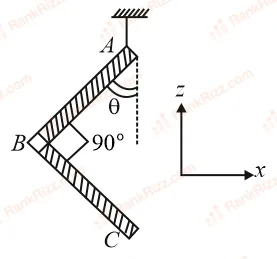
An LL-shaped object, made of thin rods of uniform mass density, is suspended with a string as shown in figure. If AB=BCAB = BC, and the angle made by ABAB with downward vertical is θ\theta, then:

Figure for JEE Main 2019 Physics question on Torque and the rotational form of Newton's second law
SOLUTION

Let AB=BC=LAB = BC = L, and the mass of each uniform rod segment be mm.

Let the point of suspension AA be the origin (0,0)(0,0).

Taking the downward vertical as the reference line. 

Coordinates of the center of mass of rod AB (G1G_1): x1=−L2sin⁡θ,z1=−L2cos⁡θx_1 = -\frac{L}{2}\sin\theta, \quad z_1 = -\frac{L}{2}\cos\theta

Coordinates of the center of mass of rod BC (G2G_2): x2=−Lsin⁡θ+L2cos⁡θ,z2=−Lcos⁡θ−L2sin⁡θx_2 = -L\sin\theta + \frac{L}{2}\cos\theta, \quad z_2 = -L\cos\theta - \frac{L}{2}\sin\theta

For rotational equilibrium about the suspension point AA:

τA=0  ⟹  mg∣x1∣+mgx2=0  ⟹  xcm=0\tau_A = 0 \implies m g |x_1| + m g x_2 = 0 \implies x_{\text{cm}} = 0

m(−L2sin⁡θ)+m(−Lsin⁡θ+L2cos⁡θ)=0m\left(-\frac{L}{2}\sin\theta\right) + m\left(-L\sin\theta + \frac{L}{2}\cos\theta\right) = 0

−32Lsin⁡θ+12Lcos⁡θ=0  ⟹  3sin⁡θ=cos⁡θ-\frac{3}{2}L\sin\theta + \frac{1}{2}L\cos\theta = 0 \implies 3\sin\theta = \cos\theta

tan⁡θ=13\tan\theta = \frac{1}{3}

Tagged Torque and the rotational form of Newton's second law. Machine-assigned, so read it as a strong shortlist rather than a verdict.

SubjectPhysics
TopicTorque and the rotational form of Newton's second law
TypeMultiple choice