JEE Main 2016 Physics question — Angular momentum of particles and rigid bodies
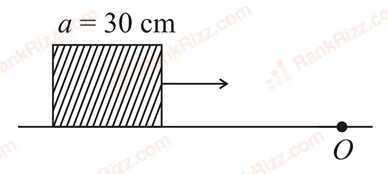
A cubical block of side 30 cm is moving with velocity 2 m s on a smooth horizontal surface. The surface has a bump at a point O as shown in the figure. The angular velocity (in rad/s) of the block immediately after it hits the bump, is:
SOLUTION
Let the mass of the cubical block be and its edge length be . The centre of mass (C.M.) is at the geometrical centre of the cube, i.e. above the horizontal surface and behind the bump.
The block is sliding with a purely translational velocity towards the bump. The bump touches the block at the point situated on the front bottom edge. Immediately after the impulsive contact, the point is at rest (there is no slipping at the instant of collision), so the block executes a pure rotation about with some angular velocity .
Because the impulsive normal force at passes through itself, it exerts zero moment about that point. Hence angular momentum about point is conserved during the impact.
1. Initial angular momentum about (just before impact)
The position vector of the C.M. from has a horizontal component (opposite to the direction of motion) and a vertical component . Denoting the horizontal direction of motion as the -axis and the vertically upward direction as the -axis, we write
The velocity vector is
Using the vector formula for translational angular momentum, we obtain
Only the magnitude is needed, so
2. Moment of inertia of the cube about the axis through
First, the moment of inertia about a parallel axis through the centre for an axis along an edge (here the -axis) is
Using the parallel-axis theorem, where
Thus
With ,
3. Final angular momentum about (just after impact)
After the collision the block rotates about only, so
4. Conservation of angular momentum about
Setting initial and final angular momenta equal,
The mass cancels, giving
Hence, the correct answer is Option B.
Tagged Angular momentum of particles and rigid bodies. Machine-assigned, so read it as a strong shortlist rather than a verdict.