JEE Main 2018 Physics question — Parallel and perpendicular axis theorems
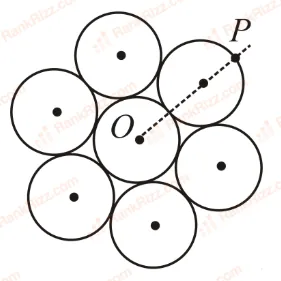
Seven identical circular planar disks, each of mass M and radius R are welded symmetrically as shown. The moment of inertia of the arrangement about the axis normal to the plane and passing through the point P is:
SOLUTION
The total moment of inertia of a symmetric multi-body system about a given axis is found by first computing the total moment of inertia about the center of mass using the parallel axis theorem, and then shifting the entire system's inertia to the parallel axis passing through point .
Moment of inertia of the central disk about center :
Moment of inertia of one surrounding disk about (using parallel axis theorem with ):
Total moment of inertia of the 7-disk arrangement about :
Total mass of the arrangement:
Given distance from to point on the periphery of an outer disk:
Shifting the total moment of inertia to axis through via parallel axis theorem:
Tagged Parallel and perpendicular axis theorems. Machine-assigned, so read it as a strong shortlist rather than a verdict.