JEE Main 2017 Physics question — Moment of inertia of standard bodies and composite systems
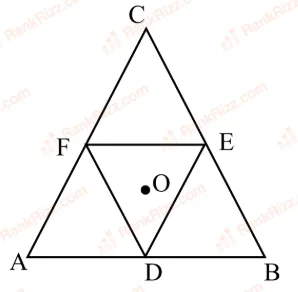
Moment of inertia of an equilateral triangular lamina , about the axis passing through its centre and perpendicular to its plane is as shown in the figure. A cavity is cut out from the lamina, where , , are the mid points of the sides. Moment of inertia of the remaining part of lamina about the same axis is:
SOLUTION
We consider the equilateral triangular lamina made of a material of uniform surface mass density . About the axis that passes through its centroid and is perpendicular to the plane, its moment of inertia is given to be .
Inside this triangle the points are the mid-points of the three sides, so joining them produces another equilateral triangle . Because each side of joins mid-points, its length is exactly one-half of the length of . Hence is similar to with a linear scale factor
First recall a standard result: for two geometrically similar laminae made of the same material,
mass (length) and moment of inertia about corresponding central axes (length).
Stating this explicitly, if the scale factor is , then
Applying this to our triangles, the moment of inertia of the inner triangle about the same central axis through is
When the inner triangle is cut out, its mass and its moment of inertia are removed from the original lamina. Therefore the moment of inertia of the remaining portion is obtained by simple subtraction:
Hence, the correct answer is Option B.
Tagged Moment of inertia of standard bodies and composite systems. Machine-assigned, so read it as a strong shortlist rather than a verdict.